Minor Arcana · Wands · fire
Three of Wands
Dates are for 2026 and shift by up to a day between years, because the tropical year is not a whole number of days.
The Book T title
Established Strength is a title about consolidation rather than growth, and the distinction runs through the whole card. Something has been set going and has held — not succeeded, held. Book T places it in the second decan of Aries, where the initiative of the first has had enough time to prove it was not a false start. The strength in the name is specifically the kind that has been tested by a small interval of time, which is why the card reads as confidence rather than hope.
Upright meaning
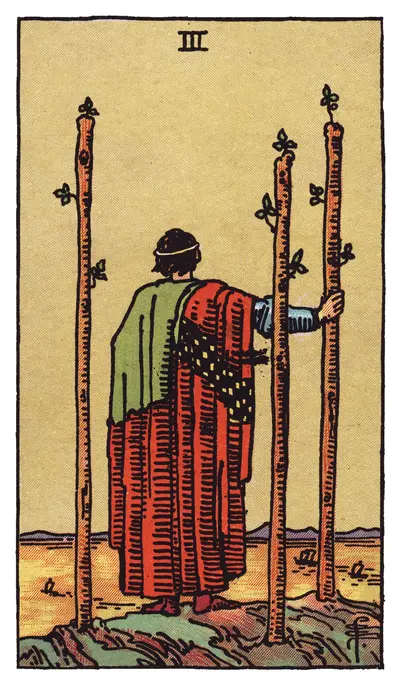
The Three of Wands shows a figure with his back to us watching ships on open water, and the position is the card. He has dispatched something and it is out of his hands. That single fact separates this from every other early Wands card: the Two is before departure, the Three is after it, and the interval between them is where the decision was actually made. What the card describes is the specific quality of waiting for something you set in motion — which is not passive, and is not the same as hoping. The ships are his. When it arrives in a reading it usually confirms that the thing being asked about has already left, and the useful question shifts from whether to act to what to do with the interval. It is also one of the most reliably favourable cards in the suit, which is worth saying plainly because Wands as a whole is a mixed suit. Nothing in the Three is going wrong. The only discomfort available in it is impatience, and the card is fairly clear that impatience is the reader’s contribution rather than the situation’s.
Reversed meaning
Reversed, the interval stops being productive. The commonest reading is delay — the ships are late, the thing that was set going has not come back — and the card is unusually specific that this is about timing rather than failure. A second and sharper reading is scope: the plan was smaller than the effort behind it, and what returns will not justify the dispatch. There is also a reading about attention, which the imagery supports well: the figure is looking out to sea because that is where he sent things, and reversed he is still looking there after the interesting developments have started happening behind him.
What Sun in Aries contributes
The Sun in Aries is exaltation — the Sun is at its most itself in this sign, and this decan contains the spring equinox degrees where the solar year actually begins. That placement explains why a card about waiting reads as confident rather than anxious. The Sun does not doubt. What it contributes specifically is visibility: the Three of Wands is not a private position, it is a vantage point, and the figure on the cliff can be seen as clearly as he sees. Aries supplies the initiating push and the Sun supplies the steadiness that keeps it from being merely a burst, which is exactly the combination the title Established Strength describes.
What is on the card
The three staves are planted rather than held, and the figure rests one hand on a single one — the only contact he has with any of them. That is the composition saying his part is done. He stands on high ground above water with ships small in the distance, and his cloak is red over green, the colours of action over growth. His back is fully turned, which is rare in the deck and always deliberate: the viewer is put behind him, looking where he looks. The mountains across the water are the same range that appears on several Wands cards, which places the suit’s cards in one continuous landscape.
In a love reading
Reads as something already under way whose outcome is not yet visible — a conversation that has been had, an approach that has been made, a decision someone has already taken and not announced. It is favourable on questions about whether interest is returned, and it consistently points at the querent being further along than they feel. On questions about a long-distance or delayed relationship it is close to literal: the card is about something that is elsewhere and coming back.
In a career reading
One of the better cards to draw on a question about an application, a pitch or a launch. The work is out and the answer is not in, and the Three of Wands treats that state as normal rather than fraught. It reads well on expansion questions specifically — the ships are trade — and it is one of the few cards in the deck that speaks directly to scale. Where it is less useful is on questions about what to do next, since its answer is that the next thing is already happening somewhere else.
How this one is usually misread
The standard misreading is treating this as a card about waiting, which flattens the one thing that distinguishes it. The Two of Wands is waiting; the Three is after dispatch, and the difference is that in the Three the decision is already made and irreversible. A reading that says "be patient" has collapsed the two cards into one and lost the information. The second error is more consequential in practice: reading the ships as a guarantee. Nothing in the card says what comes back, only that something was sent and is due. It is one of the deck’s more reliably favourable cards and it is not a promise, and the distinction matters most in exactly the questions people draw it for — applications, launches, approaches already made. A third habit worth breaking is reading the turned back as loneliness. It is the only card in the suit where the viewer is placed behind the figure rather than in front of him, and the effect is to make his vantage point yours: you are being shown what he is watching, not watched watching it.
How it behaves beside other cards
With the Two of Wands it makes the plan-to-execution sequence explicit and usually means the querent has done more than they are giving themselves credit for. Beside the Eight of Cups it sharpens into departure with no intention of return. Its most useful neighbour is the Eight of Wands, which converts the Three’s waiting into arrival — the two together often date something rather than merely describing it. Next to the Page of Cups or the Page of Wands the ships tend to read as news rather than goods.
Why this card has a zodiac sign attached
The thirty-six numbered cards from Two to Ten are mapped one-to-one onto the thirty-six decans — the ten-degree slices the zodiac divides into. Three of Wands holds 10° to 20° of Aries, ruled by Sun in the Chaldean order. That is a lookup from a position on the ecliptic, not an association someone chose, which is why this page can print a degree range and a date range next to it.
Correspondences follow the Golden Dawn attributions set out in Book T. Degrees are computed from each card’s position in the decan sequence rather than transcribed, so they cannot drift from the spread tool on the rest of this site.
Cards next to this one
The rest of Aries
See this card come up in your own chart
The spread on our tarot astrology page reads your chart positions as cards — no shuffle, the same answer every time. The daily card does the same for the Moon’s decan right now.