Minor Arcana · Cups · water
Two of Cups
Dates are for 2026 and shift by up to a day between years, because the tropical year is not a whole number of days.
The Book T title
Book T calls this card Love, without qualification, and it is one of only two titles in the entire Minor Arcana that names an emotion rather than a condition or an outcome. That bluntness is worth taking seriously. The Two of Cups sits in the first decan of Cancer, the sign where the Moon rules and where attachment is the organising principle, and the title is not being poetic — it is naming the thing the card is about. What distinguishes it from the other love cards in the deck is the number. Two is the minimum for exchange, so this is love as a transaction between exactly two parties, neither of whom is a crowd.
Upright meaning
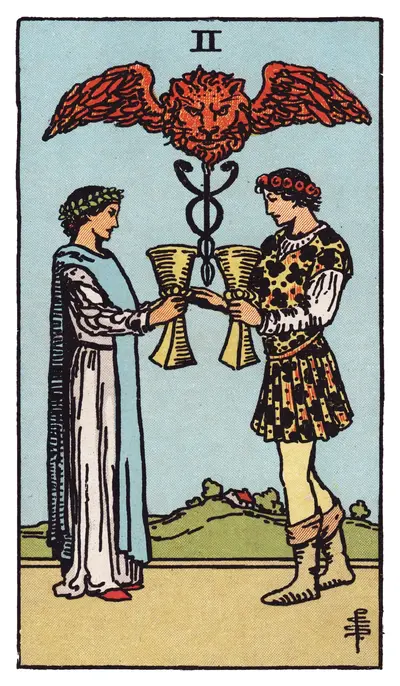
Two figures face each other and exchange cups, and everything in the composition is reciprocal. They are the same height, they hold the same vessel, each is offering and each is receiving — the card has no giver and no taker. That symmetry is the whole meaning and it is what separates the Two of Cups from every other card people reach for when the question is about love. It is not attraction, which is one-directional and belongs elsewhere. It is not commitment, which the Four of Wands and the Hierophant handle. It is the specific state of two parties recognising each other on equal terms, which can describe a romance, a friendship, a partnership or a truce with equal accuracy. When it arrives the useful reading is almost always about mutuality: something is being returned. The card carries no information at all about duration, and reading longevity into it is the commonest way to overstate it. What it does say is that whatever is happening is happening in both directions, which is a narrower and more checkable claim than the one people usually want from it.
Reversed meaning
Reversed, the symmetry breaks, and which way it breaks is the reading. The commonest is imbalance — one party offering more than the other, which the upright card’s perfect mirroring makes an unusually legible reversal. That covers everything from an unreturned approach to a partnership where the work has quietly moved to one side. The second reading concerns the exchange stalling rather than tilting: two people who recognise each other and have not acted on it, which is a real and specific situation the upright card cannot describe. A third is worth having because it is often the kindest: reversed, the Two of Cups sometimes describes a reconciliation in progress rather than a rupture, the cups being picked back up. The surrounding cards distinguish these clearly, and the card is rarely as bad reversed as its subject makes people fear.
What Venus in Cancer contributes
Venus in Cancer is the planet of attraction in the sign of attachment, and it is the most straightforwardly harmonious decan in the deck — there is no friction anywhere in the pairing. Venus supplies the drawing-together and Cancer supplies the wish to keep what has been drawn, which is why the card reads as bonding rather than as mere attraction. It also explains the card’s domesticity. Venus in an air or fire sign would give you something more like charm or pursuit; in Cancer it gives you the impulse to make a shared thing, which is what the two figures are doing. Cancer is also a cardinal sign, so this is a beginning rather than a settled state, and that is worth holding on to when the card is read as an outcome.
What is on the card
The caduceus rising between them is the detail that repays attention: two snakes wound around a staff, the emblem of exchange and of opposites reconciled, and above it a winged lion’s head, which appears nowhere else in the deck. The lion supplies appetite and the wings supply elevation, so the image is quite deliberately not sentimental — this is desire with something above it rather than instead of it. Both figures wear wreaths, one of laurel and one of flowers. The ground between them is bare and the house on the hill behind is small and distant, which places the exchange outside any existing structure. Nothing in the frame is being shared except the gesture.
In a love reading
The card most people hope for on a relationship question, and it earns the reputation, with one caveat worth stating: it describes mutuality rather than durability. On questions about whether interest is returned it is among the clearest affirmatives in the deck. On questions about whether something will last it is silent, and readers routinely supply an answer the card does not give. It reads equally well on reconciliation questions, where the symmetry of the image is the point — both parties turning toward each other at the same time rather than one pursuing.
In a career reading
Partnership on equal terms: a collaboration, a co-founder, a working relationship in which both sides contribute comparably. It is one of the better cards for questions about whether to work with someone, and one of the weaker ones for questions about individual advancement, since nothing in the image involves anybody getting ahead. On negotiation questions it is favourable and specific — it describes an agreement both sides want rather than one side conceding.
How this one is usually misread
The frequent error is reading this as a soulmate card, which is a claim about permanence that the image contains nothing to support. Two figures are exchanging cups; nothing indicates how long they have been doing it or will. That reading persists because the card is genuinely warm and because people draw it in questions where they want reassurance, which is exactly when a reader should be most careful about what is actually in the picture. The second misreading is narrower and more correctable: treating the card as necessarily romantic. Book T calls it Love and the tradition applies it to any reciprocal bond — the business partnership, the long friendship, the truce after a fight all satisfy it. Reading it as romance in a question about work will produce an answer about the wrong thing entirely.
How it behaves beside other cards
With the Four of Wands it moves toward the formal and often literally toward a wedding, which neither card says on its own. Beside the Ace of Cups it reads as a beginning that has already found its second party, which is the natural sequence. With the Devil the mutuality becomes something more like mutual dependence, and the exchange starts to look like a bargain. Its most instructive neighbour is the Three of Swords, which is the deck’s clearest statement of the same relationship going wrong; drawn together they usually date a rupture rather than merely describing one. Next to the Two of Pentacles the partnership becomes a logistical arrangement as much as a feeling.
Why this card has a zodiac sign attached
The thirty-six numbered cards from Two to Ten are mapped one-to-one onto the thirty-six decans — the ten-degree slices the zodiac divides into. Two of Cups holds 90° to 100° of Cancer, ruled by Venus in the Chaldean order. That is a lookup from a position on the ecliptic, not an association someone chose, which is why this page can print a degree range and a date range next to it.
Correspondences follow the Golden Dawn attributions set out in Book T. Degrees are computed from each card’s position in the decan sequence rather than transcribed, so they cannot drift from the spread tool on the rest of this site.
Cards next to this one
The rest of Cancer
See this card come up in your own chart
The spread on our tarot astrology page reads your chart positions as cards — no shuffle, the same answer every time. The daily card does the same for the Moon’s decan right now.