Minor Arcana · Cups · water
Three of Cups
Dates are for 2026 and shift by up to a day between years, because the tropical year is not a whole number of days.
The Book T title
Abundance, and the title is more specific than it sounds. Book T is not naming wealth or even plenty in general but the particular surplus that comes from things having gone well enough to share — the state where there is more than the people involved strictly need. Placed in the second decan of Cancer, it sits in the middle of the most domestic sign in the zodiac, which is why the abundance in question is social rather than material. What is overflowing here is company, not resources, and the card would be misread as prosperity.
Upright meaning
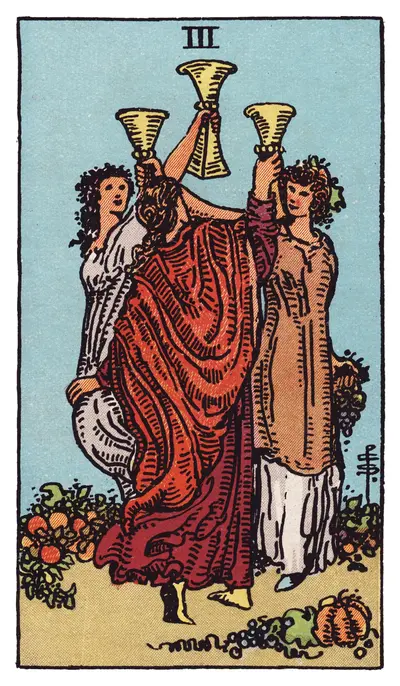
Three women stand in a circle raising cups, with fruit and a pumpkin at their feet and open country behind them. The composition is one of the least ambiguous in the deck and also one of the most frequently flattened: this is not simply celebration. What the image specifically shows is a closed group — three figures facing inward, their cups meeting above the centre — which makes it a card about belonging at least as much as about joy. When it arrives, the thing being asked about involves other people and is going well because of them. It reads accurately on friendship, on collaboration, on the particular relief of being among people who already know you. Three in the pips is the number where something that was reciprocal in the Two becomes social, and in water that produces the first genuinely communal card in the suit. Its honest limitation is that a closed circle has an outside, and the card says nothing about who is standing there.
Reversed meaning
Reversed, the circle is the thing that changes rather than the joy. The commonest reading is exclusion — being outside a group that is functioning perfectly well without you, which people recognise faster than they admit. A second and more frequent one in practice is excess: the celebration continuing past its occasion, which the upright card is only ever one step away from. There is also a reading about the group itself rather than the querent’s place in it, where the three figures have become a clique and the closeness has curdled into something that excludes by design. Where the surrounding cards are gentle it can simply mean a gathering postponed, which is worth offering before the harder readings.
What Mercury in Cancer contributes
Mercury in Cancer puts the planet of communication in the sign of feeling, and that pairing explains why this card is about talk rather than about ceremony. Mercury is what makes the three figures a conversation rather than a tableau. It is also why the card so often indicates news arriving through people — something heard rather than announced, which is a real and narrow prediction the card makes and which most readings of it miss. Cancer supplies the warmth and the enclosure; Mercury supplies the circulation. The combination is not entirely comfortable, since Mercury in a water sign thinks by association rather than by argument, and the card is accordingly better at agreement than at accuracy.
What is on the card
The three cups meet at the top of the frame and nowhere else — the figures’ hands do not touch. Their dresses are white, red and gold, which are not the elemental colours and appear to be simply festive. The ground carries a pumpkin and grapes, harvest imagery that places the scene at the end of something rather than the beginning. One figure has her back to the viewer, which repeats the Three of Wands’ device of putting you inside the scene rather than in front of it. There is no building anywhere in the frame, so the gathering has no venue and belongs to no institution.
In a love reading
Frequently indicates a relationship that has become social — being introduced, being included, the private thing becoming shared. That is usually favourable and occasionally the point of the reading. It is also one of the cards that can indicate a third party, though far less often than popular sources suggest, and the surrounding cards should carry that reading rather than this one alone. On questions about friendship it is unambiguous and among the warmest cards available.
In a career reading
Collaboration that is working and being enjoyed, which is rarer than collaboration that merely works. It reads well on questions about team culture and about whether a group will hold together, and poorly on questions about individual recognition, since nothing in the circle distinguishes anyone. On questions about networking it is close to literal: the card is about advantage that arrives through people rather than through effort.
How this one is usually misread
The habitual error is reading this purely as celebration and stopping there, which loses the structural fact that the circle faces inward. Every popular source gives it as parties and good times; almost none mention that a group this closed necessarily has an outside, and the card is as informative about exclusion as about belonging depending on where the querent is standing. The second misreading is the third-party reading, which is applied to this card far more often than the tradition warrants. Three figures raising cups in a harvest field is not an affair, and a reader who produces one from this card alone has supplied it from the number rather than the image. Where the surrounding cards genuinely support that story they will say so; the Three of Cups will not say it by itself.
How it behaves beside other cards
With the Ten of Cups it becomes family rather than friendship and the circle widens. Beside the Five of Cups it reads as the version of a group that is being remembered rather than attended, which is one of the sadder pairings in the deck. With the Three of Pentacles the social warmth acquires a task, and the two together describe a team that likes each other and is building something. Its sharpest neighbour is the Seven of Swords, which puts somebody in the group who is not being straight; that combination is much more likely to support a betrayal reading than the Three of Cups ever is alone. Next to the Eight of Cups someone is about to leave the circle. With the Nine of Pentacles the group thins to one person who is fine alone, which is the quiet opposite of this card. Beside the Page of Cups the gathering produces an announcement rather than merely an evening. With the Four of Cups the gathering happens and one person in it is not there, which is a specific and very recognisable evening.
Why this card has a zodiac sign attached
The thirty-six numbered cards from Two to Ten are mapped one-to-one onto the thirty-six decans — the ten-degree slices the zodiac divides into. Three of Cups holds 100° to 110° of Cancer, ruled by Mercury in the Chaldean order. That is a lookup from a position on the ecliptic, not an association someone chose, which is why this page can print a degree range and a date range next to it.
Correspondences follow the Golden Dawn attributions set out in Book T. Degrees are computed from each card’s position in the decan sequence rather than transcribed, so they cannot drift from the spread tool on the rest of this site.
Cards next to this one
The rest of Cancer
See this card come up in your own chart
The spread on our tarot astrology page reads your chart positions as cards — no shuffle, the same answer every time. The daily card does the same for the Moon’s decan right now.