Minor Arcana · Swords · air
Ten of Swords
Dates are for 2026 and shift by up to a day between years, because the tropical year is not a whole number of days.
The Book T title
Ruin, and it is the harshest title in the Minor Arcana. Book T does not qualify it. Placed in the third decan of Gemini, closing the sign of the mind, it is the end of the line for the suit that thinks — the point at which a line of reasoning or a situation has been carried to its absolute conclusion. What makes the title bearable is the same thing that makes the card bearable: ruin is complete, and what is complete is over.
Upright meaning
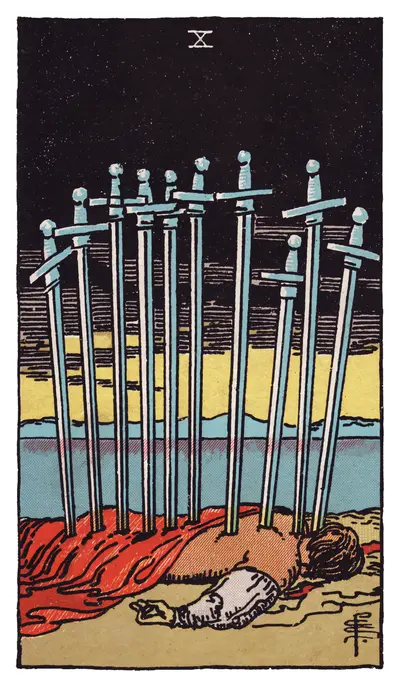
A figure lies face down with ten swords in their back beneath a black sky, while at the horizon a band of yellow light shows the beginning of dawn. The image is excessive and knows it — ten swords is more than any body requires, and the excess is the point. This is the card of something being comprehensively finished, usually with rather more force than the situation called for. What distinguishes it from the Three of Swords is completeness rather than degree: the Three is a wound and the Ten is an ending. Its one genuine consolation is structural rather than sentimental. Nothing can be added to this; ten is the last number, the sky is already at its darkest, and the light at the horizon is not hope in a vague sense but the next thing beginning because this one has stopped. When it arrives, the thing being asked about is over, and the useful reading is almost never about whether it can be saved. It is about what the ending has cleared.
Reversed meaning
Reversed, the ending is incomplete in some way. The commonest reading is recovery beginning — getting up, the swords coming out — which is straightforwardly favourable. A second is the end being prolonged: the situation refusing to finish, which is often more uncomfortable than the upright card. A third concerns melodrama, where the reversal deflates the card and the ending turns out to be survivable and smaller than it felt. That third reading is worth offering more often than it is, since the upright image is so emphatic that its reversal is frequently a correction of scale.
What Sun in Gemini contributes
The Sun in Gemini is illumination in the sign of the mind, and it is a strange placement for a card this dark until you notice the dawn in the image. The Sun does not permit anything to stay hidden, and Gemini names things — so the ruin in this card is fully understood as well as complete. That is why it hurts differently from the Five of Swords or the Three: nothing about it is unclear. The Sun is also why the card contains its own ending. A solar decan cannot produce a night that does not finish, and the light at the horizon is that placement showing up in the picture rather than a consolation added afterwards.
What is on the card
Ten swords enter the back in an even row, which is the detail that makes the image read as excessive rather than violent — this is not a wound, it is a statement. The figure’s right hand is raised in a benediction gesture, the same one the Hierophant makes, which is the strangest element in the card and the least explained. The sky is solid black above and a clear yellow band below. The water beyond is flat and still. Nothing else is in the frame: no weapon-bearer, no landscape, no witness.
In a love reading
A relationship definitively over, and the card is not gentle about it. Its usable contribution is that the ending is complete rather than partial, which forecloses the question of whether something can be recovered. On questions asked after a break it frequently indicates that the worst point has already passed, since the sky in the image is already at its darkest. It is also, unexpectedly, one of the more useful cards to draw some time after a separation, because it describes an ending that is genuinely finished rather than one still being negotiated. What people find hard about it is the excess — ten swords for something that needed perhaps two — and the excess is usually recognised rather than disputed.
In a career reading
A role or project ending badly and completely: a redundancy, a venture closed, a position that became untenable. It reads as final rather than negotiable. On questions about what comes next it is unexpectedly useful, since the card’s only forward-looking element is the dawn and it is the one thing in the image that is not finished. It also covers the ending that was handled badly by everyone involved, which is a distinct experience from simply being let go. On questions about what to do next, the only forward-looking element in the card is the band of light at the horizon, and readings that take it seriously are on firmer ground than the ones that stop at the swords.
How this one is usually misread
The common error is reading this as catastrophe still to come. The card depicts something that has finished — ten swords, already in, sky already black — and delivered as a warning it becomes a prediction of something the image says has happened. The second misreading is the opposite overcorrection, popular in gentler modern sources: rushing to the dawn and treating the card as fundamentally about new beginnings. That skips the ruin, which Book T names without qualification, and a reading that hurries a querent past an ending they are inside of is not kindness. The light at the horizon is in the picture. It is also at the horizon.
How it behaves beside other cards
With the Ten of Cups one area of life is complete in each sense, which is among the most informative pairings in the deck. Beside the Death card the ending is structural rather than circumstantial. With the Ace of any suit the dawn acquires content. Next to the Five of Swords the ruin has a cause and usually a person. Its most humane neighbour is the Four of Swords, which turns the aftermath into recovery rather than a scene one simply remains in. Beside the Fool the ending genuinely clears the ground and the next thing begins without reference to it. With the Judgement card the ruin turns out to have been a summons, which is the most redemptive pairing the card allows. Next to the Six of Swords the leaving follows immediately.
Why this card has a zodiac sign attached
The thirty-six numbered cards from Two to Ten are mapped one-to-one onto the thirty-six decans — the ten-degree slices the zodiac divides into. Ten of Swords holds 80° to 90° of Gemini, ruled by Sun in the Chaldean order. That is a lookup from a position on the ecliptic, not an association someone chose, which is why this page can print a degree range and a date range next to it.
Correspondences follow the Golden Dawn attributions set out in Book T. Degrees are computed from each card’s position in the decan sequence rather than transcribed, so they cannot drift from the spread tool on the rest of this site.
Cards next to this one
The rest of Gemini
See this card come up in your own chart
The spread on our tarot astrology page reads your chart positions as cards — no shuffle, the same answer every time. The daily card does the same for the Moon’s decan right now.