Minor Arcana · Cups · water
Four of Cups
Dates are for 2026 and shift by up to a day between years, because the tropical year is not a whole number of days.
The Book T title
Blended Pleasure is one of the strangest titles in Book T and one of the most exact. It names a state in which something pleasant is present and is not registering — pleasure mixed with enough of something else that it no longer reads as pleasure. Placed in the third decan of Cancer, closing the sign, it is what the domestic warmth of the Two and Three becomes once it has been had for long enough. The title is not describing dissatisfaction with a bad situation. It is describing a good one that has gone flat, which is a harder thing to notice and a harder thing to fix.
Upright meaning
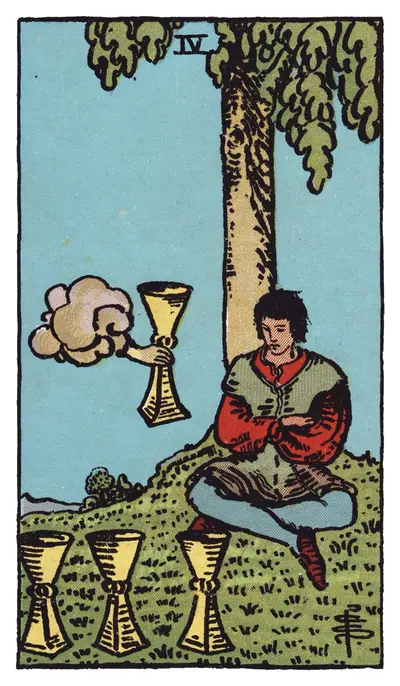
A figure sits under a tree with arms and legs crossed, three cups on the grass in front of him, while a fourth is offered from a cloud at his side. He is looking at the three. That is the entire card and it is one of the most efficient images in the deck. What it describes is not depression and not grief — both belong elsewhere in this suit — but the specific condition of having enough and not feeling it. The offered cup is the card’s real subject: something is genuinely available and is not being seen, and the reason it is not being seen is that attention is occupied by what is already there. When the Four of Cups arrives, the useful question is rarely what is missing. It is what has been offered recently that did not get taken seriously, and the answer is usually available within a minute of asking. Four in the pips is stability, and in water stability produces stagnation more readily than in any other suit, because water that is not moving is the definition of stagnant.
Reversed meaning
Reversed, the most common and most welcome reading is the attention shifting — the fourth cup being noticed, the offer being taken. It is one of the reversals that reliably improves the card, and the imagery supports it since nothing in the upright position needed to break for it to change. A second reading is re-engagement more broadly: coming out of a flat period, which people usually recognise as having already begun. The less favourable version is withdrawal deepening rather than lifting, where the crossed arms become a position rather than a mood. Where the surrounding cards are heavy that is the one to consider, though it is the minority reading and should not be the default.
What Moon in Cancer contributes
The Moon in Cancer is the only decan where the Moon sits in the sign it rules, and it is the watery mirror of Mars in Aries on the Two of Wands — a planet entirely at home. That should produce the most emotionally fluent card in the deck and instead produces this one, which is the interesting part. The Moon unmixed is feeling with nothing to push against, and feeling with nothing to push against does not intensify, it pools. That is Blended Pleasure precisely: every emotional register available at once, which averages out to none of them. It also explains why the card is so hard to argue someone out of. There is no external problem to address, and the Moon at home is not looking outward at all.
What is on the card
The three cups stand on the ground in a row, and the fourth is held out by a hand emerging from a cloud — the same device that presents each of the four Aces, which makes the offered cup an Ace being declined. That is the single most important detail in the card and it is widely missed. The figure’s posture is closed at every joint: arms folded, legs crossed, head down. He sits under a tree in full leaf on green grass, and the hills behind are unremarkable. Nothing in the landscape is hostile and nothing is lacking, which is precisely what makes the mood in the foreground so legible.
In a love reading
Usually describes a relationship that is fine and has gone quiet — not conflict, not crisis, but a flatness neither party has named. It is also one of the more common cards for someone being offered something they are not registering, which on a question about whether someone is interested tends to mean yes, and the querent has not noticed. On questions about whether to stay it is unhelpfully neutral by design: the card describes the state and pointedly does not judge it.
In a career reading
Disengagement in a job that is objectively adequate, which is a far more common professional situation than dissatisfaction with a bad one and has far fewer cards devoted to it. It frequently indicates an opportunity that has been offered and treated as unserious. On questions about whether to move it is worth reading literally: the card says something is already on the table, and the more productive line of enquiry is what was declined recently rather than what should be sought. It is a poor card for questions about ambition, since the figure has none visible, and a surprisingly good one for questions about burnout, which it distinguishes from exhaustion — nothing in the image is tired.
How this one is usually misread
The standard error is reading this as boredom, which is close enough to feel right and loses the card’s actual claim. Boredom is the absence of something interesting; Blended Pleasure is the presence of something good that is not registering, and the difference matters because the advice is opposite. Told he is bored, the figure looks for novelty. Told the fourth cup is being held out at his elbow, he looks at what is already there. The second misreading is treating the card as a judgement on the querent — apathy, ingratitude, wasted opportunity. Nothing in the image is critical. The Moon at home in Cancer produces this state without anybody doing anything wrong, and a reading that moralises about it has added something the card does not contain.
How it behaves beside other cards
Beside any Ace it sharpens considerably, because the offered cup is an Ace and the pairing usually identifies which one. With the Eight of Cups it becomes a sequence rather than a state: noticing the flatness and then leaving, which is one of the most legible two-card stories in the deck. Next to the Sun or the Star the offered cup is unmistakably worth taking. With the Hanged Man the stillness stops being avoidance and becomes deliberate, which is the one combination that reads the crossed arms favourably. Beside the Five of Pentacles the withdrawal starts to look like something the querent cannot simply choose out of.
Why this card has a zodiac sign attached
The thirty-six numbered cards from Two to Ten are mapped one-to-one onto the thirty-six decans — the ten-degree slices the zodiac divides into. Four of Cups holds 110° to 120° of Cancer, ruled by Moon in the Chaldean order. That is a lookup from a position on the ecliptic, not an association someone chose, which is why this page can print a degree range and a date range next to it.
Correspondences follow the Golden Dawn attributions set out in Book T. Degrees are computed from each card’s position in the decan sequence rather than transcribed, so they cannot drift from the spread tool on the rest of this site.
Cards next to this one
The rest of Cancer
See this card come up in your own chart
The spread on our tarot astrology page reads your chart positions as cards — no shuffle, the same answer every time. The daily card does the same for the Moon’s decan right now.