Minor Arcana · Wands · fire
Seven of Wands
Dates are for 2026 and shift by up to a day between years, because the tropical year is not a whole number of days.
The Book T title
Valour, and the word choice repays attention: Book T could have said victory or defence and chose the quality of the defender instead. Valour is about how someone conducts themselves under pressure rather than about whether they prevail. Placed in the third decan of Leo, it closes the sign, and the position is apt — this is what the Six’s public standing costs once other people decide they want it.
Upright meaning
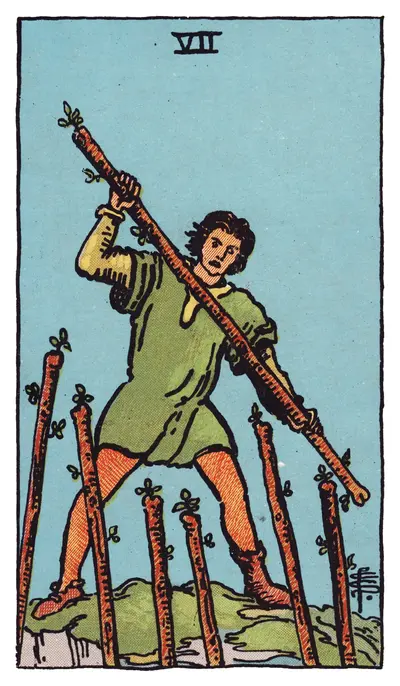
The Seven of Wands is holding a position against challenge, and the composition makes the terms plain: one figure on high ground, six staves coming up from below, nobody attached to them visible in the frame. The advantage is real and so is the pressure. What the card describes better than any other in the deck is the specific fatigue of defending something you already have, which is a different experience from competing for something you want and is far less often depicted. When it arrives, the thing being asked about is under challenge and the querent is currently holding it. The card’s honest complication is in the figure’s feet: he is wearing two different shoes, a detail the artist put in deliberately, and the usual reading — that he was caught unprepared — fits the card exactly. The defence is competent and improvised at once. Seven is the number in the deck where a settled situation meets resistance from outside, and in fire that produces a stand rather than a retreat.
Reversed meaning
Reversed, the position becomes harder to justify. The commonest reading is exhaustion — the defence has gone on past the point where the thing defended is worth it, which people recognise more readily than they act on. A second reading is about the ground rather than the fight: reversed, the high position may not be as secure as the upright card assumes, and the advantage the figure is relying on may already have gone. A third and gentler reading is worth keeping in view: sometimes the reversal simply means the challenge is over and the stance has not been dropped yet, with the querent still braced against something that stopped pushing a while ago.
What Mars in Leo contributes
Mars in Leo is fire on fire — the planet of conflict in the sign of self-assertion — and unlike Saturn in Leo two cards earlier, nothing here is being checked. That is why the Seven of Wands is a genuine stand rather than the Five’s undirected friction. Mars supplies the will to fight and Leo supplies something specific worth fighting for, namely one’s own standing. The combination also explains the card’s isolation: Leo does not share the spotlight and Mars does not wait for allies, so the figure is defending alone even though the Six of Wands had a crowd walking beside him two cards ago.
What is on the card
The figure stands above six staves whose holders are entirely outside the frame, which is the most important compositional choice in the card — the opposition is unidentified, and the reader supplies it. His own stave is held across his body in a guard rather than raised to strike. The mismatched shoes are the detail everyone eventually notices and they are not an error; they say he came to this in a hurry. The ground beneath him is uneven, the sky is pale and empty, and there is no landscape at all behind him, so nothing in the image tells you what is being defended.
In a love reading
Usually describes a relationship being defended against something external — family disapproval, other claims on time, a situation that keeps testing it. It can also describe defensiveness itself, and the surrounding cards decide which, though the imagery leans toward a real challenge rather than an imagined one. On questions about whether to keep going it is encouraging in a specific way: the card assumes the position can be held.
In a career reading
Defending a role, a decision or a piece of territory, and one of the more common cards in questions about being undermined. It reads well on questions about whether to stand firm and badly on questions about collaboration, since nothing in the card involves anybody being on the querent’s side. On questions about a contested promotion it describes an incumbent rather than a challenger, which is a useful distinction the card makes and most readings of it lose.
How this one is usually misread
The frequent error is reading this as ordinary conflict and therefore as interchangeable with the Five of Wands. They are opposite situations. In the Five nobody has anything and everybody is pushing; in the Seven the querent holds the high ground and is defending something real. Collapsing them loses the card’s actual subject, which is the particular fatigue of defending what you already have — a state far less often depicted than competing for what you want, and far more often lived. The second misreading is about the odds. The figure is outnumbered six to one and readers take that as a warning, when the composition says the reverse: he is above them, they are off the frame, and the card is called Valour rather than Defeat. Its honest caution is not that he will lose but that the stance costs something to hold, and the mismatched shoes say he was not given time to prepare for it.
How it behaves beside other cards
After the Six of Wands it is the natural and slightly deflating sequel, and the pair together is one of the clearest stories in the suit. Beside the Nine of Wands it compounds into a long defence with visible cost. With the Four of Pentacles the thing being held starts to look like the problem. Its most useful neighbour is any Cups card, which tends to reveal that the querent has support they are not using — which the Seven of Wands, alone in the frame by design, cannot show on its own. Two further neighbours change it materially. With the Strength card the defence stops being a fight and becomes something closer to patience, which is usually the better strategy the Seven cannot see on its own. And beside the Five of Pentacles the ground genuinely is precarious rather than merely contested — the only combination in which this card’s confidence in its own high position looks misplaced. With the Three of Wands the defence turns out to be protecting something already dispatched and safely elsewhere.
Why this card has a zodiac sign attached
The thirty-six numbered cards from Two to Ten are mapped one-to-one onto the thirty-six decans — the ten-degree slices the zodiac divides into. Seven of Wands holds 140° to 150° of Leo, ruled by Mars in the Chaldean order. That is a lookup from a position on the ecliptic, not an association someone chose, which is why this page can print a degree range and a date range next to it.
Correspondences follow the Golden Dawn attributions set out in Book T. Degrees are computed from each card’s position in the decan sequence rather than transcribed, so they cannot drift from the spread tool on the rest of this site.
Cards next to this one
The rest of Leo
See this card come up in your own chart
The spread on our tarot astrology page reads your chart positions as cards — no shuffle, the same answer every time. The daily card does the same for the Moon’s decan right now.