Minor Arcana · Wands · fire
Five of Wands
Dates are for 2026 and shift by up to a day between years, because the tropical year is not a whole number of days.
The Book T title
Strife, and Book T means something narrower than conflict. Strife is contention without a clear stake — pushing against other people because they are there and pushing too, rather than because something is being won. Placed in the first decan of Leo, it opens the sign most invested in being seen, and the title is best read with that in mind: the friction in this card is substantially about visibility and position rather than about resources.
Upright meaning
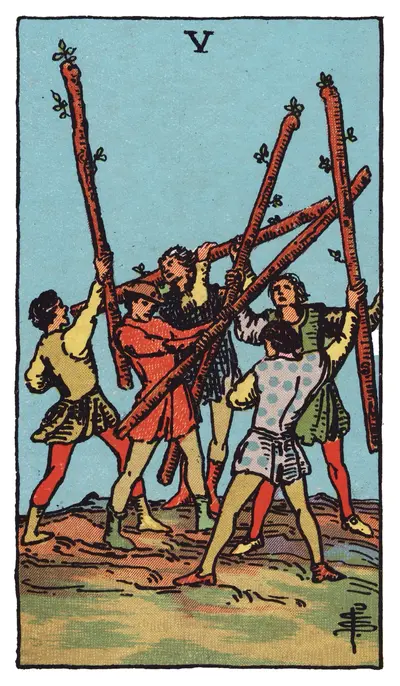
The Five of Wands shows five youths swinging staves at each other in what is very clearly not a battle. Nobody is hurt, nobody is on the ground, and the staves are crossing rather than landing. Most readers eventually land on the same reading and it is the right one: this is competition without consequence, or friction that generates heat and very little else. Meetings where everyone talks over each other, teams where the disagreement has become the activity, families where the same argument is conducted annually — these are its territory. What makes it more useful than "conflict" is the specific absence of a prize. Five is the number where the stability of Four breaks up, and in fire it breaks into noise rather than loss. The card does carry a genuine warning, which is that undirected friction is exhausting and people mistake it for progress because it is strenuous. But it is not a card of damage, and reading it as one overstates what is in the image by a considerable margin.
Reversed meaning
Reversed, the commonest reading is the friction resolving — the group finding a direction, the argument ending because someone named what it was about. That is unusually favourable for a reversal and the imagery supports it, since nothing in the upright card needed to break in order to stop. The second reading runs the other way and is worth watching for: conflict that has gone quiet without being settled, which is the only genuinely worse state available here. A third and narrower reading concerns the querent specifically opting out — putting the stave down and stepping back, which the card treats as neither cowardice nor wisdom but simply as a choice with consequences either way.
What Saturn in Leo contributes
Saturn in Leo is the pairing that explains why this card is tiring rather than dangerous. Saturn is in detriment in Leo — the planet of limit in the sign of self-expression — and what that produces is not prohibition but constant resistance. Every push meets a check. Applied to a fire card it gives you exactly the scene in the image: energy that is neither stopped nor released, dissipating into repeated small collisions. Leo supplies five people who all want to be seen, and Saturn ensures none of them can be. That is Strife more precisely than any definition of the word, and it is why the card so often describes situations that have gone on far longer than anyone would have predicted.
What is on the card
Five figures, and the detail worth noticing is that none of them is looking at another. Their staves cross in the air above them but their eyes do not meet, which is the composition making the point that this is not really a fight. Their clothing is all different — no two are dressed alike — so there are no sides. The ground is bare and pale with no landmark, giving the scene nowhere in particular to be happening. Unlike almost every other Wands card there is no landscape behind them at all, and that emptiness is doing as much work as the figures.
In a love reading
Usually describes recurring low-grade friction rather than a crisis: the same disagreement arriving in different clothes, or a relationship where the tension has become the way the two people interact. In a question about competition for someone’s attention it can be close to literal. It reads badly on questions about harmony and surprisingly well on questions about whether a relationship has life in it, because whatever else the Five of Wands is, it is not indifferent.
In a career reading
Office politics with no prize attached, or a team in which disagreement has become the default mode. It is common on questions about difficult colleagues and usually points at the dynamic rather than the individual. On questions about competing for a role it is less discouraging than it looks: the card describes a crowded field, not a lost one, and its own advice is fairly clearly to find the direction nobody else is pushing in.
How this one is usually misread
The common error is reading this as serious conflict, which overstates what is in the image by a wide margin. Look at what the picture actually shows: five staves crossing in the air, nobody on the ground, nobody hurt, nobody even looking at anyone else. Book T calls it Strife, and strife is contention without a stake — friction that produces heat and no result. A reading that treats it as a fight sends the querent to prepare for something that is not coming, and misses the card’s real and more useful warning, which is that undirected friction is exhausting and gets mistaken for progress because it is strenuous. The second misreading runs the other way and is subtler: dismissing the card as trivial because nothing is at stake. Nothing being at stake is exactly why these situations run for years.
How it behaves beside other cards
Following the Four of Wands it reads as a settled thing being tested, which is the natural sequence and usually the right one. Beside the Six of Wands, which comes next, the pair resolves — friction and then recognition — and drawing both often means the contest has an end the querent cannot yet see. With any Swords card the noise acquires words and gets worse. Its most instructive pairing is with the Seven of Wands, which is what the Five looks like when the querent is the only one holding a stave. Two further pairings are worth knowing. With the Three of Pentacles the noise resolves into actual collaboration, which is the single most favourable thing that can happen to this card — the same people, finally pointed the same way. And beside the Page of Swords the friction acquires a specific author: somebody in the situation is enjoying the argument, and the Page is usually where to look. With the Ace of Wands it reads as the contest ending because someone finally proposed something new to do.
Why this card has a zodiac sign attached
The thirty-six numbered cards from Two to Ten are mapped one-to-one onto the thirty-six decans — the ten-degree slices the zodiac divides into. Five of Wands holds 120° to 130° of Leo, ruled by Saturn in the Chaldean order. That is a lookup from a position on the ecliptic, not an association someone chose, which is why this page can print a degree range and a date range next to it.
Correspondences follow the Golden Dawn attributions set out in Book T. Degrees are computed from each card’s position in the decan sequence rather than transcribed, so they cannot drift from the spread tool on the rest of this site.
Cards next to this one
The rest of Leo
See this card come up in your own chart
The spread on our tarot astrology page reads your chart positions as cards — no shuffle, the same answer every time. The daily card does the same for the Moon’s decan right now.