Minor Arcana · Pentacles · earth
Eight of Pentacles
Dates are for 2026 and shift by up to a day between years, because the tropical year is not a whole number of days.
The Book T title
Prudence is an unexpected title for a card about craft, and it repays attention. Book T is not naming skill or industry but the quality of judgement that produces them — the decision to do the work properly rather than quickly. Placed in the first decan of Virgo, the sign of the well-made thing, it opens the sign with somebody at a bench getting it right. Prudence here is a practice rather than a caution, which is the sense the word carried when the title was written.
Upright meaning
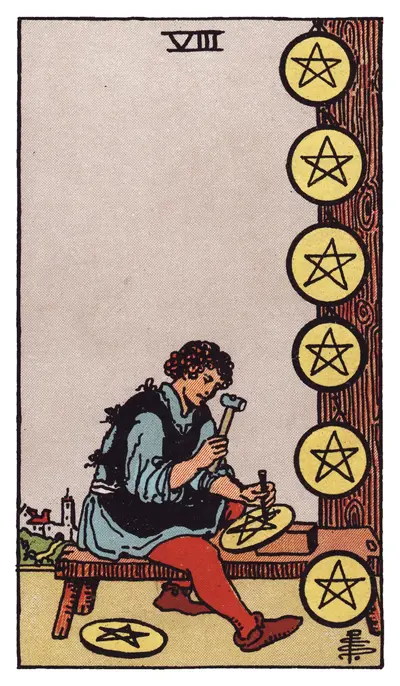
A craftsman sits at a bench carving a pentacle, six finished ones hung on a post beside him and one at his feet, with a town visible in the distance. He is working, head down, alone. The Eight of Pentacles is the deck’s card of practice — repeated, deliberate, unglamorous work that produces skill — and what distinguishes it from other effort cards is the repetition. Six are already done and he is on the seventh, which means the card is about the middle of a process rather than its start or finish. When it arrives, the thing being asked about is being built by accumulation and the querent is doing the accumulating. The town in the distance is worth noticing: he has separated himself from it in order to work, which is a cost the card records without comment. Eight in the pips is sustained application, and in earth that application is simply craft: the same action, performed well, enough times to change what the performer is capable of.
Reversed meaning
Reversed, the quality of the work changes rather than its quantity. The commonest reading is repetition without progress — the same action performed enough times to become mechanical, which is the specific way this card fails. A second concerns standards: work being rushed, or done adequately when it could be done well, which the title makes the card’s natural opposite. A third is more favourable and worth offering: the apprenticeship ending, the practice having done its job. Where the reading involves tedium the first applies; where it involves a deadline, the second.
What Sun in Virgo contributes
The Sun in Virgo is the most exact match of planet to task in the suit. The Sun is the thing itself — the vital centre — and Virgo is the sign of refinement and of the correct method, so the pairing produces work in which the doing and the identity are the same. That is why the figure is so absorbed. It also explains the card’s solitude, since Virgo perfects by attention rather than by consultation, and the town has been left behind for exactly that reason. The Sun keeps the card from being merely dutiful: there is genuine pleasure in this, of a kind that does not show on the face.
What is on the card
Six completed pentacles hang on a vertical post beside him and a seventh lies at his feet, so the display is of finished work rather than of goods for sale. He holds a chisel and mallet and is looking at the piece in his hands, not at the viewer. His bench is plain and low. The town sits on a road in the middle distance, small and separate, with a clear path leading to it. He wears a leather apron and nothing indicating status. Nothing in the frame is decorative.
In a love reading
A relationship being worked at steadily, which sounds unromantic and is one of the more durable things the deck describes. It reads well on questions about rebuilding after a difficulty, since the card is entirely about incremental repeated effort. It also appears in questions where somebody is spending their attention elsewhere — the town in the distance is being declined, and on a relationship question that detail is worth raising. On questions about whether effort is worthwhile it is favourable and specific: the sixth pentacle is already on the post, so the work has been producing results whether or not they have been noticed.
In a career reading
The clearest card in the deck for learning a craft, training, apprenticeship, or the long unglamorous stretch in which competence is actually built. It is favourable on questions about study and about whether to invest time in a skill. On questions about promotion it is quieter, because the figure is working rather than being seen — which is a genuine trade-off and one worth naming. On questions about self-employment it is close to literal. Its practical contribution is that the work in this card is producing something even during the stretch when nothing seems to be happening.
How this one is usually misread
The frequent error is reading this as drudgery, which the Sun in Virgo contradicts — there is nothing joyless in the image, and the figure has chosen the bench over the town rather than been sentenced to it. Delivered as a warning about grinding work, the card loses the one thing it is actually saying, which is that this is how capability gets built and there is no other route. The second misreading is confusing it with the Three of Pentacles. The Three is skill being recognised in company; the Eight is skill being acquired alone. A reading that promises recognition from this card has borrowed it from the wrong one.
How it behaves beside other cards
With the Three of Pentacles the practice has produced expertise that is now being consulted, which is the most satisfying sequence in the suit. Beside the Seven of Pentacles the work pauses and is assessed. With the Ace of Pentacles the craft acquires a commission. Next to the Ten of Wands the dedication has become an overload. Its most instructive neighbour is the Seven of Swords, where the patient method is set against the shortcut and the two cards make an argument neither makes alone. Beside the Hermit the solitude becomes the subject rather than the method. With the Knight of Pentacles the work continues at the same pace indefinitely, which is both the card’s strength and its risk. Next to the Six of Wands the finished pentacles finally get seen. Next to the Star the practice is sustained by something that is not discipline, which is the only thing that makes this card last for years. With the Devil it has become compulsion rather than craft. Beside the Page of Wands the craft is new enough to still be exciting, which never lasts and is worth noting while it does.
Why this card has a zodiac sign attached
The thirty-six numbered cards from Two to Ten are mapped one-to-one onto the thirty-six decans — the ten-degree slices the zodiac divides into. Eight of Pentacles holds 150° to 160° of Virgo, ruled by Sun in the Chaldean order. That is a lookup from a position on the ecliptic, not an association someone chose, which is why this page can print a degree range and a date range next to it.
Correspondences follow the Golden Dawn attributions set out in Book T. Degrees are computed from each card’s position in the decan sequence rather than transcribed, so they cannot drift from the spread tool on the rest of this site.
Cards next to this one
The rest of Virgo
See this card come up in your own chart
The spread on our tarot astrology page reads your chart positions as cards — no shuffle, the same answer every time. The daily card does the same for the Moon’s decan right now.