Minor Arcana · Wands · fire
Six of Wands
Dates are for 2026 and shift by up to a day between years, because the tropical year is not a whole number of days.
The Book T title
Victory, plainly, and Book T is not hedging — it is one of only a handful of titles in the whole Minor Arcana that names an outcome rather than a condition. It sits in the second decan of Leo, the middle of the sign most concerned with being witnessed, and the title carries that context: this is not a private win. Victory in the Book T sense requires an audience, which is the single most important thing to know about the card and the thing that separates it from every other success card in the deck. The Three of Pentacles is competence acknowledged by colleagues; the Nine of Pentacles is sufficiency arrived at alone; this one needs a street to ride down.
Upright meaning
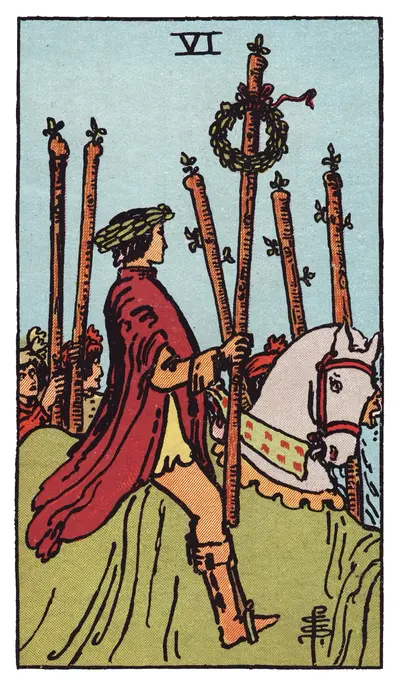
The Six of Wands is public recognition. A rider comes through on horseback wearing a laurel wreath, with a second wreath tied to his staff, and figures walk alongside him — the win has already happened and this is the part where it is acknowledged. That the acknowledgement is the subject rather than the achievement is what makes the card specific. Plenty of cards describe things going well; this one describes other people knowing. When it arrives, something the querent has done is about to be or is being seen, and the reading that usually lands is about visibility rather than outcome. The card has one honest complication and it is worth raising, because the imagery raises it: the rider is elevated, the attendants are on foot, and that arrangement only holds while the procession lasts. The Six of Wands is a moment, and it is aware of being one. Where the surrounding cards are heavy it can read as a win that costs something to sustain, though nothing in the card itself suggests the win is undeserved.
Reversed meaning
Reversed, the commonest reading is the recognition failing to arrive — the work was done, the result was real, and nobody said so. People recognise that immediately and it is usually the right reading. A second is the inverse and worth checking for: recognition arriving for something that was not actually the achievement, which the surrounding cards will normally make obvious. A third concerns the procession itself. Reversed, the Six of Wands sometimes describes success that has become dependent on being watched, where the win is no longer satisfying without the audience — a specific and fairly common condition that the upright card is one step away from at all times.
What Jupiter in Leo contributes
Jupiter in Leo is the most expansive planet in the most demonstrative sign, and the combination produces a card that is generous rather than merely triumphant. Jupiter does not hoard; the rider is not riding away from the crowd but through it. That is what keeps the Six of Wands from reading as arrogance, and it is why the attendants in the image are walking with him rather than behind him. Leo supplies the visibility and Jupiter supplies the scale, so the recognition in this card tends to be larger than the achievement strictly warrants — which is a real feature of public success and one the card neither celebrates nor criticises.
What is on the card
Two wreaths, and they are doing different jobs: the one on the rider’s head is his, and the one tied to the staff is being carried, which is the composition distinguishing what he has won from what he is displaying. The horse is draped in green, the colour of growth rather than triumph. The attendants’ staves are raised but bare — five of them, with the rider’s making six — so the crowd is materially the same group that was fighting in the Five, now walking in one direction. Nobody’s face is visible except the rider’s, which leaves the crowd’s actual feelings unreadable.
In a love reading
Reads as a relationship going well in a way others can see — being introduced, being public, being congratulated. It is favourable and slightly external, which is the caution: the card describes how a relationship appears at least as much as how it is. On questions about whether interest is returned it is one of the clearer yeses in the deck, and on questions about recovering someone’s regard after a difficulty it is unusually encouraging.
In a career reading
Promotion, credit, a result that lands publicly. It is among the strongest cards to draw on a question about recognition and one of the few that speaks to reputation specifically rather than to competence. On questions about interviews and presentations it is close to literal. Where it is less useful is on questions about sustainable progress, since the card is a moment rather than a trajectory and says nothing about the day after the procession.
How this one is usually misread
The usual reading is simply "success", which is true and discards the specific thing the card contributes. Every suit has success cards; this is the one about being seen. Strip the crowd out of the image and nothing is left — the laurel means nothing in an empty street. A reading that gives the querent success without the audience has described the Nine of Pentacles or the Three of Pentacles instead. The second and more useful correction concerns durability. The Six of Wands is a procession, and a procession is a moment: the rider is elevated only while people are walking beside him, and the Seven of Wands, which is the very next card, is what happens when the same crowd decides they want the position. Reading the Six as a stable state rather than an event is the error that makes the Seven feel like a betrayal.
How it behaves beside other cards
After the Five of Wands it resolves the contest, and the two together usually mean a current friction has an ending the querent cannot yet see. Before the Seven of Wands — which is what happens when the crowd stops cheering and starts challenging — it becomes a warning about the fragility of position rather than a simple win. With the Star it reads as recognition after a hard stretch. Beside the Moon or the Seven of Cups the acclaim becomes suspect, and the useful question turns to what exactly is being applauded. Two pairings sharpen it considerably. With the Three of Cups the recognition becomes genuinely shared rather than merely witnessed, which is the warmest version of this card available. And beside the Seven of Cups the acclaim should be treated with care: the Seven is the card of attractive options that are not all real, and next to the Six it often means the win being celebrated is not the one that will matter.
Why this card has a zodiac sign attached
The thirty-six numbered cards from Two to Ten are mapped one-to-one onto the thirty-six decans — the ten-degree slices the zodiac divides into. Six of Wands holds 130° to 140° of Leo, ruled by Jupiter in the Chaldean order. That is a lookup from a position on the ecliptic, not an association someone chose, which is why this page can print a degree range and a date range next to it.
Correspondences follow the Golden Dawn attributions set out in Book T. Degrees are computed from each card’s position in the decan sequence rather than transcribed, so they cannot drift from the spread tool on the rest of this site.
Cards next to this one
The rest of Leo
See this card come up in your own chart
The spread on our tarot astrology page reads your chart positions as cards — no shuffle, the same answer every time. The daily card does the same for the Moon’s decan right now.