Minor Arcana · Pentacles · earth
Five of Pentacles
Dates are for 2026 and shift by up to a day between years, because the tropical year is not a whole number of days.
The Book T title
Material Trouble is deliberately unglamorous, and the plainness is the point. Book T is not naming catastrophe or poverty in the abstract but trouble of a material kind — the practical, countable sort. Placed in the first decan of Taurus, the sign most concerned with physical security, it opens the sign with its absence. The title says nothing about spirit, dignity or fault, which is a restraint the card’s imagery makes very easy to abandon.
Upright meaning
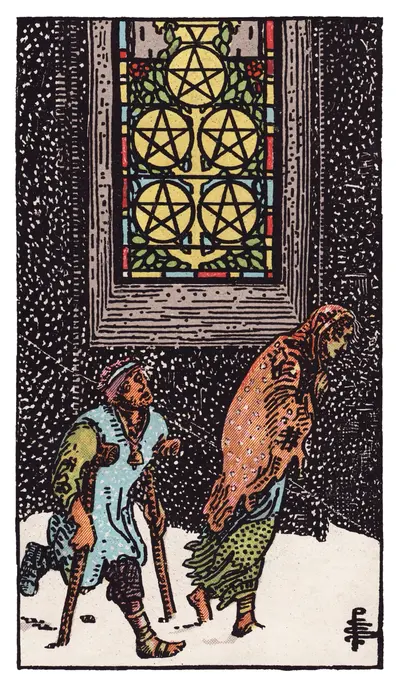
Two figures move through snow past a lit stained-glass window: one on crutches, one barefoot with a shawl, neither looking up. The window is directly above them and they pass beneath it. The Five of Pentacles is the deck’s card of hardship, and the detail that makes it more than that is the window — help, warmth or shelter is immediately present and is not being seen, and the card is careful not to say why. It may be pride, exhaustion, or simply that the two are looking where they are walking. When it arrives, the thing being asked about involves a genuine shortage and something available that is not being used. Five in the pips is where a stable four breaks, and in earth it breaks into want. The card is often read as exclusion, which the image supports: they are outside the building, in the weather, and the light is on the other side of the glass. Both are true and neither is the whole of it.
Reversed meaning
Reversed, the situation turns. The commonest reading is recovery — the door found, the help accepted, the worst of a hard period passing — and it is favourable and reliable. A second is the shortage being recognised rather than relieved: asking, which is the step before the first and is genuinely difficult for the people this card describes. A third and less comfortable reading is the hardship continuing while the appearance of it improves. The first two are much the more common; a reader should offer them before reaching for the third.
What Mercury in Taurus contributes
Mercury in Taurus is the mind in the sign of the body, and it accounts for the card’s most distinctive feature: the two figures are thinking about their situation. Mercury in a fixed earth sign is slow and practical and does not stop calculating, which is why the card so often describes people who know exactly how bad things are — the trouble is not confusing, it is countable. That also explains why the window goes unnoticed. Mercury here is occupied with the immediate arithmetic of the next step, and a stained-glass window is not in that calculation.
What is on the card
The window is the card’s argument: five pentacles set in stained glass, lit from inside, directly above two people who do not look up. One figure is on crutches with a bell around the neck, the medieval mark of a leper — an exclusion that was enforced rather than chosen. The other is barefoot in snow. Both are moving, not stopped, and both are heading out of the frame past the building rather than toward its door. The snow is heavy and the light from the window falls across it.
In a love reading
A relationship under material strain, or one in which both people feel unsupported and neither is saying so. The two figures are together in the image, which is worth noticing: this is shared hardship rather than solitary, and reading it as isolation misses that nobody in the card is alone. It also describes the specific state of not asking for help from a partner who would give it. On questions about whether support is available the card is quite clear — the window is lit — and it is equally clear that availability and access are not the same thing.
In a career reading
Redundancy, a contract ending, a period of genuinely reduced means. It is one of the few cards that speaks directly to insecurity rather than to dissatisfaction. On questions about whether help exists — a scheme, a contact, an entitlement — the answer is generally yes and is not being pursued. Its most practical contribution is that the trouble in the image is temporary weather rather than a permanent condition: the two are walking through snow, which is a season. On questions about asking a former employer or colleague for something it is encouraging in a way the querent will probably resist.
How this one is usually misread
The frequent error is reading this as spiritual failure — the two have turned away from the church, the help was divine and they refused it. That reading is imported rather than found; nothing in the image indicates refusal, and both figures are looking at the ground in front of them like anybody walking through deep snow. The second misreading is more damaging in practice: treating the card as a verdict on the querent’s choices. Material Trouble is a circumstance, not a judgement, and one of the two figures carries a bell that marks an exclusion imposed on him. A reading that makes hardship into a lesson has added a moral the Golden Dawn did not.
How it behaves beside other cards
With the Six of Pentacles help arrives and is accepted, which is the most direct resolution the deck offers. Beside the Four of Pentacles the shortage explains the grip and the pair often describes a whole history. With the Three of Pentacles the institution that was a wall becomes a place of work. Next to the Ten of Pentacles the contrast is between two versions of the same material world and usually concerns family. Its most hopeful neighbour is the Star, which is the card of light after exactly this kind of period. Beside the Hermit the exclusion is chosen rather than imposed, which is worth distinguishing carefully. With the Ace of Pentacles something concrete is available and has not been reached for, and the pair is one of the more actionable in the suit. Next to the Sun the snow ends. Next to the Nine of Pentacles the two cards show the same walled property from opposite sides of the wall, which is the most pointed contrast the suit contains. With the Temperance card the hardship is being managed rather than merely endured. Beside the Knight of Cups an offer of help arrives from somebody the two figures do not expect it from. With the World the period is over and can be seen whole.
Why this card has a zodiac sign attached
The thirty-six numbered cards from Two to Ten are mapped one-to-one onto the thirty-six decans — the ten-degree slices the zodiac divides into. Five of Pentacles holds 30° to 40° of Taurus, ruled by Mercury in the Chaldean order. That is a lookup from a position on the ecliptic, not an association someone chose, which is why this page can print a degree range and a date range next to it.
Correspondences follow the Golden Dawn attributions set out in Book T. Degrees are computed from each card’s position in the decan sequence rather than transcribed, so they cannot drift from the spread tool on the rest of this site.
Cards next to this one
The rest of Taurus
See this card come up in your own chart
The spread on our tarot astrology page reads your chart positions as cards — no shuffle, the same answer every time. The daily card does the same for the Moon’s decan right now.