Minor Arcana · Pentacles · earth
Ten of Pentacles
Dates are for 2026 and shift by up to a day between years, because the tropical year is not a whole number of days.
The Book T title
Wealth, and it is the only Minor title that names the thing outright rather than a quality of it. Placed in the third decan of Virgo, closing the sign and the last of the earth decans, it is the terminal statement of the suit: everything the Pentacles have been building, arrived at and handed on. What makes the title less simple than it looks is that the card shows almost no money. What it shows is continuity, and Book T is naming that as the actual wealth.
Upright meaning
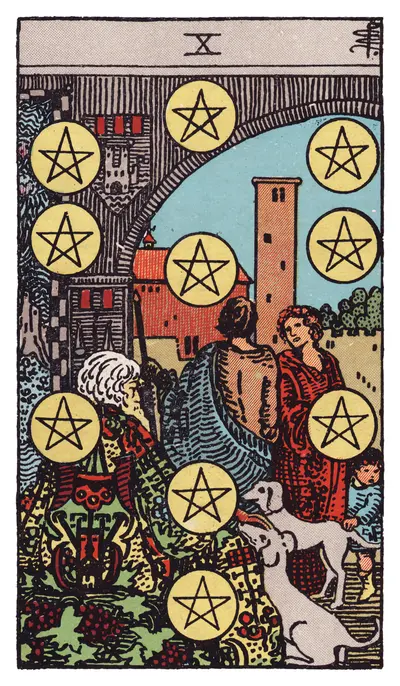
An old man in a patterned cloak sits with two dogs while a couple talk beside him and a child reaches toward one of the dogs, all beneath an archway bearing a coat of arms. Ten pentacles are arranged across the image in the pattern of the Tree of Life. Nobody is looking at anybody else. The Ten of Pentacles is the card of established, inherited, continuing wealth — family, property, institution, the material world at its most durable — and its subject is time rather than money. Three generations are present in one frame. When it arrives, the thing being asked about is secure in a way that extends beyond the querent, which is favourable and carries the particular weight of things that were not built by the person enjoying them. Ten completes the suit, and what completes is finished: the card describes an arrival rather than a trajectory. Its quiet observation is that nobody in the picture is talking to the old man.
Reversed meaning
Reversed, the continuity is disrupted. The commonest reading concerns family — disagreement, a legacy disputed, a break in something that was supposed to pass on. A second is financial in the ordinary sense: security that turns out to be less established than assumed. A third is the querent’s relationship to the whole structure, where reversed the card describes somebody who does not want the inheritance, literal or otherwise, which is a real and under-served situation. Where the reading involves relatives the first applies; where it involves the querent’s own choices, the third.
What Mercury in Virgo contributes
Mercury in Virgo is both rulership and exaltation — the only decan in the deck where a planet holds both dignities, and the strongest placement available anywhere in the 36. That is a remarkable thing to find on the final earth card and it explains the card’s particular texture. Mercury is exchange, record and transmission; Virgo is accuracy and continuity. Together they produce wealth as something documented and handed on correctly rather than merely possessed, which is why the image contains a coat of arms, an archway and three generations instead of a strongbox.
What is on the card
The ten pentacles are arranged in the Kabbalistic Tree of Life, the only card in the deck where they form a named pattern rather than a composition — the wealth is structured. The old man sits apart at the edge of the frame, richly dressed, attended by two dogs, and neither of the adults is addressing him. The child touches a dog rather than a person. An archway carries a coat of arms and a tower is visible beyond it. The setting is a courtyard within a property, and everyone in it belongs there.
In a love reading
Family in the broad sense, and one of the strongest cards for questions about whether a relationship will become permanent in the institutional way — marriage, property, children, the long arrangement. It is favourable and slightly formal. On questions about in-laws or family approval it is close to literal. Its complication is worth raising on relationship questions: the old man is present and unattended, and the card is quietly interested in what happens to people once the structure is established. On questions about whether love and security can coexist it says yes and does not pretend they are the same thing.
In a career reading
Established institutions, long-term security, family businesses, pensions, property. It is the deck’s clearest card for material stability that outlasts a person, and it reads well on questions about legacy, succession and whether something will last. On questions about excitement or innovation it is poor — nothing in this card is new, and the structure it describes is not a place where things change quickly. On questions about money it is the most favourable card available and is specific that the money is structural rather than sudden.
How this one is usually misread
The common error is reading this as a financial windfall, which the Ace and the Nine handle and this card does not. The Ten of Pentacles shows almost no money; it shows an archway, a coat of arms and three generations, and Book T calls that Wealth. Delivered as a lottery card it becomes a prediction about an amount rather than a description of a structure. The second misreading is treating it as uncomplicatedly happy in the way the Ten of Cups is. Nobody in this picture is looking at anybody else, the old man sits apart, and the card is at least as interested in the cost of a durable structure as in its benefits.
How it behaves beside other cards
With the Ten of Cups the material and emotional completions arrive together, which is as favourable a pairing as the deck offers. Beside the Nine of Pentacles the solitary garden and the crowded courtyard pose the suit’s final question. With the Five of Pentacles the archway is the building the two figures are walking past. Next to the Tower the structure is threatened, which is the most alarming thing that can happen to this card. Its most poignant neighbour is the Ace of Pentacles, which is where all of this started as a single coin in an open hand. Beside the Hierophant the institution becomes explicit and the wealth is unmistakably inherited. With the Eight of Cups somebody is leaving all of it, which is the sharpest contradiction the deck can stage. Next to the Fool the whole structure is being declined by somebody who has not yet started. Next to the Wheel of Fortune the structure meets something it cannot absorb. With the Death card the succession actually happens, which is what an archway and a coat of arms exist to survive. Beside the Star the inheritance is a genuine gift rather than an obligation, which is the reading most families would recognise least. With the Lovers somebody has a choice to make about whether to join this.
Why this card has a zodiac sign attached
The thirty-six numbered cards from Two to Ten are mapped one-to-one onto the thirty-six decans — the ten-degree slices the zodiac divides into. Ten of Pentacles holds 170° to 180° of Virgo, ruled by Mercury in the Chaldean order. That is a lookup from a position on the ecliptic, not an association someone chose, which is why this page can print a degree range and a date range next to it.
Correspondences follow the Golden Dawn attributions set out in Book T. Degrees are computed from each card’s position in the decan sequence rather than transcribed, so they cannot drift from the spread tool on the rest of this site.
Cards next to this one
The rest of Virgo
See this card come up in your own chart
The spread on our tarot astrology page reads your chart positions as cards — no shuffle, the same answer every time. The daily card does the same for the Moon’s decan right now.