Minor Arcana · Pentacles · earth
Nine of Pentacles
Dates are for 2026 and shift by up to a day between years, because the tropical year is not a whole number of days.
The Book T title
Material Gain names something the imagery makes specific: gain that has been realised and is being enjoyed, rather than accumulated or awaited. Placed in the second decan of Virgo, the middle of the sign of refinement, it describes wealth that has been arranged rather than merely acquired. The title is plain and the card is not — everything interesting about the Nine of Pentacles is in what the gain has been spent on, which is solitude, security and a very well-kept garden.
Upright meaning
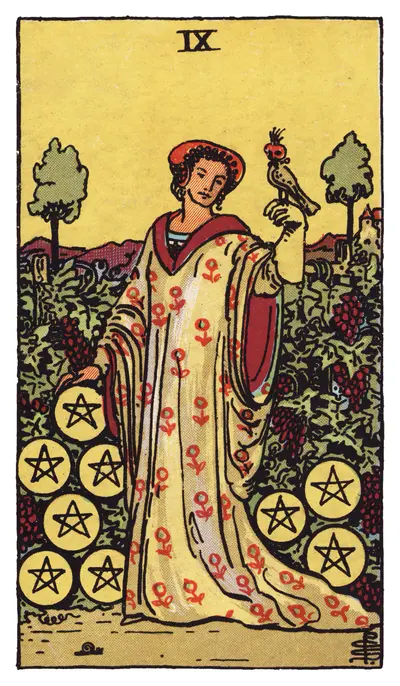
A woman stands in a walled garden of heavy grapevines with a hooded falcon on her gloved hand and a snail near her feet. She is alone and entirely composed. The Nine of Pentacles is the card of self-sufficiency achieved, and the reason it is more than simple prosperity is that every element of the image is disciplined: the vines are trained, the falcon is hooded, the garden is walled, and the woman’s posture is perfectly still. This is not luxury that arrived; it is a life that has been constructed. When it arrives, the thing being asked about concerns something the querent has built for themselves and can now enjoy without reference to anybody else. Nine in the pips is near-completion, so the card describes sufficiency rather than a conclusion. Its one quiet complication is the solitude, which the card presents as an achievement and which is genuinely ambiguous: she is alone in the garden, and the garden has walls.
Reversed meaning
Reversed, the self-sufficiency is qualified. The commonest reading is security that depends on something or somebody else — the garden turning out not to be hers, which is a specific and uncomfortable discovery. A second concerns the solitude becoming isolation rather than independence, where the walls stop being protection. A third is more favourable: the hood coming off the falcon, a discipline relaxed, something being let out. Where the reading involves other people the second applies; where it involves money, the first.
What Venus in Virgo contributes
Venus in Virgo is the planet of pleasure in the sign of exactness, and it is the pairing that makes this card what it is. Venus in fall here does not reduce enjoyment; it refines it, which is why the garden is cultivated rather than wild and why the figure’s dress is elaborate and her surroundings are orderly. Nothing in this decan is indulgent. Virgo supplies the arrangement and Venus supplies the reason for arranging anything at all, and the result is pleasure that has been earned, organised and is being taken deliberately.
What is on the card
The falcon is hooded, which means it is trained and currently prevented from flying — the card’s clearest statement that this peace is maintained by control rather than by absence of appetite. The vines are heavy with fruit and carefully trained along supports. A snail crosses the ground near her feet, the slowest creature available and a deliberate note about the pace at which this was built. The wall runs behind her and a manor house sits beyond it. Her glove is the only working garment in the picture.
In a love reading
Most often describes someone who is content alone, and it is one of very few cards in the deck that treats that as an achievement rather than a lack. On questions about whether a relationship is needed it is a quiet no. Where a relationship exists it describes one between people who do not require each other, which is favourable and slightly cool. It also appears in questions after a separation, where it indicates a life successfully rebuilt. The hooded falcon is worth raising on any love question: something is being held in check, and the card does not say whether that should continue.
In a career reading
Independence earned — a business that works, a reputation that no longer needs defending, a position of genuine autonomy. It is among the strongest cards for questions about self-employment and about whether the querent can support themselves on their own terms. On questions about whether to take a role it frequently indicates that none is needed. On money questions it is favourable and specific: the gain has been realised rather than projected, which distinguishes it from the Seven and the Ace. Its limitation is that nothing in the card involves anybody else, so on questions about collaboration it has little to say.
How this one is usually misread
The common error is reading this as luxury or windfall, which the snail and the trained vines argue against — everything in the garden took a long time and continuous attention. Delivered as good fortune arriving, the card loses the fact that it depicts something built. The second misreading is treating the solitude as incidental scenery. She is alone, the garden is walled, and the falcon is hooded; the card is quite deliberately about a life arranged to require nobody, and whether that reads as freedom or as enclosure is the genuine question it raises. A reading that only takes the prosperity has taken the easier half.
How it behaves beside other cards
With the Ten of Pentacles the solitary garden is contrasted with a family, and the pair is one of the deck’s sharper questions about what wealth is for. Beside the Hermit the withdrawal is deliberate and the card reads as chosen rather than settled for. With the Three of Cups the walls come down and the garden acquires visitors. Next to the Eight of Pentacles the sequence is complete: the bench produced this. Its most searching neighbour is the Two of Cups, which asks whether the gate is ever opened. Beside the Empress the garden becomes abundant rather than merely well kept. With the Four of Pentacles the walls start to look defensive rather than protective. Next to the Knight of Cups somebody arrives at the gate, which is the one event this card has no provision for. Next to the Star the solitude is restorative rather than defended. With the World the arrangement is complete in the fullest sense the deck allows, and the walls stop mattering because nothing outside them is wanted. Beside the Moon the garden is less settled than it looks. With the Queen of Pentacles the self-sufficiency turns out to extend to looking after other people as well, which is the version of this card that scales. With the Hierophant the garden turns out to sit inside an institution rather than apart from one. Beside the Ace of Cups something is being offered that the walls were built to keep out.
Why this card has a zodiac sign attached
The thirty-six numbered cards from Two to Ten are mapped one-to-one onto the thirty-six decans — the ten-degree slices the zodiac divides into. Nine of Pentacles holds 160° to 170° of Virgo, ruled by Venus in the Chaldean order. That is a lookup from a position on the ecliptic, not an association someone chose, which is why this page can print a degree range and a date range next to it.
Correspondences follow the Golden Dawn attributions set out in Book T. Degrees are computed from each card’s position in the decan sequence rather than transcribed, so they cannot drift from the spread tool on the rest of this site.
Cards next to this one
The rest of Virgo
See this card come up in your own chart
The spread on our tarot astrology page reads your chart positions as cards — no shuffle, the same answer every time. The daily card does the same for the Moon’s decan right now.