Moon phase calendar 2022
Every full moon, new moon and quarter of 2022, computed to the minute and shown in your own timezone, with folk names, zodiac signs and eclipses.
- 12
- Full moons
- 13
- New moons
- 2
- Umbral lunar eclipses
- 29.64days
- Back to the same phase
January
- New moon
- Wolf Moon
February
- New moon
- Snow Moon
March
- New moon
- Worm Moon
April
- New moon
- Pink Moon
- New moon
May
- Flower Moon
- New moon
June
- Strawberry Moon
- New moon
July
- Buck Moon
- New moon
August
- Sturgeon Moon
- New moon
September
- Harvest Moon
- New moon
October
- Hunter's Moon
- New moon
November
- Beaver Moon
- New moon
December
- Cold Moon
- New moon
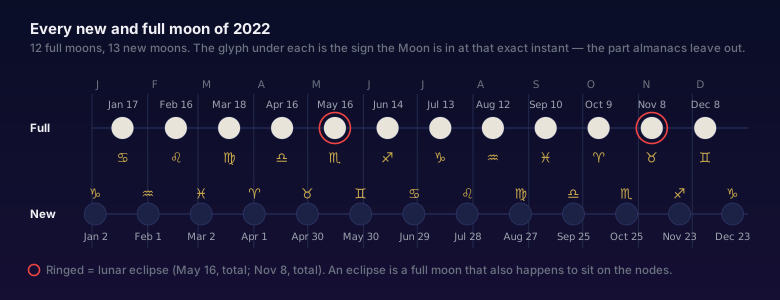
Every moon phase of 2022
All 50 quarter instants of the year, to the minute, with the degree and sign each one falls on. Eclipses, blue moons and traditional full-moon names are marked.
| Date | Phase | Sign | Notes | |
|---|---|---|---|---|
| New Moon | 12.3° Capricorn | |||
| First Quarter | 19.5° Aries | |||
| Full Moon | 27.9° Cancer | Wolf Moon | ||
| Last Quarter | 5.6° Scorpio | |||
| New Moon | 12.3° Aquarius | |||
| First Quarter | 19.8° Taurus | |||
| Full Moon | 28.0° Leo | Snow Moon | ||
| Last Quarter | 5.3° Sagittarius | |||
| New Moon | 12.1° Pisces | |||
| First Quarter | 19.8° Gemini | |||
| Full Moon | 27.7° Virgo | Worm Moon | ||
| Last Quarter | 4.6° Capricorn | |||
| New Moon | 11.5° Aries | |||
| First Quarter | 19.4° Cancer | |||
| Full Moon | 26.8° Libra | Pink Moon | ||
| Last Quarter | 3.3° Aquarius | |||
| New Moon | 10.5° Taurus | |||
| First Quarter | 18.4° Leo | |||
| Full Moon | 25.3° Scorpio | TotalFlower Moon | ||
| Last Quarter | 1.7° Pisces | |||
| New Moon | 9.1° Gemini | |||
| First Quarter | 16.9° Virgo | |||
| Full Moon | 23.4° Sagittarius | Strawberry Moon | ||
| Last Quarter | 29.8° Pisces | |||
| New Moon | 7.4° Cancer | |||
| First Quarter | 15.0° Libra | |||
| Full Moon | 21.4° Capricorn | Buck Moon | ||
| Last Quarter | 27.9° Aries | |||
| New Moon | 5.7° Leo | |||
| First Quarter | 13.0° Scorpio | |||
| Full Moon | 19.4° Aquarius | Sturgeon Moon | ||
| Last Quarter | 26.2° Taurus | |||
| New Moon | 4.1° Virgo | |||
| First Quarter | 11.2° Sagittarius | |||
| Full Moon | 17.7° Pisces | Harvest Moon | ||
| Last Quarter | 25.0° Gemini | |||
| New Moon | 2.8° Libra | |||
| First Quarter | 9.8° Capricorn | |||
| Full Moon | 16.5° Aries | Hunter's Moon | ||
| Last Quarter | 24.3° Cancer | |||
| New Moon | 2.0° Scorpio | |||
| First Quarter | 8.8° Aquarius | |||
| Full Moon | 16.0° Taurus | TotalBeaver Moon | ||
| Last Quarter | 24.2° Leo | |||
| New Moon | 1.6° Sagittarius | |||
| First Quarter | 8.4° Pisces | |||
| Full Moon | 16.0° Gemini | Cold Moon | ||
| Last Quarter | 24.4° Virgo | |||
| New Moon | 1.6° Capricorn | |||
| First Quarter | 8.3° Aries | |||
Rows are UTC calendar days. The exact times follow the timezone setting above, so a time close to midnight can belong to the neighbouring day in your own zone.
2022 at a glance
2022 carries twelve full moons and 13 new moons — the ordinary arrangement, where each calendar month gets exactly one full moon and the dates walk steadily backwards through the year.
The moon phase calendar 2022 below lists all of them, in your own timezone, with the exact instant rather than the date alone. Every time on this page is searched for individually in the ephemeris rather than stepped forward from the one before, because the lunation length varies enough that adding 29.53 days repeatedly drifts off within months.
One thing the table will not do is round to the day. Instants matter here more than they look like they should: the difference between a full moon at 23:40 and one at 00:20 is a whole calendar date, and which side of midnight it falls on depends on where the reader is standing rather than on anything about the Moon.
The shortest lunar cycle of 2022 runs 29.47 days and the longest 29.64 — a spread of about 4 hours between them. That variation comes from the Moon's elliptical orbit: it moves fastest at perigee, so the cycles that contain a perigee near new moon finish sooner.
Lunar eclipses in 2022
2 full moons of 2022 are eclipsed — flagged in the table above with the fraction of the disc inside the umbra at maximum.
At least one of them is total, which means the Moon passes entirely inside the dark inner shadow. It does not go black: it turns deep copper red, lit by sunlight refracted around the Earth through our atmosphere and stripped of its blue wavelengths on the way. That light is every sunrise and sunset on Earth at once, landing on the Moon.
Unlike a solar eclipse, a lunar eclipse is visible from everywhere on the night side of the planet at the same instant, and it is completely safe to watch with no filter of any kind. The only thing that changes from place to place is whether the Moon is above your horizon.
The longest and shortest lunar cycle of 2022
A lunation is not a fixed length. In 2022 the shortest runs 29.47 days, from the new moon on January 2, and the longest runs 29.64 days, from the one on May 30 — a difference of about 4 hours between two consecutive months of the same cycle.
The cause is the shape of the orbit. The Moon travels along an ellipse, moving fastest near perigee and slowest near apogee, so a cycle that happens to contain its perigee close to the new moon gets through the 360° of elongation sooner. Over a year the effect is large enough to matter: adding 29.53 days repeatedly to a known new moon drifts off the real dates within a few months, which is why every instant on this page is searched for individually rather than stepped forward from the one before.
This is also the answer to a question the table above raises for anyone who studies it. The gaps between consecutive full moons are not equal, the gaps between a full moon and the next first quarter are not equal, and neither pattern repeats from year to year. The moon phase calendar 2022 above spaces them where they actually fall; one that spaces its events evenly is drawing the idea of a lunation rather than the real one.
How 2022's full moons fall across the zodiac
Every full moon in the moon phase calendar 2022 above carries a sign, and because a full moon is always opposite the Sun, its sign is fixed by the date: a full moon while the Sun is in Leo is a full moon in Aquarius, every time. The sequence marches forward one sign a month and cannot do anything else.
In 2022 no sign carries two full moons, which is the usual arrangement in a twelve-moon year — each of the twelve gets exactly one.
The degree is the number worth reading rather than the sign. A full moon at 2° of a sign and one at 28° are nearly a month apart in the cycle they belong to, and only one of them will be within orb of anything in a particular birth chart.
The other pattern worth noticing in 2022's table is where in each sign the moons fall. Because thirteen lunations do not fit evenly into twelve months, the degree creeps in one direction across the year — forwards in a twelve-moon year, backwards in a thirteen-moon one. Two consecutive Januarys can therefore put the full moon at very different points in the same sign, which is why a birth chart contact that fires one year may not the next.
Frequently asked questions
How many full moons are there in 2022?
12. The moon phase calendar 2022 above lists each one with its exact instant, folk name and zodiac sign.
Which timezone is this 2022 calendar in?
Yours, resolved in your browser, with a toggle to UTC for comparing against a published almanac. A full moon late in the UTC day falls on the previous date across the Americas — the same instant, two calendar dates.
Is there a Blue Moon in 2022?
The table flags it if there is. A Blue Moon is the second full moon in one calendar month, which happens roughly every two and a half years rather than annually.
Are there lunar eclipses in 2022?
Any eclipsed full moon is flagged in the table with the fraction of the disc inside the umbra. Penumbral eclipses are left out here — they are real but essentially invisible, and the eclipse calendar lists them separately.
How accurate are these 2022 dates?
Each instant is located by search over the ephemeris and is stable to well under a minute. As a published cross-check, the 28 August 2026 full moon computes here to 04:19 UTC, matching the Farmers' Almanac's 12:19 a.m. EDT.
Why do the full moon names not match my almanac?
Check Harvest and Hunter's Moon first. Both are defined by the September equinox rather than by a month — Harvest is the full moon nearest it, Hunter's the one after — so tables that assign names by month get them wrong in some years. This calendar computes them.