Moon phase calendar 2020
Every full moon, new moon and quarter of 2020, computed to the minute and shown in your own timezone, with folk names, zodiac signs and eclipses.
- 13
- Full moons
- 12
- New moons
- 0
- Umbral lunar eclipses
- 29.75days
- Back to the same phase
January
- Wolf Moon
- New moon
February
- Snow Moon
- New moon
March
- Worm Moon
- New moon
April
- Pink Moon
- New moon
May
- Flower Moon
- New moon
June
- Strawberry Moon
- New moon
July
- Buck Moon
- New moon
August
- Sturgeon Moon
- New moon
September
- Corn Moon
- New moon
October
- Harvest Moon
- New moon
- Hunter's Moon
November
- New moon
- Beaver Moon
December
- New moon
- Cold Moon
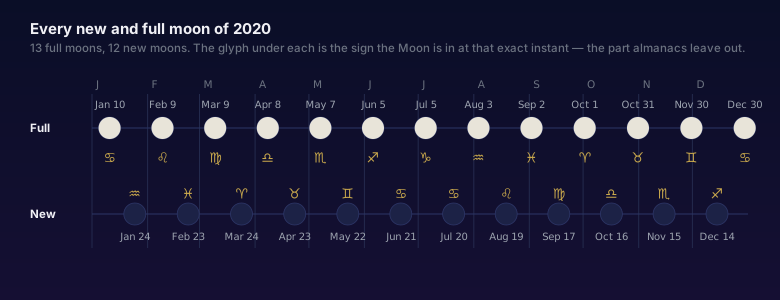
Every moon phase of 2020
All 50 quarter instants of the year, to the minute, with the degree and sign each one falls on. Eclipses, blue moons and traditional full-moon names are marked.
| Date | Phase | Sign | Notes | |
|---|---|---|---|---|
| First Quarter | 12.3° Aries | |||
| Full Moon | 20.0° Cancer | Wolf Moon | ||
| Last Quarter | 26.9° Libra | |||
| New Moon | 4.4° Aquarius | |||
| First Quarter | 12.7° Taurus | |||
| Full Moon | 20.0° Leo | Snow Moon | ||
| Last Quarter | 26.7° Scorpio | |||
| New Moon | 4.5° Pisces | |||
| First Quarter | 12.7° Gemini | |||
| Full Moon | 19.6° Virgo | Worm Moon | ||
| Last Quarter | 26.3° Sagittarius | |||
| New Moon | 4.2° Aries | |||
| First Quarter | 12.2° Cancer | |||
| Full Moon | 18.7° Libra | Pink Moon | ||
| Last Quarter | 25.4° Capricorn | |||
| New Moon | 3.4° Taurus | |||
| First Quarter | 11.0° Leo | |||
| Full Moon | 17.3° Scorpio | Flower Moon | ||
| Last Quarter | 24.2° Aquarius | |||
| New Moon | 2.1° Gemini | |||
| First Quarter | 9.2° Virgo | |||
| Full Moon | 15.6° Sagittarius | Strawberry Moon | ||
| Last Quarter | 22.7° Pisces | |||
| New Moon | 0.4° Cancer | |||
| First Quarter | 7.1° Libra | |||
| Full Moon | 13.6° Capricorn | Buck Moon | ||
| Last Quarter | 21.1° Aries | |||
| New Moon | 28.5° Cancer | |||
| First Quarter | 4.9° Scorpio | |||
| Full Moon | 11.8° Aquarius | Sturgeon Moon | ||
| Last Quarter | 19.5° Taurus | |||
| New Moon | 26.6° Leo | |||
| First Quarter | 3.0° Sagittarius | |||
| Full Moon | 10.2° Pisces | Corn Moon | ||
| Last Quarter | 18.1° Gemini | |||
| New Moon | 25.0° Virgo | |||
| First Quarter | 1.5° Capricorn | |||
| Full Moon | 9.1° Aries | Harvest Moon | ||
| Last Quarter | 17.2° Cancer | |||
| New Moon | 23.9° Libra | |||
| First Quarter | 0.6° Aquarius | |||
| Full Moon | 8.6° Taurus | Blue MoonHunter's Moon | ||
| Last Quarter | 16.6° Leo | |||
| New Moon | 23.3° Scorpio | |||
| First Quarter | 0.3° Pisces | |||
| Full Moon | 8.6° Gemini | Beaver Moon | ||
| Last Quarter | 16.4° Virgo | |||
| New Moon | 23.1° Sagittarius | |||
| First Quarter | 0.6° Aries | |||
| Full Moon | 8.9° Cancer | Cold Moon | ||
Rows are UTC calendar days. The exact times follow the timezone setting above, so a time close to midnight can belong to the neighbouring day in your own zone.
2020 at a glance
2020 is a thirteen-full-moon year. Thirteen full moons and 12 new moons fit into the twelve months, which means one month gets two of them and the year carries a Blue Moon.
The moon phase calendar 2020 below lists all of them, in your own timezone, with the exact instant rather than the date alone. Every time on this page is searched for individually in the ephemeris rather than stepped forward from the one before, because the lunation length varies enough that adding 29.53 days repeatedly drifts off within months.
One thing the table will not do is round to the day. Instants matter here more than they look like they should: the difference between a full moon at 23:40 and one at 00:20 is a whole calendar date, and which side of midnight it falls on depends on where the reader is standing rather than on anything about the Moon.
The shortest lunar cycle of 2020 runs 29.35 days and the longest 29.75 — a spread of about 10 hours between them. That variation comes from the Moon's elliptical orbit: it moves fastest at perigee, so the cycles that contain a perigee near new moon finish sooner.
The 2020 Blue Moon
October is the month with two full moons in 2020, which makes the second one a Blue Moon under the modern definition. It happens because the lunar cycle is 29.53 days and most months are longer: a full moon in the first day or two of a long month leaves just enough room for another before it ends.
This is a calendrical event rather than an astronomical one. Nothing about the second full moon is different — it is not bigger, brighter or bluer, and the Moon does not know which month it is. What is genuinely unusual is the arithmetic that produced it, and that only happens about every two and a half years.
An older seasonal definition — the third full moon in a season containing four — gives different dates entirely. This calendar uses the month-based one, because that is what almost every calendar a reader might compare against uses, and because the seasonal rule was already being misreported by the 1940s.
Why 2020 has no visible lunar eclipse
2020 is unusual on this calendar: not one of its full moons falls close enough to a lunar node for the Earth's umbral shadow to reach the Moon. There are no total or partial lunar eclipses in the year at all.
Eclipses need the Sun, Earth and Moon nearly in a line, and the Moon's orbit is tilted about 5° to ours. Twice a year the Sun passes near one of the two nodes where the orbits cross, opening an eclipse season — but a full moon has to land inside that window, and in some years the timing simply misses on both passes.
Penumbral eclipses may still occur, and are omitted here deliberately: the Moon dims very slightly, almost nobody can see the difference, and flagging one teaches you to distrust the flag on the eclipses you actually can see. The eclipse calendar lists them, clearly labelled, because that page's job is completeness rather than usefulness at a glance.
The longest and shortest lunar cycle of 2020
A lunation is not a fixed length. In 2020 the shortest runs 29.35 days, from the new moon on August 19, and the longest runs 29.75 days, from the one on February 23 — a difference of about 10 hours between two consecutive months of the same cycle.
The cause is the shape of the orbit. The Moon travels along an ellipse, moving fastest near perigee and slowest near apogee, so a cycle that happens to contain its perigee close to the new moon gets through the 360° of elongation sooner. Over a year the effect is large enough to matter: adding 29.53 days repeatedly to a known new moon drifts off the real dates within a few months, which is why every instant on this page is searched for individually rather than stepped forward from the one before.
This is also the answer to a question the table above raises for anyone who studies it. The gaps between consecutive full moons are not equal, the gaps between a full moon and the next first quarter are not equal, and neither pattern repeats from year to year. The moon phase calendar 2020 above spaces them where they actually fall; one that spaces its events evenly is drawing the idea of a lunation rather than the real one.
How 2020's full moons fall across the zodiac
Every full moon in the moon phase calendar 2020 above carries a sign, and because a full moon is always opposite the Sun, its sign is fixed by the date: a full moon while the Sun is in Leo is a full moon in Aquarius, every time. The sequence marches forward one sign a month and cannot do anything else.
What varies is the degree, and in 2020 that produces a doubling: Cancer carries more than one full moon. That happens when a full moon falls very early in a sign and the next cycle brings another before the Sun has moved on.
The degree is the number worth reading rather than the sign. A full moon at 2° of a sign and one at 28° are nearly a month apart in the cycle they belong to, and only one of them will be within orb of anything in a particular birth chart.
The other pattern worth noticing in 2020's table is where in each sign the moons fall. Because thirteen lunations do not fit evenly into twelve months, the degree creeps in one direction across the year — forwards in a twelve-moon year, backwards in a thirteen-moon one. Two consecutive Januarys can therefore put the full moon at very different points in the same sign, which is why a birth chart contact that fires one year may not the next.
Frequently asked questions
How many full moons are there in 2020?
13. The moon phase calendar 2020 above lists each one with its exact instant, folk name and zodiac sign.
Which timezone is this 2020 calendar in?
Yours, resolved in your browser, with a toggle to UTC for comparing against a published almanac. A full moon late in the UTC day falls on the previous date across the Americas — the same instant, two calendar dates.
Is there a Blue Moon in 2020?
The table flags it if there is. A Blue Moon is the second full moon in one calendar month, which happens roughly every two and a half years rather than annually.
Are there lunar eclipses in 2020?
Any eclipsed full moon is flagged in the table with the fraction of the disc inside the umbra. Penumbral eclipses are left out here — they are real but essentially invisible, and the eclipse calendar lists them separately.
How accurate are these 2020 dates?
Each instant is located by search over the ephemeris and is stable to well under a minute. As a published cross-check, the 28 August 2026 full moon computes here to 04:19 UTC, matching the Farmers' Almanac's 12:19 a.m. EDT.
Why do the full moon names not match my almanac?
Check Harvest and Hunter's Moon first. Both are defined by the September equinox rather than by a month — Harvest is the full moon nearest it, Hunter's the one after — so tables that assign names by month get them wrong in some years. This calendar computes them.
Calculated live from the ephemeris. Page rebuilt daily.