Major Arcana · 10
Wheel of Fortune
Upright meaning
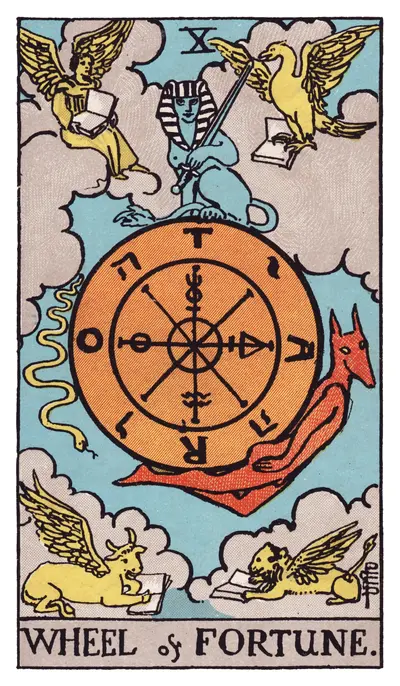
A wheel marked with letters and alchemical signs turns in the sky. A sphinx sits on top with a sword, a serpent descends on one side, a jackal-headed figure rises on the other, and four winged creatures read books at the corners. There is no ground anywhere in the picture. The Wheel is change that is not the querent’s to control — circumstance turning, timing shifting, the situation altering for reasons that have nothing to do with anybody’s effort. What makes it specific is that nothing in the frame is standing on anything. Every other card in the Majors has a floor; this one is entirely in the air, and the absence is the argument. When it arrives, the thing being asked about is moving on its own schedule. The card is usually favourable in the sense that a stuck situation is unsticking, and it makes no promise about direction. It is numbered ten, the first two-digit card, and ten is where every Minor suit completes and tips over into the next thing. The Wheel arriving at exactly that number is the sequence being deliberate: this is the card at which a count finishes and starts again, which is what a wheel is.
Reversed meaning
Reversed, the turning works against the querent or stops. The commonest reading is a downturn — the same wheel, the other quarter — and it is worth delivering without drama, because the card’s entire content is that this is a phase rather than a verdict. A second is resistance: somebody fighting a change that is not fightable, which is where most of the suffering in this card actually comes from. A third concerns luck relied upon, where a querent has been treating circumstance as a strategy. A fourth: the wheel stuck, a situation that ought to have moved and has not.
What Jupiter contributes
Jupiter is the planet of expansion, and the attribution is the reason this card is generally read as fortunate rather than merely changeable. A wheel on its own is neutral; Jupiter tilts it. But the more useful half of the correspondence is scale. Jupiter is the largest body in the classical scheme and the slowest of the seven, taking about twelve years to circle the zodiac, so what it governs is change measured in phases rather than in days. That is why this card reads badly as a prediction about next week and well as a statement about where somebody is in a longer cycle. It also explains the card’s most-ignored feature: the figures at the four corners are reading. Under a Jupiter attribution the response to a turning wheel is to understand the pattern, which is exactly what those four are doing while everything else rotates.
What is on the card
The rim carries the letters T-A-R-O, which also read R-O-T-A, Latin for wheel, and interleaved with them the four Hebrew letters of the divine name. The inner spokes bear the alchemical signs for mercury, sulphur, water and salt. A sphinx sits on top holding a sword — the only stationary thing in the frame, at the axis. A serpent descends on the left and Anubis rises on the right. At the four corners, a man, an eagle, a lion and a bull read books, each winged: the fixed signs of the zodiac, and the only figures in the picture doing anything deliberate. The sphinx on top is the only thing in the frame that is not moving, because it sits at the axis — the picture’s own statement that there is a still point on a turning wheel and that it is at the centre rather than at the top.
In a love reading
A change of circumstance rather than of feeling — a move, a reunion, a situation that shifts for reasons outside either person. It is favourable on questions about whether something stuck will move and unhelpful on questions about somebody’s intentions, since nothing in this card is about anybody’s choices. On questions about meeting someone it is one of the better cards for chance encounters. Where a querent is waiting for a situation to resolve, this card says it will change and declines to say into what, which is the correct refusal. On questions about whether a stalled situation will change it is among the clearest yeses in the deck, and on questions about whether the querent can make it change it is an equally clear no, which is an unwelcome pair to deliver together and usually the accurate one.
In a career reading
Circumstances shifting — reorganisations, market turns, opportunities appearing or closing for reasons unconnected to performance. It is among the better cards for questions about timing and among the least useful for questions about effort, since the picture contains no ground to stand on and push from. On questions about whether to wait for conditions to change it is a yes. Its practical contribution is Jupiter’s twelve-year scale: whatever cycle this is, it is longer than the querent is probably measuring.
How this one is usually misread
The persistent error is reading it as good luck, which the Jupiter attribution encourages and the picture does not settle. A wheel turns in both directions and the card shows one figure rising and one descending in the same frame. Delivered as fortune it becomes a promise the deck cannot keep. The second misreading is treating it as fate, which is the opposite error and just as common. **The four figures at the corners are reading books**, deliberately, while the wheel turns — the card’s own answer to what a person does about circumstance is to understand it, and a reading of pure helplessness has ignored the only intentional act in the picture. A third error is to treat the card as describing speed. A wheel turning suggests something quick, and the Jupiter attribution says otherwise: the slowest of the seven classical bodies, twelve years to a circuit. Delivered as imminent change the card sets an expectation the following weeks will not meet. What it actually says is that the querent is somewhere in a long rotation, which is a more useful thing to know and a less exciting one to hear.
How it behaves beside other cards
With the Tower the change stops being a turn and becomes a break. Beside the Seven of Pentacles the waiting acquires a reason and a horizon. With the Two of Swords a decision is being deferred while circumstance decides instead, which is the most quietly instructive pairing this card has. Next to the Eight of Cups somebody is leaving under their own power rather than being moved. Its most favourable partner is the Ace of Pentacles, where the turning delivers something concrete rather than only different. Beside the Wheel’s own opposite number the reading is rarely subtle: with the Five of Pentacles the turn has already happened and the querent is in the harder quarter, and the useful thing the card supplies is that quarters end.
Why this card has a planet or sign attached
The twenty-two Major Arcana carry the seven classical planets, the twelve signs and three of the four elements between them — one each, with nothing left over. Wheel of Fortune takes Jupiter. The allocation is the Golden Dawn’s and it is structural rather than poetic: it is what lets a card be looked up from a chart instead of chosen from a shuffle.
Correspondences follow the Golden Dawn attributions set out in Book T. Degrees are computed from each card’s position in the decan sequence rather than transcribed, so they cannot drift from the spread tool on the rest of this site.
Cards next to this one
See this card come up in your own chart
The spread on our tarot astrology page reads your chart positions as cards — no shuffle, the same answer every time. The daily card does the same for the Moon’s decan right now.