Major Arcana · 11
Justice
Upright meaning
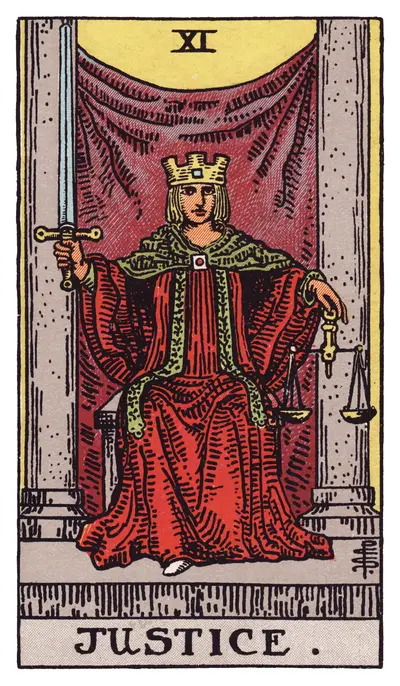
A crowned figure sits between two grey pillars holding an upright sword in one hand and level scales in the other, a purple veil hanging behind. One foot shows beneath the robe. Justice is consequence — the relation between what was done and what follows, weighed accurately. What makes the card specific is that the scales and the sword are both held, and held in balance with each other: the measuring and the acting are one office. When it arrives, the matter involves fairness in the literal sense, and frequently a real decision by a real authority. The card is not a moral judgement about the querent. It is the statement that something will be assessed on its merits, which is favourable to whoever has the better case and unwelcome to whoever does not, and the deck is indifferent as to which the querent is. It is numbered eleven here, which is the Golden Dawn’s change and not an arbitrary one — Justice and Strength were swapped from the older order specifically so the twelve signs would fall in zodiacal sequence through the Majors. A deck numbering Justice eight is following the earlier arrangement, and both are defensible; this site follows the zodiacal one because the whole cluster is built on those attributions.
Reversed meaning
Reversed, the weighing fails. The commonest reading is unfairness — a decision going against the merits, which does happen and which the card names without consoling. A second is accountability avoided, where somebody is escaping a consequence rather than receiving an unjust one. A third concerns the querent’s own assessment: bias, a situation being weighed on a scale that is not level. A fourth is worth offering because it is frequent and unflattering: a person who wants justice for others and an exception for themselves, which the reversed card describes more precisely than any other in the deck.
What Libra contributes
Libra is cardinal air, and the scales in the picture are the sign drawn literally — one of the few Majors where the attribution appears as the central object rather than as a device in the furniture. The fit goes further than the emblem. Libra is the sign of relation: it evaluates one thing *against* another rather than in itself, which is exactly what a balance does and exactly why this card cannot be read as a verdict on a person in isolation. Cardinal air also explains the sword. Libra initiates, so the weighing here results in an act, not merely an opinion — the scales and the blade are one office and the attribution is why. It is also worth knowing that Justice and Strength swap numbers between decks, and the Golden Dawn moved Justice to eleven precisely so the signs would run in zodiacal order.
What is on the card
The sword is held upright and perfectly vertical, unlike the King of Swords’ which tilts — this is the one blade in the deck drawn without a lean. The scales hang level and empty. Her crown carries a small square at the front, the sign of measurement. The pillars are grey and plain, the same pair as the Hierophant’s rather than the High Priestess’s black and white. A purple veil hangs behind, so what lies beyond is not visible from where the querent stands. One foot protrudes from under the robe, the detail Waite pointed to himself: the office is occupied by a person. The foot showing beneath the robe is the detail Waite drew attention to himself, and it is doing the same job as the empty scales: the office is occupied by a person, so the weighing is something being done rather than something that happens.
In a love reading
Fairness in a relationship, or a situation in which an imbalance is being addressed. It frequently indicates legal matters attached to a relationship — a settlement, an agreement, a formal separation — and on those it is close to literal. On questions about whether somebody is being treated fairly it is direct and does not flatter either party. On questions about whether a relationship is equal, the empty scales are the point: the card is a measure, not a result, and it says the measuring is happening rather than how it will come out. Where a querent is on the weaker side of a fair process, the card is worth delivering without softening and without gloom: an accurate weighing is the outcome most people say they want and the one they least want when it goes against them, and naming that plainly is more use than a reading that hedges. The empty scales are the honest part — nothing has been put in them yet, and what goes in is the matter rather than the person.
In a career reading
Contracts, reviews, legal processes, and any decision that will be made on the merits. It is among the strongest cards for questions about a formal assessment and among the least sentimental in the deck about the querent’s preferences. On questions about a dispute it indicates a process that will reach a defensible answer. On questions about whether to raise something formally, the vertical sword argues yes: this card’s whole position is that the weighing is better done than avoided.
How this one is usually misread
The frequent error is reading Justice as reassurance — the card arrives and the querent hears that things will work out. It says the matter will be assessed accurately, and accuracy is only good news for one side. Delivered as comfort it misleads exactly half the people who draw it. The second misreading is karmic, which the tradition has accumulated and the picture does not carry. **The scales are empty.** Nothing has been weighed yet, and a reading that announces a cosmic settling of accounts has filled the pans itself, which is precisely the invention this cluster declines everywhere else. A third misreading is to hear the card as being about the querent’s virtue. Justice weighs an action and its consequence, not a person and their worth, and the Libran attribution is why — a balance compares one thing against another and has no opinion about either in isolation. Delivered as a verdict on character the card becomes either flattery or an accusation, and it is neither. The scales in the picture are for a matter, and the matter is usually narrower than the querent fears.
How it behaves beside other cards
With the Judgement card the two are frequently confused and are not related: one is assessment, the other is a reckoning arriving from outside. Beside the King of Swords the ruling becomes personal rather than institutional, and the spread is usually about which authority applies. With the Two of Swords a decision is being avoided that this card would settle. Next to the Seven of Swords something has been done that the scales are about to be applied to. Its most uncomfortable neighbour is the Five of Pentacles, where a fair outcome and a hard one are the same outcome. Beside the Ten of Swords a consequence has already landed in full. With the Six of Pentacles the weighing is being done by somebody with the resources, which is a different and less neutral scale.
Why this card has a planet or sign attached
The twenty-two Major Arcana carry the seven classical planets, the twelve signs and three of the four elements between them — one each, with nothing left over. Justice takes Libra. The allocation is the Golden Dawn’s and it is structural rather than poetic: it is what lets a card be looked up from a chart instead of chosen from a shuffle.
Correspondences follow the Golden Dawn attributions set out in Book T. Degrees are computed from each card’s position in the decan sequence rather than transcribed, so they cannot drift from the spread tool on the rest of this site.
Cards next to this one
See this card come up in your own chart
The spread on our tarot astrology page reads your chart positions as cards — no shuffle, the same answer every time. The daily card does the same for the Moon’s decan right now.