Major Arcana · 9
The Hermit
Upright meaning
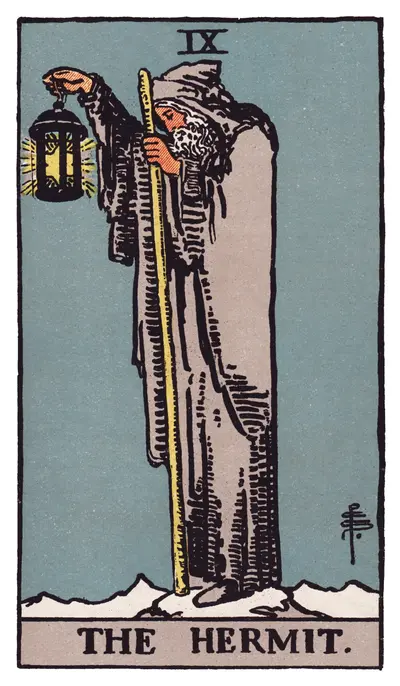
An old man stands alone on a snowy peak, holding up a lantern with a six-pointed star inside it and leaning on a staff. He is looking down, not out. The Hermit is deliberate withdrawal — stepping back from a situation in order to see it, which the card presents as an activity rather than an absence. What makes it specific is the lantern. He is not searching in the dark; he is carrying the light and holding it out, and the star inside it is the same device that appears on no other Major. When it arrives, the useful move is away from the noise. The card is frequently delivered as loneliness and the picture does not support that: there is nobody else in it, but there is nothing in his posture suggesting he wants there to be. Solitude chosen and solitude imposed are different cards, and this is the first. He is numbered nine, and nine is the last of the single digits — the end of a count rather than the start of one. Every Nine in the Minor Arcana is a card of a position reached and held alone, for better or worse, and the Hermit on his peak is the same statement at the Major scale.
Reversed meaning
Reversed, the withdrawal goes wrong. The commonest reading is isolation rather than solitude — the same position arrived at involuntarily or stayed in too long, which is exactly the distinction the upright card depends on. A second is the refusal to withdraw, somebody staying in the noise because the quiet would be worse, and it is more often the accurate one for busy querents. A third concerns advice: the Hermit is the deck’s guide figure, and reversed he can indicate counsel refused or counsel given badly. A fourth, worth offering: the light held so high that the person holding it cannot see their own feet.
What Virgo contributes
Virgo is mutable earth, and the attribution accounts for the card far better than the popular reading of it as a wise elder. Virgo is the sign of discrimination and of work done carefully on small things — not grandeur, not vision, but the patient sorting of what matters from what does not. That is what the lantern is for. It casts a small light on the ground immediately ahead, and he is looking at exactly that, which is a Virgoan way to proceed and a very unmystical one. The earth half explains why the card is practical rather than transcendent: nothing here is being revealed, it is being examined. And mutability is why the withdrawal is temporary. He is on a peak with a staff, dressed for travel, and nothing in the picture suggests he intends to stay.
What is on the card
The lantern holds a six-pointed star, the Seal of Solomon, and it is the only light in an otherwise grey frame. He holds it out and away from himself rather than close, so it lights the path rather than the man. The staff is plain wood. His robe is grey, the most neutral colour in the deck, and his head is bowed. He stands on snow at the top of a peak with nothing above him. There is no lamp-post, no dwelling and no companion — but also no wind, no threat and no distress anywhere in the picture. He holds the lantern out and away rather than close to his chest, so it lights the ground for whoever is behind him as much as for himself — which is the picture quietly making him a guide rather than a recluse, without anybody else needing to be in the frame.
In a love reading
Time alone, or a relationship in which somebody needs space that is not a rejection. It is among the less comfortable cards to draw on a relationship question and frequently one of the more honest. On questions about whether somebody is pulling away, it distinguishes between withdrawal and departure and generally indicates the first. On questions about being single it is genuinely favourable rather than consoling: the figure in this card is not waiting for anyone. Where a querent wants the card to say somebody is coming back, it says only that they went somewhere on purpose. Where a querent reads somebody’s need for space as a verdict on them, this card is usually the correction: the figure in it has gone up a mountain and is looking at the path, not at the people he left, and neither fact is about them.
In a career reading
Independent work, research, expertise built alone, or a period of stepping back to assess. It is among the strongest cards for questions about whether to take time before deciding and among the weaker ones for questions about visibility or collaboration. On questions about a mentor it indicates somebody who teaches by being asked rather than by instructing. On questions about a difficult professional problem, the Virgoan lantern is the practical advice the card actually contains: look at the ground immediately ahead rather than at the whole mountain.
How this one is usually misread
The habitual error is reading the Hermit as lonely, which imports a mood the picture declines to show. Nothing in his posture is bereft; he is standing still on a summit holding a light. Delivered as loneliness the card becomes a problem to solve rather than a move to make. The second misreading is treating the solitude as permanent. **He is dressed for travel and carrying a staff**, and mutable earth is the least static combination in the scheme — the withdrawal in this card has an end, and readings that make it a way of life have stopped describing the card. A third misreading is to make the card mystical. The lantern and the star invite it, and Virgo is the least mystical attribution in the scheme — mutable earth is the sign of careful work on small things, and the light in this card falls on the few feet of ground immediately ahead. Read as revelation the card promises something it does not contain. Read as examination it gives the querent something to do, which is the more useful and the more accurate of the two.
How it behaves beside other cards
With the Hierophant the same search appears with a lineage behind it, and the spread is usually about which the querent needs. Beside the Three of Cups the solitude is being chosen against company that is available, which changes what it means. With the Five of Pentacles the isolation becomes exclusion, which is the reversed reading arriving from outside. Next to the Eight of Cups the stepping back has become a departure. Its most productive neighbour is the Eight of Pentacles, where the solitude has work in it. Beside the Two of Swords the withdrawal has become a way of not deciding. With the Star the solitude turns out to be the condition the restoration needed.
Why this card has a planet or sign attached
The twenty-two Major Arcana carry the seven classical planets, the twelve signs and three of the four elements between them — one each, with nothing left over. The Hermit takes Virgo. The allocation is the Golden Dawn’s and it is structural rather than poetic: it is what lets a card be looked up from a chart instead of chosen from a shuffle.
Correspondences follow the Golden Dawn attributions set out in Book T. Degrees are computed from each card’s position in the decan sequence rather than transcribed, so they cannot drift from the spread tool on the rest of this site.
Cards next to this one
See this card come up in your own chart
The spread on our tarot astrology page reads your chart positions as cards — no shuffle, the same answer every time. The daily card does the same for the Moon’s decan right now.