Minor Arcana · Pentacles · earth
Two of Pentacles
Dates are for 2026 and shift by up to a day between years, because the tropical year is not a whole number of days.
The Book T title
Harmonious Change is a title that reads as a contradiction until you notice what it is not saying. It is not describing a change that goes well; it is describing change being handled well, which is a claim about the handler rather than the circumstances. Placed in the first decan of Capricorn, the sign of structure and of carrying weight, it opens the sign with somebody keeping two things in the air at once. The harmony is in the motion, not in the situation, and the moment the motion stops the harmony does too.
Upright meaning
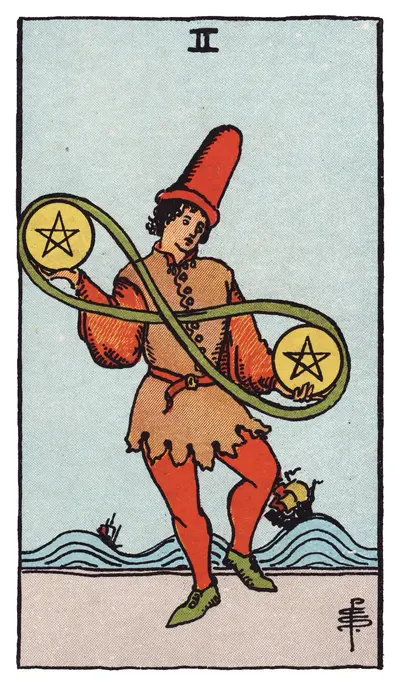
A young man juggles two pentacles inside a green band shaped like a lemniscate, while behind him two ships ride waves that are clearly too big for comfort. Everything in the image is in motion and nothing is falling. The Two of Pentacles describes managing competing demands successfully, and the reason it is not simply a card about being busy is the sea: the conditions are genuinely difficult and the juggling is working anyway. When it arrives, the thing being asked about involves more than one commitment and the querent is currently holding them. The card is neither a warning nor a congratulation. Its honest observation is that this is a dynamic balance rather than a stable one, which means it costs attention continuously and cannot be set down without something dropping. Two in the pips is the first form the suit takes, and in earth the first form is not a possession but a trade-off — the very first thing that happens to a material resource is that it has to be allocated against another one.
Reversed meaning
Reversed, the juggling fails or is abandoned, and the surrounding cards decide which. The commonest reading is overcommitment tipping over — too many demands, something dropped, which is the natural failure mode of the upright position. A second and more useful reading in practice is disorganisation rather than overload: the same number of commitments handled badly, where the problem is sequencing rather than volume. A third concerns the querent stopping deliberately, putting one pentacle down in order to hold the other properly, which the upright card never considers and is often the right answer. It is rarely a severe reversal; nothing in this card is load-bearing enough to break.
What Jupiter in Capricorn contributes
Jupiter in Capricorn is expansion in the sign of limit, and it is in fall here — the weakest placement in the deck for that planet. What that produces is not failure but the specific condition the card shows: growth that has to be managed rather than enjoyed, because Capricorn will not let Jupiter simply add. Every increase has to be fitted into an existing structure, which is exactly what juggling is. The pairing also explains the card’s good humour. Jupiter is irrepressible even in fall, and the figure is not grimacing — he is performing, which is the one thing Jupiter can still do when Capricorn has taken away his room to expand.
What is on the card
The green band around the two pentacles is a lemniscate, the infinity figure that also floats above the Magician and the Strength card, and its presence here converts juggling into a continuous system rather than a struggle. The two ships behind are on waves drawn far larger than the vessels, which is the image quietly noting that the conditions are worse than the foreground suggests. His hat is tall and red and slightly absurd. His stance is mid-step, weight on one foot, so he is dancing as well as juggling. Nothing in the frame is at rest.
In a love reading
A relationship being fitted around other commitments — work, family, distance, the ordinary logistics that take up more of most relationships than anybody admits. It is one of the better cards for questions about whether two lives can be made to work together, and its answer is that they currently are, with effort. It is also common in questions about someone dividing their attention, where it describes the situation without implying dishonesty: the Two of Pentacles is not the Seven of Swords and nobody in it is deceiving anybody. On questions about timing it usually indicates that something is being deferred rather than refused, and that the deferral is about capacity rather than interest.
In a career reading
Multiple projects, competing deadlines, a role that has quietly become two roles. It is among the most frequently drawn cards in questions about workload, and it differs from the Ten of Wands in a way worth preserving: the Ten is a load being carried and the Two is a load being balanced, which is a different kind of tiredness and a different solution. On questions about freelancing, contracting or holding a second job it is close to literal. Its practical contribution is the observation that dynamic balance cannot be paused — so the useful question is not how to carry more but what would happen if one thing were set down on purpose rather than dropped.
How this one is usually misread
The common error is reading this as instability, which the lemniscate contradicts: the two pentacles are in a closed circuit and nothing is falling. It describes a system that works, and delivering it as a warning tells a querent their arrangement is about to collapse when the card says the opposite. The second misreading is the cheerful one, which treats the juggling as effortless because the figure is dancing. The ships behind him are on genuinely rough water, and the card is quite specific that the balance is being achieved rather than enjoyed. Both errors come from reading only half the frame — the foreground is competent and the background is difficult, and the card is the relationship between them.
How it behaves beside other cards
With the Ten of Wands the balancing has become carrying, which is the deterioration this card is one step away from. Beside the Eight of Pentacles the competing demands resolve into a single craft, which is the most constructive pairing available. With the Wheel of Fortune the conditions change from outside and the juggling has to be re-learned. Next to the Devil the second pentacle turns out to be something the querent will not put down rather than cannot. Its most clarifying neighbour is Temperance, which supplies the proportion that converts juggling into a sustainable rhythm. Beside the Knight of Pentacles the juggling is replaced by a single steady pace, which is the slower and usually better answer.
Why this card has a zodiac sign attached
The thirty-six numbered cards from Two to Ten are mapped one-to-one onto the thirty-six decans — the ten-degree slices the zodiac divides into. Two of Pentacles holds 270° to 280° of Capricorn, ruled by Jupiter in the Chaldean order. That is a lookup from a position on the ecliptic, not an association someone chose, which is why this page can print a degree range and a date range next to it.
Correspondences follow the Golden Dawn attributions set out in Book T. Degrees are computed from each card’s position in the decan sequence rather than transcribed, so they cannot drift from the spread tool on the rest of this site.
Cards next to this one
The rest of Capricorn
See this card come up in your own chart
The spread on our tarot astrology page reads your chart positions as cards — no shuffle, the same answer every time. The daily card does the same for the Moon’s decan right now.