Minor Arcana · Wands · fire
Ten of Wands
Dates are for 2026 and shift by up to a day between years, because the tropical year is not a whole number of days.
The Book T title
Oppression, which is a harder word than most readers expect and harder than the imagery strictly requires. Book T places it in the final decan of Sagittarius, closing the fire suit’s numbered cards, and the title describes where unchecked fire ends up: carrying everything it started. Oppression here is not external tyranny. It is the weight of one’s own accumulated undertakings, which is a specific and very common condition and one the deck has no other card for.
Upright meaning
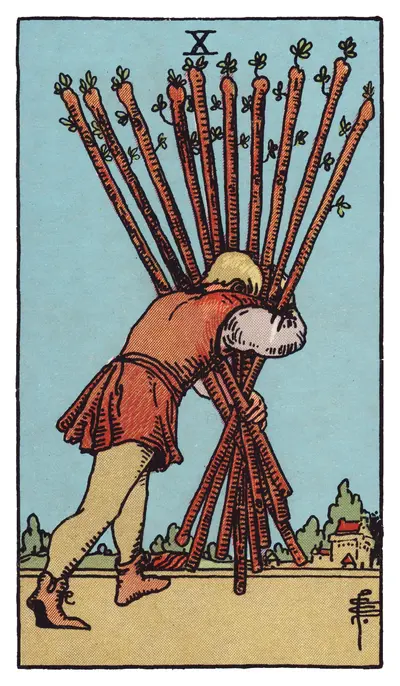
A man carries ten staves bundled in his arms, bent forward under them, with a town visible a short distance ahead. Every element is doing the same work. The load is his, the staves are the same ones that were planned in the Two and defended in the Seven, and the destination is close enough to see. The Ten of Wands is about having taken on more than can be carried comfortably and being nearly there anyway. What makes it useful rather than merely gloomy is how specific the burden is: the staves are not rocks, they are the accumulated commitments of the whole suit, taken up one at a time for reasons that were good at the time. When it arrives, the question worth asking is almost never how to endure but which of the ten was never actually yours to carry — because the bundle in the image is held together only by his arms, and nothing in the card suggests anyone gave it to him. The load obscures his view, which is the quiet cruelty of the image: he cannot see the town he is walking toward.
Reversed meaning
Reversed, the commonest and most welcome reading is the load being put down — delegation, refusal, the recognition that some of it was optional. Given how heavy the upright card is, this is one of the reversals readers can offer with some confidence. A second reading is less kind: the burden being carried in a way that has stopped being effective, where the effort has become a performance of effort. A third concerns collapse rather than release, and the surrounding cards usually make that unmistakable. It is also worth knowing that reversed, this card sometimes indicates the querent being the one who has handed the staves to somebody else.
What Saturn in Sagittarius contributes
Saturn in Sagittarius is limit applied to expansion, and it is the most structurally coherent decan in the suit. Sagittarius wants distance and more of everything; Saturn supplies the weight that distance actually costs. The result is not a card about being stopped — the figure is walking — but about every added ambition arriving with its own mass. That is precisely why the Ten of Wands feels like the natural end of a sequence that began with a man holding a globe and looking out to sea. Saturn is also what makes the load specifically one’s own: Saturn does not distribute responsibility, it concentrates it.
What is on the card
The ten staves are held in a bundle across the front of the body rather than shouldered, which is the least efficient way to carry them and the reason his back is bent. They obscure his face entirely — the only Wands card where the figure cannot be seen at all — and they block his forward view. The town ahead sits among trees in decent light and is close, perhaps a few minutes’ walk. The ploughed field he is crossing suggests the ground is workable. Nothing in the landscape is hostile; the difficulty is entirely in his arms.
In a love reading
A relationship carrying more than its share of obligation — logistics, family, responsibilities that have accumulated until they are most of the interaction. It rarely indicates a bad relationship and frequently indicates a tired one. On questions about why something feels heavy it is close to diagnostic, and its answer is usually that both people have agreed to too much rather than that either is failing.
In a career reading
Overcommitment, and one of the most frequently drawn cards in questions about workload. It describes the state accurately and offers a single piece of usable advice, which is that some of the ten were taken on voluntarily. On questions about whether a project will finish, it leans yes — the town is close — but says the finish will cost more than planned. It reads badly on questions about taking anything else on.
How this one is usually misread
The common error is reading the load as imposed, which the image does not show and which changes the card’s advice completely. Nobody hands the figure the staves; they are the accumulated undertakings of the entire suit, each taken up at a point when it seemed reasonable. Read as oppression from outside, the card offers only endurance. Read accurately, it asks which of the ten was never actually yours, and that is a question with an answer. The second misreading concerns the ending. Because the card is heavy, readers treat it as failure, when the town is close and clearly visible and the ground is workable — the difficulty is entirely in his arms, not in the landscape. The genuine cruelty of the image is subtler than defeat: the bundle blocks his view, so the one thing he cannot see is how near he is.
How it behaves beside other cards
After the Nine of Wands it completes a fatigue sequence that has been building since the Seven, and drawing the three together is unambiguous. Beside the Eight of Wands it reads as speed that has left a backlog. With the Devil the load becomes something the querent is choosing, which is the harder and often the truer reading. Its most constructive neighbour is the Ace of any suit, which tends to say the bundle can be put down because something genuinely new is available. Two pairings are worth knowing. With the Six of Pentacles the load becomes shareable — somebody in the situation has capacity and has not been asked, which is the most actionable thing this card can be told. And beside the Hanged Man the answer is not to redistribute the bundle but to stop walking, which is the one piece of advice the Ten of Wands is structurally incapable of generating by itself. With the Ace of Swords a single decision cuts the bundle down, and the card is unusually specific that one will do it. Beside the Star the walk gets shorter, because the Star is the card that restores the sense of how far is left.
Why this card has a zodiac sign attached
The thirty-six numbered cards from Two to Ten are mapped one-to-one onto the thirty-six decans — the ten-degree slices the zodiac divides into. Ten of Wands holds 260° to 270° of Sagittarius, ruled by Saturn in the Chaldean order. That is a lookup from a position on the ecliptic, not an association someone chose, which is why this page can print a degree range and a date range next to it.
Correspondences follow the Golden Dawn attributions set out in Book T. Degrees are computed from each card’s position in the decan sequence rather than transcribed, so they cannot drift from the spread tool on the rest of this site.
Cards next to this one
The rest of Sagittarius
See this card come up in your own chart
The spread on our tarot astrology page reads your chart positions as cards — no shuffle, the same answer every time. The daily card does the same for the Moon’s decan right now.