Minor Arcana · Pentacles · earth
Four of Pentacles
Dates are for 2026 and shift by up to a day between years, because the tropical year is not a whole number of days.
The Book T title
Earthly Power is a title with no criticism in it, which is worth registering because the card attracts a great deal. Book T names what the figure has: power in the material world, held securely. Placed in the third decan of Capricorn, closing the sign that accumulates, it is the endpoint of building — the position reached once the structure is complete and the question becomes what to do with it. The title makes no comment on the grip. It simply notes that the holding is effective.
Upright meaning
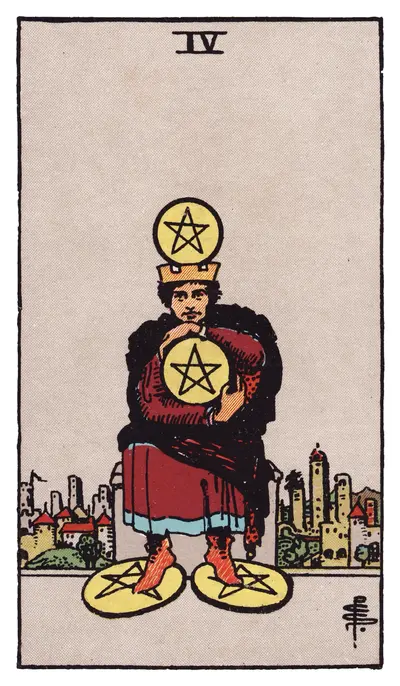
A seated figure clutches one pentacle to his chest, balances another on his head, and rests his feet on two more. A city sits behind him. Every pentacle is in contact with his body and none is in use. The Four of Pentacles is the card of holding on, and it is more interesting than its reputation because the holding is genuinely effective — nothing here is being lost, and the security is real rather than illusory. What it describes is a position that has been secured and is now being maintained at the cost of everything else, since a person in this posture cannot stand, work or reach for anything. When it arrives, the thing being asked about involves something the querent is keeping, and the question worth raising is what the keeping prevents. Four in the pips is stability, and in earth stability is the most natural thing the suit can do — which is precisely why this card can persist indefinitely without any external pressure to change.
Reversed meaning
Reversed, the grip changes. The commonest and most favourable reading is loosening — spending, giving, releasing something that was being held past its usefulness, which is the resolution the upright card most needs. A second reading runs the other way: loss, something taken or slipping, which the surrounding cards usually make clear. A third is worth knowing because it is frequently the true one: reversed, the card sometimes describes generosity that has become reckless, the grip released too completely. Where the reading concerns fear the first applies; where it concerns circumstance, the second.
What Sun in Capricorn contributes
The Sun in Capricorn is the winter solstice decan — the darkest point of the year, and the exact position where the Sun begins to return. That placement gives the card its double character. The Sun is authority and visibility, Capricorn is containment, and together they produce power that is real and entirely enclosed. It is also why the card is not simply about meanness. The solstice is a holding point rather than an ending: everything is being conserved because conserving is what the season is for. Reading the Four of Pentacles as miserliness misses that Capricorn holds things for a reason, and the reason is usually that they were hard to get.
What is on the card
The pentacle on his head is the detail that separates this from simple hoarding — it is balanced rather than held, which requires him to keep his head absolutely still. The two beneath his feet are being stood on, so he cannot move either. Only the one at his chest is actually embraced. He wears a crown and sits on a plain stone block with the city behind him at a distance, outside the walls of nothing in particular. His expression is not greedy; it is fixed. The whole posture is a set of constraints he has arranged around himself using the things he owns.
In a love reading
Emotional withholding more often than financial, and the card is usually describing someone protecting themselves rather than someone being ungenerous. It appears in questions about a partner who will not open up, and equally in questions where the querent is the one holding back. On questions about commitment it is ambiguous in a specific way: the security is genuine and it is also the reason nothing is moving. It also covers relationships organised around keeping things as they are, where any change is treated as a loss regardless of what it would bring. The card makes no judgement about whether that is wise.
In a career reading
Holding a position, a budget, a piece of territory or information. It is common in questions about a manager who will not delegate and about organisations that have stopped investing in anything. On questions about money it is frequently literal and, importantly, not a warning — the resources are secure. Its practical contribution is the posture: a person in this position cannot reach for anything, so on questions about opportunity the card says the obstacle is not availability but that both hands are already full. On questions about negotiation it indicates somebody who will not move first.
How this one is usually misread
The persistent error is reading this as greed, which Book T does not say and the image does not show. Earthly Power is a neutral title, the figure’s expression is fixed rather than avaricious, and the pentacles are held in a posture that costs him movement rather than one that gains him anything. Greed accumulates; this card conserves. The second misreading is financial by default. The Four of Pentacles is drawn at least as often about emotional holding, about control, and about a refusal to let a situation change, and reading it as money in a question about a relationship will produce an answer about the wrong resource entirely.
How it behaves beside other cards
With the Five of Pentacles the holding is a response to a remembered shortage rather than a present one, which is the most sympathetic reading the card gets. Beside the Six of Pentacles the grip is contrasted with circulation and the pair is a straightforward argument. With the Devil the holding becomes something the querent is bound to rather than choosing. Next to the Two of Wands both cards describe potential unspent, one in fire and one in earth. Its most constructive neighbour is the Ace of Cups, which asks something of the hands that are currently occupied. Beside the Hermit the holding turns out to be solitude rather than security. With the Ten of Pentacles the grip is protecting something that was inherited rather than earned, which is a different and often more rigid attachment. Next to the Star the grip relaxes because the fear behind it has gone rather than because anyone argued with it. Beside the Page of Pentacles somebody younger wants to be given something and is not going to be.
Why this card has a zodiac sign attached
The thirty-six numbered cards from Two to Ten are mapped one-to-one onto the thirty-six decans — the ten-degree slices the zodiac divides into. Four of Pentacles holds 290° to 300° of Capricorn, ruled by Sun in the Chaldean order. That is a lookup from a position on the ecliptic, not an association someone chose, which is why this page can print a degree range and a date range next to it.
Correspondences follow the Golden Dawn attributions set out in Book T. Degrees are computed from each card’s position in the decan sequence rather than transcribed, so they cannot drift from the spread tool on the rest of this site.
Cards next to this one
The rest of Capricorn
See this card come up in your own chart
The spread on our tarot astrology page reads your chart positions as cards — no shuffle, the same answer every time. The daily card does the same for the Moon’s decan right now.