Major Arcana · 21
The World
Upright meaning
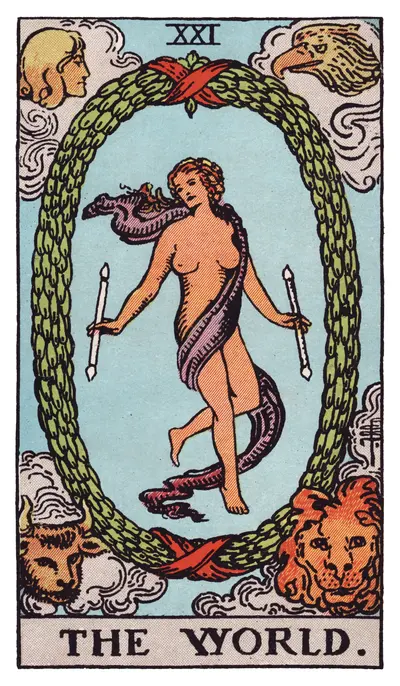
A figure dances inside a laurel wreath bound at top and bottom, holding a wand in each hand, a light scarf the only clothing. At the four corners are a man, an eagle, a lion and a bull, the same four as the Wheel of Fortune, here without books and without wings in motion. The World is completion — a cycle finished, fully, with nothing outstanding. What makes the card specific is that the four corner figures appear twice in the deck and only twice. On the Wheel they are reading while everything turns; here they are simply present, and the turning has stopped. When it arrives, something is genuinely done. It is numbered twenty-one and it is the last card of the sequence, which the deck then reopens at zero — the Fool and the World are the same wheel at opposite points, and a spread containing both is usually about which one the querent is at.
Reversed meaning
Reversed, the completion is withheld. The commonest reading is a cycle nearly closed — the last step outstanding, which is a specific and very recognisable frustration. A second is completion unacknowledged, where something has genuinely finished and neither the querent nor anybody else has marked it, and the card indicates the marking rather than the finishing. A third concerns closure sought from a situation that cannot provide it. A fourth is worth offering: a completion the querent is reluctant to accept because what follows it is unwritten, which the Fool at zero is the answer to and which querents at this point rarely find reassuring. A fifth possibility is the most administrative and the most common: everything finished except the paperwork, where the substantive cycle has genuinely closed and some formal step has not, and the querent cannot feel the completion until it does.
What Saturn contributes
Saturn is the outermost of the seven classical bodies, the slowest, and the one traditionally associated with limit — the boundary of the visible sky in the scheme this deck was built in. Handing it to the card of completion is exact rather than ironic. A thing is complete when it has reached its boundary, and Saturn is the boundary; there is no eighth planet in the classical arrangement and no twenty-second card in the sequence. It also explains why this card does not read as celebration despite the dancing figure. Saturn takes about twenty-nine years to circle the zodiac, so what it marks is not an achievement but the closing of something that took a long time. And the wreath is the attribution drawn: a closed shape, bound at both ends, with the figure inside it rather than crowned by it.
What is on the card
The wreath is an ellipse of laurel bound top and bottom with red ribbon in a figure-eight, the lemniscate appearing a third time in the Majors after the Magician and Strength. The figure holds a wand in each hand, mirroring the Magician’s single raised one — what was one becomes two at the end of the sequence. The scarf is the only garment. The four corner creatures are the fixed signs and the four evangelists, the same set as the Wheel, and here they are looking on rather than reading. The legs are crossed in the same figure-four as the Hanged Man’s. There is no landscape behind at all. The crossed legs make the same figure-four as the Hanged Man, and the two cards are the sequence’s furthest apart uses of one shape: one hangs in it, suspended and unable to act, and one dances in it, at the end of everything. Smith repeats very little, and repeating this is the clearest internal argument the Majors make.
In a love reading
A relationship arriving somewhere — a commitment fulfilled, a long process concluded, or the closing of something that ran its full course. It is among the most favourable cards on a relationship question and it is a card of arrival rather than of beginning, which matters when a querent is asking about somebody new. On questions about closure it is one of the few cards in the deck that genuinely offers it. Where a relationship is ending well rather than badly, this card describes that specifically, and the distinction is worth drawing because the deck has several cards for the other kind. Where a querent is asking about somebody new, this card is worth reading carefully rather than enthusiastically: it is the card of a cycle closing, so it describes the ending of what preceded the new thing at least as often as it describes the new thing itself.
In a career reading
A project completed, a qualification finished, a long-term goal reached. It is among the strongest cards for questions about whether something will conclude successfully and among the least informative about what comes next, which is the Fool’s office rather than this card’s. On questions about whether to close something out it is a plain yes. Its practical contribution is Saturn’s timescale: what this card marks took considerably longer than the querent is usually crediting, and saying so is frequently the most useful thing the reading does.
How this one is usually misread
The frequent error is reading the World as perfection or as a life permanently arranged. It marks the close of one cycle, and the deck reopens at zero immediately — the Fool follows it, which is the sequence’s own comment. Delivered as a final state the card promises something it explicitly contradicts. The second misreading is treating it as external recognition. **The wreath is a boundary rather than a crown**: the figure is inside it, not wearing it, and a completion can be entirely private. A third, and it is common: assuming the card means the querent has got what they wanted. A cycle completing and a wish being granted are different events, and the card is scrupulous about which one it depicts — Saturn closes things on their own terms rather than on anybody’s. A fourth, worth naming because it is the cheerful version of the second: treating the card as the deck telling somebody they have finished growing. The four corner creatures are looking on rather than applauding, and the sequence restarts at zero on the very next card.
How it behaves beside other cards
With the Fool the wheel is shown at both ends, and the spread is almost always about which point the querent is standing at. Beside the Wheel of Fortune the four corner figures appear twice in one reading, which is the deck’s most visible internal echo. With the Ten of Pentacles the completion is material and generational. Next to Death a full completion and an unnegotiated ending sit side by side, and the difference between them is usually the whole reading. Its most useful partner is any Ace, where what has closed is immediately followed by what opens. Beside the Eight of Cups the completion is of something somebody walked away from, which is a genuine closing and rarely recognised as one.
Why this card has a planet or sign attached
The twenty-two Major Arcana carry the seven classical planets, the twelve signs and three of the four elements between them — one each, with nothing left over. The World takes Saturn. The allocation is the Golden Dawn’s and it is structural rather than poetic: it is what lets a card be looked up from a chart instead of chosen from a shuffle.
Correspondences follow the Golden Dawn attributions set out in Book T. Degrees are computed from each card’s position in the decan sequence rather than transcribed, so they cannot drift from the spread tool on the rest of this site.
Cards next to this one
See this card come up in your own chart
The spread on our tarot astrology page reads your chart positions as cards — no shuffle, the same answer every time. The daily card does the same for the Moon’s decan right now.