Minor Arcana · Wands · fire
Ace of Wands
The Book T title
Book T calls each Ace the Root of the Powers of its element, and for fire that is the most literal naming in the deck: this is the root of everything the suit goes on to do. An Ace is not the first card in a sequence so much as the source the sequence draws on, which is why it has no decan and no degrees. Every other Wands card occupies ten degrees of the zodiac; this one occupies none, because it is what those thirty-six degrees of fire are made of.
Upright meaning
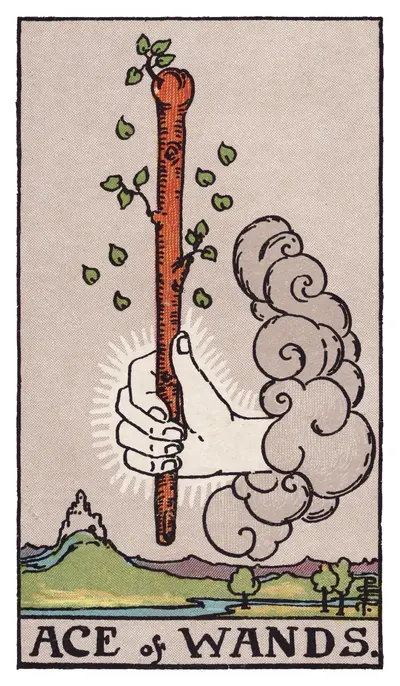
A hand emerges from a cloud holding a budding staff, with leaves falling from it and a castle on a distant hill. Nothing is being done with it yet. The Ace of Wands is potential in its purest available form — an impulse, an opportunity, a spark that has arrived and has not been applied to anything. What distinguishes it from the Two of Wands, which is the very next card and looks superficially similar, is that the Two involves a person holding something and this one involves an offer. The hand is not the querent’s. When it arrives, something has become available: an idea, an invitation, a sudden appetite for a thing that was not on the table last week. The card says nothing whatever about whether it will be taken, and that silence is deliberate. An Ace is the moment before the story, and every reading that turns it into an outcome has skipped the part the card is about. It is worth seeing the four Aces as a set, because they are the only cards in the deck that share a grammar: a hand emerging from a cloud, a single emblem, and no figure anywhere in the frame. Nobody has accepted anything on any of them. That shared composition is the tradition stating something structural — an Ace is not a card about a person, which is why it cannot describe what someone will do with what is being offered. Of the four, this one is the most kinetic: the staff is budding and shedding leaves, so the offer is already in the process of changing while it is held out, and the fire suit’s whole character is that its opportunities do not wait.
Reversed meaning
Reversed, the spark fails to catch. The commonest reading is an opportunity not taken — the hand withdrawn, the impulse not acted on, which is the natural failure of an offer. A second is a false start: energy that arrived and went nowhere, which is different and usually less painful. A third concerns timing, where the reversal indicates something arriving before there is any capacity to use it. Reversed Aces are rarely disasters; they describe a beginning that did not begin, and the appropriate reading is generally more wistful than severe.
The root of Fire
Fire is the element of will, appetite and initiation, and the Ace is its undiluted form — not applied to a project, a person or a plan, simply the capacity to want something and move toward it. That is why the card is drawn as a single living branch rather than as a finished tool. In the Golden Dawn scheme each Ace also governs a quadrant of the heavens rather than a sign, which is the technical reason it cannot be resolved from a chart position: a planet at 14° Leo is somewhere specific, and the root of fire is everywhere the fire signs are.
What is on the card
The staff is budding — small leaves are visible along it — so what is being offered is alive rather than manufactured. Eight leaves fall away from it, loose in the air, which is the detail most often read as potential being shed unused. The hand comes from a cloud on the left, the direction the deck consistently uses for things arriving from outside the querent. A castle sits on a rise in the far distance with a river below it, and the landscape between is empty. The staff is held upright and firmly, fingers wrapped around it, ready to be passed rather than planted.
In a love reading
Attraction arriving, usually suddenly and usually before anything has been done about it. It is among the clearest cards for the beginning of something, and it is entirely silent about where it goes. On questions about whether there is interest it is favourable; on questions about whether a relationship will develop it has nothing to offer, because the card depicts a moment that precedes all of that. It also appears in established relationships to describe renewed appetite after a flat stretch, which is one of the more welcome things it can mean.
In a career reading
A new opportunity, an idea worth pursuing, the beginning of something with energy behind it. It reads well on questions about whether to start and badly on questions about whether to persist, since nothing in it has been sustained yet. On questions about creative work it is one of the strongest cards in the deck. Its practical contribution is that the staff is being offered rather than held: somebody or something outside the querent has made this available, and the card is quite specific that it will not stay in the air indefinitely.
How this one is usually misread
The frequent error is reading an Ace as a guaranteed outcome — new job, new relationship, new venture, all settled. An Ace is an offer, and the deck has thirty-five other Minor cards for what happens next. Delivered as a promise it makes a prediction the card structurally cannot make. The second misreading is treating it as the querent’s own initiative. The hand comes out of a cloud; the impulse has arrived rather than been generated, which is why the useful question after drawing it is what has recently become available rather than what should be started.
How it behaves beside other cards
With the Two of Wands the offer has been taken and is being surveyed, which is the natural sequence. Beside the Eight of Wands it is acted on immediately. With the Four of Cups the offered staff is the cup being declined, and the pair is one of the clearest statements the deck makes about an opportunity going unnoticed. Next to the Ten of Wands the new thing is arriving to somebody already fully loaded. Its most decisive neighbour is the Chariot, which supplies the will to convert an offer into a direction. Beside the Page of Wands the offer has found somebody eager enough to take it without weighing it. With the Seven of Pentacles the spark arrives during a wait and is a distraction rather than a direction. Next to the Ace of Pentacles the same opportunity exists in two registers at once, energy and substance, which is the most complete beginning the deck can show. With the Hermit the spark arrives during a withdrawal and has to wait.
Why this card has no degrees
The four Aces are the root of their element rather than a place in the zodiac. Ace of Wands is the root of Fire. A card with no span cannot be drawn from a chart position, which is exactly why the spread tool never returns one.
Correspondences follow the Golden Dawn attributions set out in Book T. Degrees are computed from each card’s position in the decan sequence rather than transcribed, so they cannot drift from the spread tool on the rest of this site.
Cards next to this one
See this card come up in your own chart
The spread on our tarot astrology page reads your chart positions as cards — no shuffle, the same answer every time. The daily card does the same for the Moon’s decan right now.