Major Arcana · 20
Judgement
Upright meaning
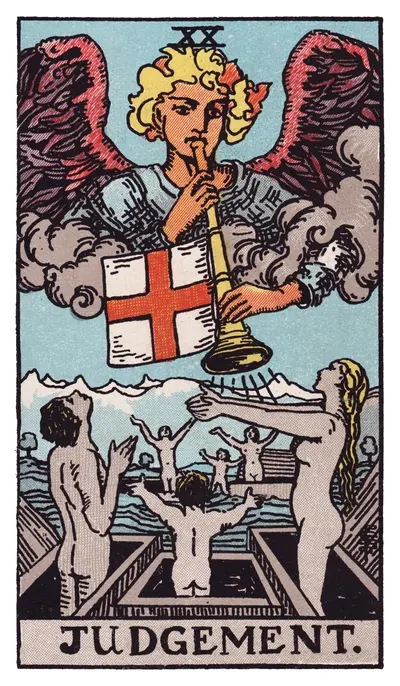
An angel blows a trumpet from the clouds, a square banner with a cross hanging from it. Below, grey figures rise from open coffins on a grey sea, arms raised, faces turned up. In the foreground a man, a woman and a child stand together. Judgement is a reckoning that arrives from outside — a call, a summons, a moment at which something long settled is reopened and has to be answered. What makes the card specific is that everybody in it is rising. Nothing in the picture is being sorted or condemned; the whole crowd is coming up, arms open, with no division drawn between them. It is numbered twenty, the last card before the World, and what it does is gather: the sequence spends twenty cards on the experience and this is where the account of it is called for.
Reversed meaning
Reversed, the call goes unanswered. The commonest reading is a summons ignored — something the querent knows they are being asked to face, which the card names without specifying. A second is self-judgement, where the reckoning has become a verdict the querent passes on themselves repeatedly and never concludes. A third concerns a decision under appeal, something reopened that would have been better left. A fourth: the call missed rather than refused, where the moment came and was not recognised, and which surrounding cards of distraction or confusion usually confirm. The first is the reading most often correct and the one querents most often already know. A fifth is worth having ready for spreads about family or long-standing disputes: a reckoning being demanded by somebody else on terms the querent did not agree to, which is a summons and is not the impartial one the upright card describes.
What Fire contributes
Fire is the third of the three elements to reach the Majors, and Judgement takes it — the element that transforms what it touches rather than moving it or dissolving it. That is the attribution doing the work the trumpet only illustrates. Fire is also the classical element of spirit in the scheme, which is why this card is a summons rather than an assessment: something is being called up, not weighed. The distinction matters because the card is constantly confused with Justice, eleven, which has the scales and is cardinal air. Justice measures a matter against a standard. Judgement calls a person to account for a life, which no balance can do, and the choice of an element rather than a sign or a planet is the scheme saying that what this card describes has no single position in the wheel.
What is on the card
The banner is square and carries a cross of five equal squares, the same proportion as the square on the Chariot’s breastplate. The coffins float on a flat grey sea and are open from beneath. All three foreground figures have their backs to the viewer and their arms raised, so nobody in the picture is looking out. Snow-capped mountains stand at the far horizon, the same range that appears behind the Fool and the Lovers. The angel’s trumpet has seven lines coming from it. Everything below the clouds is drawn in grey, and the only colour in the lower half is the banner. The three foreground figures all have their backs to the viewer, which is unusual enough to be worth naming: on a card about being called to account, the deck declines to show any of the faces. Whatever is being answered for is between each figure and the trumpet, and the reader is positioned behind them rather than among the judges.
In a love reading
A reckoning in a relationship — a conversation that has been coming, a reconnection, a past attachment resurfacing. It is among the more literal cards for questions about someone returning, and the return in it is of something rather than the promise of a good outcome. On questions about whether to raise something long left, it is a clear argument for doing so. Where a querent is waiting to be forgiven or to forgive, the card describes the moment at which the matter is opened, and it is honest that what follows opening it is not in the picture. On questions about a reconciliation, the card describes the moment of opening rather than the outcome, and the honest delivery keeps those apart — a conversation being had is what this picture shows, and every figure in it is rising rather than being sorted.
In a career reading
A call to something, a decision about a direction, or an assessment of work done over a long period. It is among the better cards for questions about vocation in the strict sense — being summoned to a thing rather than choosing it — and for questions about whether a past piece of work is about to matter again. On questions about a formal review it is less apt than Justice, and saying which of the two the situation is usually clarifies more than the reading does. It is also the card for work that is being reassessed after a long time — an old project reopened, a decision revisited, a reputation catching up with something. On questions about whether something long past is about to matter again, it is among the few cards in the deck that says yes directly.
How this one is usually misread
The persistent error is reading the card as condemnation, which the name and the Christian imagery make almost automatic. **Every figure in the picture is rising and none is being separated from the others**, which is precisely the detail the tradition preserved and the popular reading discards. Delivered as a verdict the card frightens and misinforms. The second misreading is confusing it with Justice. One weighs a matter and one calls a person, and a querent asking about a contract needs the first while a querent asking about a direction needs the second. A third: treating the call as optional. The card gives no indication that the trumpet can be declined — the reversed reading covers ignoring it, and ignoring a thing is not the same as its not having happened. A fourth is smaller and worth naming: reading the trumpet as good or bad news. The card shows a call, and the content of what is being answered for is nowhere in the picture — a reading that supplies the verdict has done the same thing as a reading that supplies a fall on the Fool.
How it behaves beside other cards
With the World the sequence reaches its end and the reckoning is followed by a completion. Beside Death an ending and a summons sit together, and the order between them is usually the reading. With the Six of Cups something genuinely from the past is returning rather than being remembered. Next to the Eight of Cups somebody is being called in the direction they were already walking. Its most testing neighbour is Justice, where the two cards readers confuse appear in one spread and the useful work is telling the querent which of them their situation actually is. Beside the Three of Swords the summons and the grief arrive together. With the Ace of Cups the reckoning turns out to open something rather than close it, which is the kinder of the two directions this card runs in.
Why this card has a planet or sign attached
The twenty-two Major Arcana carry the seven classical planets, the twelve signs and three of the four elements between them — one each, with nothing left over. Judgement takes Fire. The allocation is the Golden Dawn’s and it is structural rather than poetic: it is what lets a card be looked up from a chart instead of chosen from a shuffle.
Correspondences follow the Golden Dawn attributions set out in Book T. Degrees are computed from each card’s position in the decan sequence rather than transcribed, so they cannot drift from the spread tool on the rest of this site.
Cards next to this one
See this card come up in your own chart
The spread on our tarot astrology page reads your chart positions as cards — no shuffle, the same answer every time. The daily card does the same for the Moon’s decan right now.