Major Arcana · 19
The Sun
Upright meaning
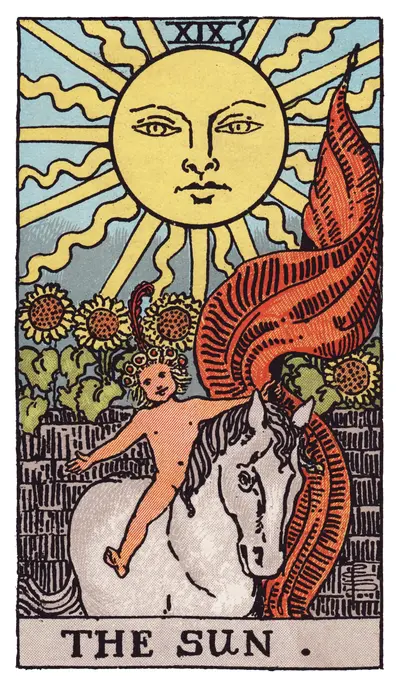
A naked child rides a white horse out from behind a garden wall, holding a large orange banner, with four sunflowers turned over the bricks and an enormous sun overhead with a human face and alternating straight and wavy rays. The Sun is clarity and vitality — things going well, visibly, with nothing hidden. What makes the card specific is the wall. The child has come out from behind it, so the picture is not of a garden but of leaving one, and the sunflowers are on the far side facing the way the child has gone. When it arrives, the matter is straightforward in a way the querent may not have believed it could be. It is numbered nineteen, immediately after the Moon, and the pair is the deck at its most schematic: reflected light and then direct, uncertainty and then the removal of it. The card is the most unambiguously favourable in the deck and the reason is structural rather than cheerful — there is nothing in the frame that is obscured.
Reversed meaning
Reversed, the clarity dims without going out. The commonest reading is a delay rather than a denial — the good outcome still coming, more slowly, which is one of the gentler reversals in the deck. A second is optimism overdone, where somebody is reading a situation more favourably than it supports. A third concerns visibility: success that is real and not being seen, which on career questions is frequent and worth naming. A fourth, quieter and often accurate for querents who have had a hard stretch, is difficulty enjoying something that is genuinely going well, which the surrounding cards usually show and which is not the same as the good thing being false. A fifth reading, and the one that comes up most often in practice: a good result arriving at a time when the querent has no capacity to meet it, which is not the result being false and is a real reason people report this card landing badly.
What Sun contributes
The Sun is the only Major that takes the body it is named after, and the correspondence is the least mysterious in the scheme — which is itself the point. Every other attribution requires an argument; this one requires none, and a card about things being plainly what they are gets the one assignment nobody has to explain. The useful part is what the classical Sun actually governs: not luck but vitality and visibility, the principle of being the source rather than the reflector. That distinction is what pairs it with the Moon at eighteen, and it is why the card reads as energy rather than as good fortune. The Wheel is fortune. This is the card for a thing that is working because the conditions for it are present, which is why nothing in the picture is being hoped for.
What is on the card
The rays alternate straight and wavy, twenty-one in all, and the sun carries a human face looking directly out — the only celestial body in the deck drawn full-face rather than in profile, which the Moon three cards earlier is not. Four sunflowers rise above the wall, turned toward the child rather than toward the sun. The horse is white and unsaddled and the child rides bareback without reins, a detail worth holding against the Chariot’s reinless sphinxes. The banner is orange and streams backward. The wall is grey brick and complete, and the ground on the near side is bare. The four sunflowers are turned toward the child rather than toward the sun, which is botanically wrong and deliberately so — Smith has the flowers following the figure. On a card about a source of light, the one detail that could have been ordinary is arranged to point at the person instead.
In a love reading
Happiness, openness, and a relationship in which things are what they appear to be. It is the most favourable card in the deck on a relationship question and it is worth being specific about why: the card describes a situation with nothing concealed, which is rarer and more valuable than a card describing passion. On questions about whether something will work out it is as close to a yes as the deck offers. On questions asked during a difficult stretch, the fourth reversed reading is the one to hold — a querent who cannot feel a good thing is in a different situation from one who does not have it. On questions about whether to be open about something, this card is among the deck’s clearest affirmatives, and the reason is in the picture rather than in optimism: everything in the frame is lit and nothing is concealed, so the card is describing a set of conditions in which openness costs nothing.
In a career reading
Success, recognition, work going well and being seen to. It is among the strongest cards for questions about outcomes and about visibility, which are separable and which this card covers together. On questions about a creative project it is close to ideal. Its practical contribution is the wall: the child has left an enclosure, so whatever is going well here involved coming out from behind something, and asking a querent what the wall was usually produces the most useful sentence in the reading. Where a querent is asking whether to put something in front of other people, this card is the deck’s plainest yes, and the sunflowers turning toward the child rather than toward the sky are the reason: on this card attention follows the person.
How this one is usually misread
The frequent error is reading the card as childishness or naivety, which the naked child invites and the picture does not support — this figure is riding out in full daylight with a banner, which is not innocence but confidence. Delivered as naive the card acquires a caution it does not contain. The second misreading is treating it as a guarantee, which is the opposite error and the more consequential. **The card describes present conditions, not a permanent state**, and a reading that promises everything will be fine indefinitely has extended it past what any card can carry. A third: assuming it cancels the rest of the spread. The Sun is favourable and it sits beside whatever else was drawn; a spread with the Sun and the Five of Pentacles in it is describing something specific, and letting the bright card erase the other is the commonest way this one gets misread by people who like it.
How it behaves beside other cards
With the Moon the sequence reads in order and the pair is the deck’s clearest before-and-after. Beside the Ten of Cups the happiness is domestic and shared. With the Four of Wands the clarity has an occasion attached. Next to the Tower the Sun arrives either just before or just after, and which one it is changes the whole reading — the surrounding cards usually say. Its most instructive neighbour is the Five of Pentacles, where genuine good fortune and genuine exclusion sit in the same spread and the honest reading refuses to let either cancel the other. Beside the Six of Cups the clarity attaches to something from a long way back. With the Knight of Wands the energy in both cards compounds, which is the most straightforwardly favourable pairing in the deck and one of the least careful.
Why this card has a planet or sign attached
The twenty-two Major Arcana carry the seven classical planets, the twelve signs and three of the four elements between them — one each, with nothing left over. The Sun takes Sun. The allocation is the Golden Dawn’s and it is structural rather than poetic: it is what lets a card be looked up from a chart instead of chosen from a shuffle.
Correspondences follow the Golden Dawn attributions set out in Book T. Degrees are computed from each card’s position in the decan sequence rather than transcribed, so they cannot drift from the spread tool on the rest of this site.
Cards next to this one
See this card come up in your own chart
The spread on our tarot astrology page reads your chart positions as cards — no shuffle, the same answer every time. The daily card does the same for the Moon’s decan right now.