Major Arcana · 18
The Moon
Upright meaning
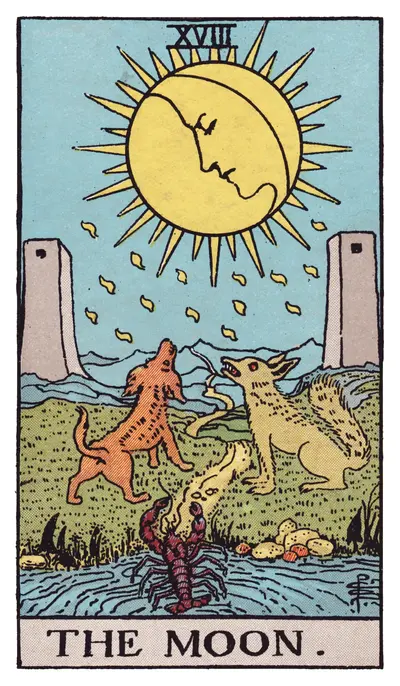
A path runs from a pool into the distance between two towers. A dog and a wolf howl at a moon that carries a face in profile inside a full disc, and drops of light fall from it. A crayfish climbs out of the water onto the path. The Moon is uncertainty — a situation in which what is being perceived cannot be relied on, not because anybody is lying but because the light is wrong. What makes the card specific is the path. It exists, it is unobstructed, and it goes somewhere; the difficulty is entirely about visibility rather than about obstacle. When it arrives, the querent is working from an incomplete picture and does not yet know which part is missing. It is numbered eighteen, between the Star and the Sun, and the sequence is exact: this is the night between a restoration and a daylight, not a disaster and not an ending. Every other card in the deck that describes not knowing describes a decision or a secret; this one describes conditions.
Reversed meaning
Reversed, the uncertainty resolves or intensifies. The commonest reading is clarity returning — confusion lifting, a misunderstanding cleared, which is favourable and frequently undramatic. A second is the opposite: fear taking over entirely, where the querent has stopped distinguishing what they know from what they have imagined. A third concerns deception by somebody rather than by conditions, which the upright card deliberately does not claim and which the reversal can. A fourth is worth offering because querents rarely raise it: something sensed and dismissed, where the card indicates a perception that was accurate and got argued away. Where the spread otherwise concerns other people the third applies; where it concerns the querent alone, the second and fourth.
What Pisces contributes
Pisces is mutable water, the last sign of the zodiac and the one with the least definite edges, and the attribution accounts for the card more precisely than the Moon in the title does. Pisces dissolves boundaries — between one thing and another, between what is observed and what is supplied — and that is exactly the condition the picture shows. The dog and the wolf are the same animal at two degrees of domestication and the card declines to separate them; the crayfish is climbing out of water onto land at the point where the two meet. Mutability is why the state is temporary rather than a verdict. And the water half explains why the card cannot be argued with: this is not a misunderstanding that better reasoning would fix, it is a period during which the available light is reflected rather than direct, and the only response the picture offers is the path.
What is on the card
The moon is drawn as a crescent with a face in profile set inside a full disc, so both phases are present at once — the same doubling as the High Priestess, whose crown and footstool carry the two. Fifteen drops of light fall from it, shaped like the Hebrew letter yod, the same device Smith uses on the Tower. The two towers are the gateway drawn on Death, and the sun that rose between them there is absent here. A dog and a wolf face each other across the path, howling. The crayfish is half out of the pool. Nothing in the picture is threatening anybody and nothing is clearly lit. The dog and the wolf are the detail most worth sitting with: they are the same animal at two distances from domestication, drawn facing each other across the path, and the card makes no attempt to say which is which by posture or position. On a card about not being able to tell things apart, the two figures a reader most wants distinguished are the two the picture refuses to separate.
In a love reading
Confusion, mixed signals, or a situation in which the querent cannot tell what is happening. It is among the least comfortable cards on a relationship question and among the most honest about a common state. On questions about whether somebody is being straight with them, it is a genuine refusal: the card says the conditions are poor for reading the situation and declines to convict anybody, and the reversed third reading is where an accusation becomes available. Where a querent has a suspicion they keep dismissing, the fourth reversed reading is worth raising, because this card describes the exact circumstances in which a real perception gets talked away.
In a career reading
A situation with information missing, a role whose terms are unclear, or a decision being made on an account that does not fit. It is among the better cards for questions about whether the querent has the full picture — the answer is no — and among the least useful for questions about what to do, since the whole content of the card is that the conditions are poor. On questions about whether to commit to something now it argues for waiting, and the argument is in the picture rather than in caution: the path is fine and the light is not, and light changes on its own. On questions where a querent has been handed conflicting accounts by two people, this card is unusually precise about the situation and unusually unhelpful about the resolution: it says both accounts are being read in poor light, which is not a verdict on either and is frequently the most accurate thing available.
How this one is usually misread
The persistent error is reading the Moon as deception by a person. The card describes conditions, not conduct, and there is nobody in the picture at all — a reading that produces a liar has supplied one, which is the same invention this cluster refuses everywhere else. The second misreading is treating it as a warning not to proceed. **The path is drawn clear and unobstructed**, running between the towers to the horizon; what the card withholds is visibility, not permission. A third, and it is the commonest among readers who have learned the card properly: reading it as the unconscious and stopping there. The psychological gloss is useful and it is a gloss. What the picture actually shows is a person working from reflected light, which is as true of a badly documented handover at work as of anything interior.
How it behaves beside other cards
With the Star the sequence reads in order and the night follows the repair. Beside the Sun the pair is the deck’s cleanest statement about light: eighteen and nineteen, reflected and direct, and drawn together the reading is usually about how long the querent has to wait. With the High Priestess two kinds of not-knowing sit together — one where the answer exists and cannot be said, one where it cannot yet be seen — and distinguishing them is the whole spread. Next to the Seven of Swords the uncertainty acquires somebody acting inside it. Its most useful partner is the Eight of Cups, where somebody sets off down exactly this path in exactly this light. Beside the Two of Swords the querent is refusing to look at something they could not see clearly anyway, which is a distinction worth drawing carefully because the two states call for opposite advice.
Why this card has a planet or sign attached
The twenty-two Major Arcana carry the seven classical planets, the twelve signs and three of the four elements between them — one each, with nothing left over. The Moon takes Pisces. The allocation is the Golden Dawn’s and it is structural rather than poetic: it is what lets a card be looked up from a chart instead of chosen from a shuffle.
Correspondences follow the Golden Dawn attributions set out in Book T. Degrees are computed from each card’s position in the decan sequence rather than transcribed, so they cannot drift from the spread tool on the rest of this site.
Cards next to this one
See this card come up in your own chart
The spread on our tarot astrology page reads your chart positions as cards — no shuffle, the same answer every time. The daily card does the same for the Moon’s decan right now.