Major Arcana · 1
The Magician
Upright meaning
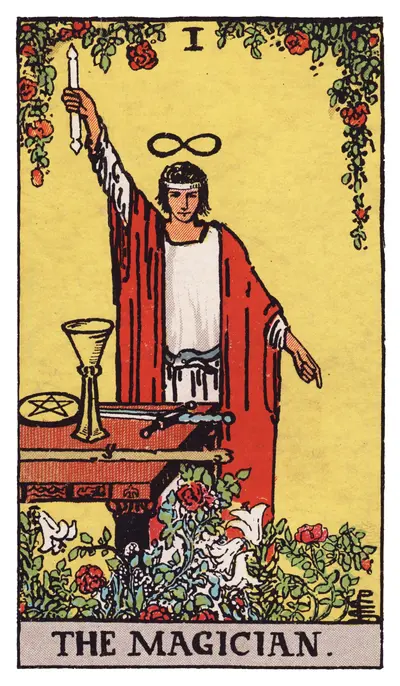
A figure stands behind a table bearing a cup, a coin, a sword and a wand — one emblem from each suit — with one arm raised holding a wand aloft and the other pointing at the ground. Roses and lilies grow around him. The Magician is capability: the moment at which the means to do a thing are all present and the doing has not started. What makes him specific rather than generic is the table. Every tool of the deck is laid out and none of them is being used yet, so the card is not about talent in the abstract but about resources actually to hand. When it arrives, the querent has what the situation requires, which is frequently news to them. Its correspondence with Mercury is doing real work: this is the planet of transmission, and the card’s claim is not that the figure creates anything but that he channels — the raised hand and the lowered hand are one gesture, not two.
Reversed meaning
Reversed, the channel is blocked or misused. The commonest reading is capability unapplied — the tools on the table and nobody at it, which on a practical question usually means a plan that has not been started rather than one that has failed. A second is manipulation, and the tradition is old and specific about this: a figure this skilled at transmission can transmit something untrue as easily as something true, and the reversed Magician is the deck’s clearest indicator of a persuasive account that does not hold up. A third concerns self-deception, which is the same failure turned inward. Where the reading involves somebody else the second is worth weighing; where it involves only the querent, the first and third. There is a fourth reading the tradition supplies and modern decks tend to drop: the Magician reversed as somebody with real skill applying it to something far below what it is for, which is a waste rather than a fraud and reads quite differently in a spread.
What Mercury contributes
Mercury is the planet of transmission — messages, trade, language, anything that moves between one place and another without being consumed in the journey — and the Magician is the card where the whole Minor Arcana sits on a table waiting to be used. The connection is the table, not the man. Mercury does not own what it carries; it conducts, which is exactly what the raised hand and the lowered hand depict as a single circuit rather than two gestures. It is also why this card is not about willpower however often it is read that way: a conductor exerts nothing. The attribution carries the card’s risk with it, and the tradition has always known this. Mercury rules the honest messenger and the persuasive liar with the same indifference, because both are transmission — which is why the reversed Magician is the deck’s clearest sign of an account that is fluent and does not hold up, and why fluency on this card is never evidence of content.
What is on the card
The lemniscate — the sideways figure of eight — floats above his head, and it is the same symbol that appears over the Strength card and nowhere else in the Majors. The belt is a serpent swallowing its own tail. The raised hand holds a wand and the lowered one points at the earth, the gesture usually glossed as "as above, so below", which is the Hermetic formula the whole card is built on. Four emblems sit on the table, one per suit, so the entire Minor Arcana is present in miniature. Roses and lilies frame the frame — desire and purity, the pair Smith uses whenever a card is about the union of two things. His robe is white beneath and red above. The lemniscate over his head is the detail that connects him to Strength, the only other Major carrying it, and the two cards are the deck’s pair about applying power — one through skill and one through patience. Nothing else in the twenty-two wears it.
In a love reading
Somebody who knows exactly what they are doing, which is favourable or alarming depending on what else is in the spread. On questions about whether an attraction can be acted on, it is a clear affirmative: the means are there. On questions about somebody’s sincerity it is the least conclusive court-free card in the deck, because skill at communication says nothing about the content being communicated — and this is the one place where the reversed reading of manipulation deserves to be held in mind even upright. Where a querent is wondering whether to make the first approach, the card is a straightforward yes and says the approach will land.
In a career reading
Resources present, skills adequate, the project doable. It is among the strongest cards for questions about whether the querent is equipped for something, and it is quiet on the question of whether they will actually do it — the table is laid and nothing is in motion. On questions about communication, negotiation, writing, teaching or sales it is close to literal, given the Mercury correspondence. On questions about whether to start now, the four emblems argue yes: the card’s whole content is that nothing further is needed. It is also the card for anybody whose work is to make one thing intelligible to somebody else, which under a Mercury attribution is not a stretch but the literal reading.
How this one is usually misread
The frequent error is reading this as a card about willpower, which imports a Victorian gloss the picture does not carry. The Magician is not exerting; he is conducting, and the two raised and lowered hands are a circuit rather than a strain. Read as force, the card stops explaining why the four suit emblems are on the table at all. The second misreading is treating it as a guarantee of success. **Having the means is not the same as the outcome**, and every tool in the image is untouched — a reading that promises the result has read the table as a report rather than an inventory.
How it behaves beside other cards
With the High Priestess the pair makes the deck’s cleanest contrast: one knows and does not say, the other says and may not know. Beside the Ace of Wands the capability meets a specific opportunity. With the Seven of Cups the means are real and the goal is not yet chosen, which is a very common and very stuck combination. Next to the Devil the skill at transmission acquires a use nobody should want. Its most practical neighbour is the Eight of Pentacles, where the tools stop being displayed and start being used. Beside the Three of Pentacles the capability acquires a commission and other people. With the Two of Wands the means are in hand and the direction is being chosen, which is the pairing closest to an ordinary planning problem.
Why this card has a planet or sign attached
The twenty-two Major Arcana carry the seven classical planets, the twelve signs and three of the four elements between them — one each, with nothing left over. The Magician takes Mercury. The allocation is the Golden Dawn’s and it is structural rather than poetic: it is what lets a card be looked up from a chart instead of chosen from a shuffle.
Correspondences follow the Golden Dawn attributions set out in Book T. Degrees are computed from each card’s position in the decan sequence rather than transcribed, so they cannot drift from the spread tool on the rest of this site.
Cards next to this one
See this card come up in your own chart
The spread on our tarot astrology page reads your chart positions as cards — no shuffle, the same answer every time. The daily card does the same for the Moon’s decan right now.