Major Arcana · 2
The High Priestess
Upright meaning
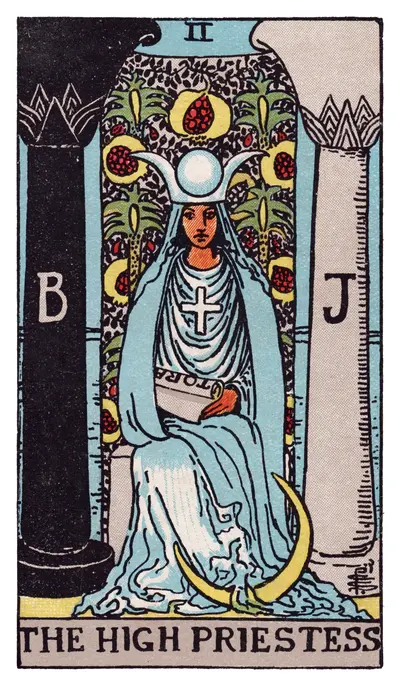
A woman sits between two pillars, one black and one white, with a veil stretched behind her and a crescent moon at her feet. A scroll marked TORA rests half-hidden in her lap. The High Priestess is knowledge that is present and not being handed over — not secrecy in the sense of something withheld out of malice, but understanding that cannot be transmitted by being stated. What makes the card specific is the veil. It is patterned with pomegranates and it is *behind* her, so she is not concealing anything; she is sitting in front of the thing that conceals, which is a different posture entirely. When she arrives, the answer to the question exists and is not currently available in words. The Moon correspondence is exact and unusually literal: this is the body that governs cycles, reflection and what is visible only at certain times, and every one of those is in the picture. She is numbered two, and the position is part of the argument. One is the Magician, who states things; two is the first card that cannot be reduced to a single figure acting, and she sits between two pillars rather than behind a table. The deck has put speech and silence adjacent and in that order.
Reversed meaning
Reversed, the relationship to the hidden goes wrong. The commonest reading is intuition ignored — the querent has already understood something and is proceeding as though they have not, which is the specific failure this card describes. A second is the opposite: secrecy that has stopped serving anything, information withheld past the point where withholding it was protective. A third concerns surfaces, where the reversal describes taking a situation at the level it presents itself and being wrong about it. Where the spread otherwise concerns other people the second applies; where it concerns the querent alone, the first is usually the reading and usually unwelcome. A fourth possibility is worth holding for spreads about other people: the card reversed can describe somebody who has been told something in confidence and is carrying the weight of not repeating it, which looks like withholding from the outside and is not.
What Moon contributes
The Moon is the only body in the sky that visibly changes shape, and it is the one that shows a different amount of itself depending on when you look. Both facts are in the picture: a crescent lies at her feet and a full lunar crown sits on her head, the same body at two phases in one frame. That is the attribution doing real work rather than decorating — a card about knowledge that is present and not currently available in words needs a correspondence that is *periodically* visible rather than hidden outright, and no other body in the scheme behaves that way. The Moon also reflects rather than emits, which is why this figure is stationed in front of a veil instead of behind it. She is not the source of what is concealed. She sits at the threshold of it, showing as much as the phase allows, and the amount is not hers to choose.
What is on the card
The two pillars are Boaz and Jachin, the ones that stood at the entrance to Solomon’s temple, and she is seated exactly between them — a threshold rather than a destination. The veil behind her carries pomegranates, the fruit that took Persephone into the underworld for a third of every year. The scroll is partly covered by her robe, so the text is present and unreadable. A crescent moon lies at her feet and a full lunar crown sits on her head, the same body at two phases in one frame. Her robe falls into water at the base of the card. There is no landscape: everything here is interior. Her robe falls away into water at the base of the frame, so the boundary between the figure and what is beneath her cannot be drawn — the same device Smith uses on the Queen of Cups, whose robe runs into the sea beside her throne.
In a love reading
Something not being said, which may be the most important fact in the reading or the least dramatic one. It frequently indicates a situation where the querent already knows the answer and wants the deck to say it instead. On questions about somebody else’s feelings it is genuinely unhelpful in a useful way: it says the feelings exist and are not being shown, and declines to report them. On questions about whether to wait, it is a yes of a particular kind — not "wait and it will come" but "this is not at the stage where it can be spoken about." Where a querent suspects something, this card usually confirms the suspicion is worth taking seriously without confirming its content.
In a career reading
Information that is not public, a situation being read rather than discussed, or a decision that should not be made on the available account. It is among the better cards for questions about whether there is more going on than the querent has been told. On questions about whether to speak up it is a caution rather than a refusal — the card’s position is that not everything gains by being stated immediately. On straightforward questions about advancement it is quiet, since nothing in this figure is pushing at anything. Where a querent has been handed a clean account of a messy situation, this card is usually indicating that the account is the part to examine rather than the situation.
How this one is usually misread
The persistent error is reading her as passive because she is seated and silent. She is stationed — between two pillars, at the entrance to something — and a guard at a threshold is not inactive. Delivered as passivity the card becomes advice to do nothing, which is not what it says. The second misreading is the psychic one, which this cluster refuses everywhere it appears. **Intuition here means having noticed something you cannot yet articulate**, a real and ordinary faculty; delivered as foreknowledge it turns a card about the limits of stating things into a claim about powers, and the difference matters because the first is checkable against the querent’s own experience and the second is not.
How it behaves beside other cards
With the Magician the pair is the deck’s cleanest opposition and usually the reading itself. Beside the Moon the unstated becomes genuinely uncertain rather than merely unspoken, which is a real downgrade. With the Three of Swords she is the person who knew. Next to the Two of Swords the refusal to look and the inability to say sit together, and the spread is usually about which one the querent is doing. Its most revealing neighbour is the Queen of Swords, where the same accuracy exists and is entirely willing to speak. Beside the Seven of Swords something is being kept from the querent rather than merely unspoken, and the difference between those two is the reading. With the Ace of Cups the unstated is a feeling rather than a fact. Beside the Eight of Cups somebody is leaving on the strength of something they have understood and cannot yet explain, which is this card supplying the reason for that one.
Why this card has a planet or sign attached
The twenty-two Major Arcana carry the seven classical planets, the twelve signs and three of the four elements between them — one each, with nothing left over. The High Priestess takes Moon. The allocation is the Golden Dawn’s and it is structural rather than poetic: it is what lets a card be looked up from a chart instead of chosen from a shuffle.
Correspondences follow the Golden Dawn attributions set out in Book T. Degrees are computed from each card’s position in the decan sequence rather than transcribed, so they cannot drift from the spread tool on the rest of this site.
Cards next to this one
See this card come up in your own chart
The spread on our tarot astrology page reads your chart positions as cards — no shuffle, the same answer every time. The daily card does the same for the Moon’s decan right now.