Major Arcana · 0
The Fool
Upright meaning
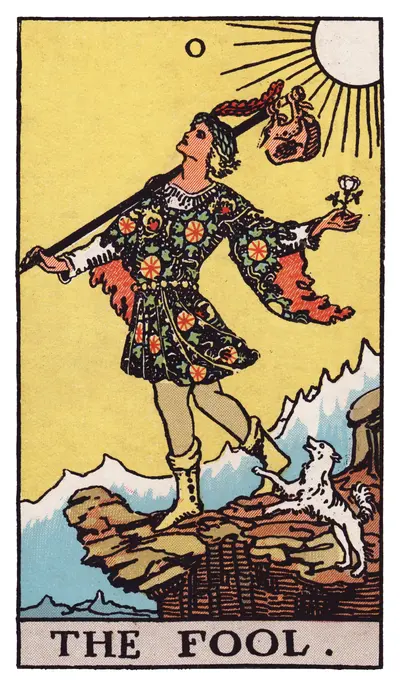
A young figure steps toward the edge of a cliff, face turned to the sky, a white rose in one hand and everything they own knotted into a small bag on a stick. A small dog leaps at their heel. The Fool is the beginning before anything has been committed — the moment at which a thing is still entirely possible because nothing about it has been tested. It is numbered zero, and the zero is the whole argument: this is not the first card in a sequence so much as the condition the sequence has not started from yet. When it arrives, something is genuinely open. The card carries no promise that it will go well and no warning that it will not, which is the most honest thing it could do, because at the moment it depicts there is no information either way. What it does insist on is that the step has not been taken. A Fool who has already jumped is a different card, and the deck has several.
Reversed meaning
Reversed, the openness fails in one of two opposite directions and the surrounding cards decide which. The commoner reading is recklessness — the step taken without looking, where the upright card’s freedom from calculation becomes a refusal to calculate at all. The less common and frequently more accurate one is the opposite: the step not taken. A querent standing at the edge indefinitely, holding an open situation open because closing it in any direction would end the possibility, is exactly this card inverted, and it is a state people can stay in for years. A third reading worth offering concerns naivety being exploited rather than merely risky, which the surrounding court cards usually make obvious. Where the spread is otherwise static the second applies; where it is fast, the first.
What Air contributes
Air is one of only three elements to reach the Majors — earth is absent, because in the Golden Dawn scheme its three cards were needed elsewhere — and of the three the Fool takes air, the element with no fixed shape and no weight. The fit is exact rather than poetic. Air is the medium things move *through* rather than a thing in itself, which is what a card numbered zero has to be: not the first item in a sequence but the condition before the sequence has anything in it. The attribution also explains why the card is so hard to pin to a verdict. Fire would make the step ambitious, water would make it feeling, earth would make it practical, and each of those would tell you something about how it turns out. Air tells you only that nothing has settled, which is the honest position at the edge of a drop whose depth the picture declines to show. Every reading that supplies a fall has quietly swapped the element for a heavier one.
What is on the card
The figure is mid-stride with the forward foot already past solid ground, and Smith drew the drop deliberately vague — it may be a cliff and may be a slope, and the card declines to say. The white rose is the suit-free flower of the deck, purity without an element attached. The bag is small, which is the point: whatever this person has, it is not much and it is carried rather than stored. The dog is usually read as instinct, and it is worth noting that it is leaping *toward* the figure rather than pulling them back — nothing in the image is trying to stop anything. The sun sits directly behind the head, low and full. The mountains behind are snow-covered and unclimbed.
In a love reading
A beginning with no track record, which is both what makes it exciting and what makes it unassessable. It appears at the start of things and at the point where somebody is deciding whether to open themselves to something they cannot yet evaluate. On questions about whether to take a risk on somebody it is favourable and specifically non-predictive: it says the situation is genuinely open, not that it will work. On questions about an established relationship it more often describes somebody wanting a return to that openness, which is a different and more difficult thing to arrange. Where a querent is being asked to commit and this card appears, the honest reading is that they are not at the commitment stage yet, whatever the calendar says. The dog is worth bringing into a relationship reading, because it is the only other living thing in the picture and it is not warning anybody. Whatever instinct is doing in this card, it is accompanying rather than objecting, which is a distinction querents at this stage usually want and rarely get.
In a career reading
A new venture, a change of direction, or the point before a decision has been made. It reads well on questions about starting something and poorly on questions about whether it will sustain, because there is nothing in the image that has been sustained. On questions about leaving a stable position for an uncertain one it is the deck’s most direct depiction of exactly that moment, and it neither encourages nor discourages — the cliff is genuinely ambiguous in the drawing. Its most useful contribution on a practical question is the size of the bag: whatever this move involves, it is being made without much infrastructure, which is worth naming out loud. On questions about timing it is one of the few cards with a genuine answer: the step has not been taken, so whatever deadline the querent believes they are against, they are earlier in the process than they think.
How this one is usually misread
The persistent error is reading the Fool as foolish. The word has drifted — in the tradition this figure is the holy fool, the one whose lack of accumulated position is a form of freedom rather than a deficiency, and the zero places them outside the sequence rather than at the bottom of it. Delivered as a warning about stupidity the card becomes advice nobody needed. The second misreading is supplying the fall. Smith drew a drop whose nature cannot be determined from the picture, and every retelling that adds a fatal cliff has added information the card withholds. **The Fool is standing at an edge, and the card ends there.** A reading that continues past the edge has stopped describing the card.
How it behaves beside other cards
With the Tower the openness is about to be involuntary rather than chosen. Beside the Ten of Pentacles somebody is declining a whole structure, which is the sharpest contrast the deck can stage. With the Four of Pentacles the step is being refused by somebody holding on. Next to the Ace of Wands the beginning has a specific opportunity behind it rather than only a mood. Its most testing neighbour is the World: the two are the same wheel at opposite points, and drawn together they usually mean a cycle has closed and the next has not been entered. Beside the Hierophant somebody is declining a lineage rather than a possession. With the Nine of Pentacles the openness meets a life somebody has already finished building, which is one of the harder pairings to deliver honestly.
Why this card has a planet or sign attached
The twenty-two Major Arcana carry the seven classical planets, the twelve signs and three of the four elements between them — one each, with nothing left over. The Fool takes Air. The allocation is the Golden Dawn’s and it is structural rather than poetic: it is what lets a card be looked up from a chart instead of chosen from a shuffle.
Correspondences follow the Golden Dawn attributions set out in Book T. Degrees are computed from each card’s position in the decan sequence rather than transcribed, so they cannot drift from the spread tool on the rest of this site.
Cards next to this one
See this card come up in your own chart
The spread on our tarot astrology page reads your chart positions as cards — no shuffle, the same answer every time. The daily card does the same for the Moon’s decan right now.