Major Arcana · 6
The Lovers
Upright meaning
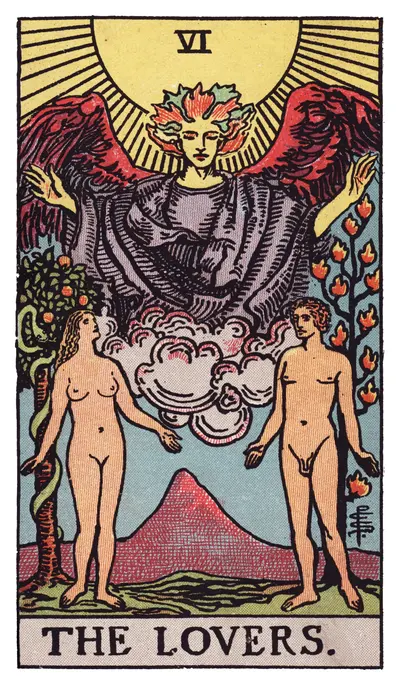
A naked man and woman stand apart beneath a winged figure in the clouds, the sun blazing behind. Behind her is a tree with a serpent in it; behind him, a tree of flames. The Lovers is choice — a decision between two things that cannot both be had, made by somebody who will have to live inside the result. What makes the card specific and much less romantic than its name is the geometry. The two figures are not looking at each other. She looks up at the angel and he looks at her, so the attention in the picture runs in a line rather than a circle, and nobody is embracing anybody. When it arrives, something requires a decision that involves values rather than logistics. The card is genuinely about love in the sense that it is often a relationship that forces the choice, but the deck has other cards for union, and this one is about the fork. The card is numbered six, and every Six in the Minor Arcana is a card of exchange between people — the gift, the reunion, the passage, the recognition. This is the Major that carries the same number, and the fork it depicts is a fork about another person. The sequence is being consistent rather than coincidental.
Reversed meaning
Reversed, the choice goes wrong or is refused. The commonest reading is a decision avoided — the querent standing at the fork indefinitely, which is a real position and a costly one. A second is misalignment: a choice made against the querent’s own values, which the card is unusually specific about because values are what the upright card is deciding between. A third concerns the relationship reading directly, where the reversal indicates two people wanting different things and one of them knowing it. A fourth, quieter version: a choice made correctly and grieved anyway, which is not a failure and is frequently what a querent is actually holding.
What Gemini contributes
Gemini is the sign of the pair, and the correspondence is doing more work than the obvious "two people" reading suggests. Gemini is mutable air — the sign of the twins, of things that come in twos and are *not the same* — and the card’s whole subject is two options that cannot be reconciled into one. It also explains the strangest thing about the picture, which is that the figures are not interacting. Gemini is an air sign; its business is discrimination, telling one thing from another, and a card about fusion would need a water attribution instead. The serpent in her tree and the flames in his are two different trees, not a decorated pair, and the attribution says they are meant to stay that way. The choice is real because the options are genuinely different, which is the one condition under which choosing costs anything.
What is on the card
The two figures stand naked and apart, and the line of attention runs woman to angel, man to woman — a hierarchy rather than a mutual gaze. Behind her is the tree of knowledge with its serpent; behind him a tree bearing twelve flames, one per sign. The winged figure above is usually identified as Raphael, the angel traditionally associated with air, which is the attribution appearing in the frame. A mountain rises between and behind them, the only obstacle in the picture and placed exactly at the centre. The sun is directly overhead and enormous. Nothing here is in shadow, which for a card about a difficult decision is the picture’s most pointed choice. Smith drew these two figures a second time, chained and beneath a different overseer, on the Devil — same posture, same arrangement, horns added. It is the closest thing to a direct quotation anywhere in the Majors, and it means the two cards have to be read against each other: one shows a choice being offered and the other shows what the same pair look like once it has stopped being one.
In a love reading
The card people most want to draw on a relationship question and among the least reassuring when read properly. It does describe love, and it describes it at the point where it requires something — a decision, a declaration, a preference stated out loud. On questions about whether two people are suited it is favourable; on questions about whether the situation is comfortable it is honest that it is not, because a fork is not comfortable. Where a querent is choosing between two people it is close to literal and worth handling carefully: the card says the choice is theirs and declines to make it, which is the correct refusal and rarely the one they came for.
In a career reading
A decision between roles, offers or directions, usually one where the money and the values point different ways. It is among the better cards for questions about whether a choice is significant — if this card is in the spread, it is — and among the less useful for questions about which option wins, since the picture puts the deciding entirely on the figure. On questions about partnership or collaboration it is favourable and specifically about alignment: the useful question is whether the two parties want the same thing, not whether they get on. On questions where the querent already knows which option they prefer and is looking for permission, this card is unusually pointed: the deciding in the picture is being done by the figures, not by the angel above them, who is present and not intervening.
How this one is usually misread
The persistent error is reading this as a romance card and stopping. The name and the naked figures make it almost automatic, and it costs the card its subject — a querent with a job offer, a house, or a family obligation meets the Lovers just as often. Delivered as romance on a career question it reads as irrelevant, when it is the most relevant card in the spread. The second misreading is treating it as a promise of union. **Nobody in this picture is touching anybody.** The two figures are apart, looking in different directions, with a mountain between them; a reading that hears a couple has looked at the title rather than the card.
How it behaves beside other cards
With the Two of Cups the fork resolves into an actual meeting between two people, which is the union the Lovers is regularly mistaken for. Beside the Hierophant the choice is between the sanctioned option and the chosen one, which is the deck’s cleanest version of that fork. With the Seven of Cups the two real options become several imagined ones, and the spread is usually about narrowing rather than deciding. Next to the Devil the same two figures appear chained beneath a different overseer — Smith drew them deliberately, and the pairing is the deck arguing with itself about what choice is worth. Beside the Four of Wands the choice has been made and there is a celebration attached to it. With the Three of Swords it was made and somebody is carrying the cost.
Why this card has a planet or sign attached
The twenty-two Major Arcana carry the seven classical planets, the twelve signs and three of the four elements between them — one each, with nothing left over. The Lovers takes Gemini. The allocation is the Golden Dawn’s and it is structural rather than poetic: it is what lets a card be looked up from a chart instead of chosen from a shuffle.
Correspondences follow the Golden Dawn attributions set out in Book T. Degrees are computed from each card’s position in the decan sequence rather than transcribed, so they cannot drift from the spread tool on the rest of this site.
Cards next to this one
See this card come up in your own chart
The spread on our tarot astrology page reads your chart positions as cards — no shuffle, the same answer every time. The daily card does the same for the Moon’s decan right now.