Major Arcana · 7
The Chariot
Upright meaning
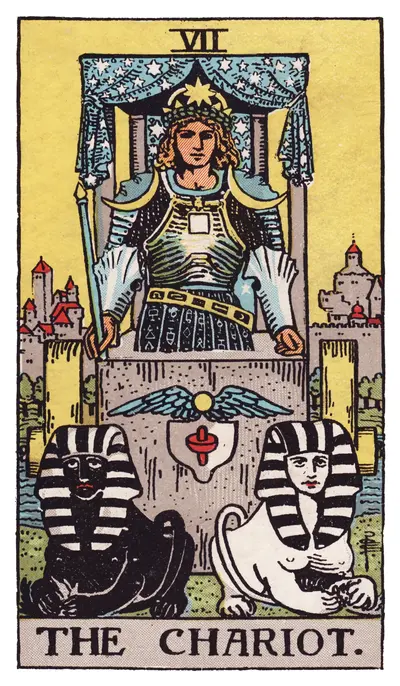
An armoured figure stands in a stone chariot drawn by two sphinxes, one black and one white, beneath a canopy of stars, with a walled city behind. There are no reins. The Chariot is control held over things that are pulling in different directions — momentum that is being directed rather than merely happening. What makes the card specific is the absence of reins, and it is not an oversight: the sphinxes are being held by will rather than by tack, which is why the card reads as effortful even though nothing in the picture looks strained. When it arrives, the querent is holding something together and it is working. The card is favourable and it is not restful. Its success is the kind that stops the moment the attention does, and every reading that turns it into a guaranteed victory has quietly removed the driver. It is numbered seven, and it follows the Lovers directly. Six is the choice; seven is the leaving. Whatever the figure in the chariot is driving away from, the card before it is the deck’s picture of deciding to, and the walled city at his back is the thing the previous card was standing in front of.
Reversed meaning
Reversed, the control fails. The commonest reading is direction lost — movement continuing without anybody steering, which is the specific failure of a vehicle held by will alone. A second is the opposite: control so tight that nothing moves, the sphinxes held so hard they have stopped pulling. A third concerns force, where the reversal describes somebody imposing a direction on people rather than on circumstances. A fourth is worth offering because querents recognise it: the driver exhausted, which is what happens to anything held together by attention over a long enough period. Where the spread is fast the first applies; where it is static, the second.
What Cancer contributes
Cancer is cardinal water, and this is the attribution readers find hardest to believe — a card of armour and conquest handed the sign of the crab. The fit is the shell. Cancer’s defining structure is a hard exterior around something soft, which is exactly a figure in armour standing inside a stone box, and the walled city behind him is the same idea at a larger scale. Cardinal water also explains the motion: cardinal signs initiate, so this is not a vehicle that was already moving. Somebody set it going. And the water half accounts for what the picture otherwise leaves unexplained, which is why a card about control needs a canopy of stars and a crescent moon on each shoulder — the thing being driven here is not a situation but the driver’s own tides, and that is a harder vehicle than any external one.
What is on the card
The two sphinxes are black and white and facing slightly apart, the same opposition as the High Priestess’s pillars rendered as motive power. There are no reins anywhere in the frame. A crescent moon sits on each shoulder of the armour, and a square is set on the breastplate. The canopy overhead is a field of stars, so the vehicle is covered by the sky rather than by cloth. A winged disc and a lingam-yoni device decorate the front of the chariot. The city wall behind is complete and he has left it — whatever this movement is, it began somewhere secure. The square on the breastplate is the only geometric figure worn by anybody in the Majors, and it is the sign of the fixed and the measurable — set on the chest of the one figure whose vehicle has nothing holding it together but attention. The armour is stating what the sphinxes are not.
In a love reading
Determination, and usually a relationship in which one person is holding the thing together. It is favourable on questions about whether something can be kept going and quiet on whether it is easy. On questions about pursuing somebody it is among the more encouraging cards in the deck, with one caveat the picture supplies: this is a vehicle driven by will, so what it describes is effort that works rather than an outcome that arrives. Where a querent is asking whether to keep trying, it is a yes — and the reversed reading of the exhausted driver is the one to hold in reserve if the surrounding cards are heavy. Where two people are moving at very different speeds, this card usually identifies the one supplying the momentum, and the reversed reading of the exhausted driver is worth holding in reserve for any querent who recognises themselves in that description.
In a career reading
Drive, focus, and a project being carried by somebody’s personal command of it. It is among the strongest cards for questions about whether the querent can pull something off and among the least informative about whether the structure will outlast them, since there is no structure in the picture except the one the driver is imposing. On questions about competition it is favourable. On questions about delegation it is a caution: nothing in this card has been handed to anybody.
How this one is usually misread
The habitual error is reading it as victory, which is the card’s reputation and about half of its content. A chariot in motion is not a chariot arrived, and the deck has other cards for the arrival — the Six of Wands is the parade and this is the drive. Delivered as a result the card stops being usable as advice. The second misreading is missing the missing reins. **The sphinxes are not restrained by anything in the picture**, which is the single most important detail in it: this control is being exerted continuously and the card is honest that it can stop. A third misreading is geographical, and it is common enough to name: the card is frequently delivered as travel because there is a vehicle in it. Nothing in the picture is going anywhere in particular — there is no road, no destination and no horizon, only a walled city behind. It can coincide with a literal journey and it is not a card about one, and a reading that produces a trip from a chariot has read the object rather than what the object is doing.
How it behaves beside other cards
With the Six of Wands the drive reaches its public recognition, which is the pairing that completes the card. Beside the Knight of Swords two kinds of speed sit together and the difference is the driver. With the Four of Swords the vehicle should be stopped and is not. Next to the Moon the direction becomes genuinely uncertain, which for a card with no reins is the most destabilising neighbour it has. Its most useful partner is the Eight of Wands, where the momentum stops being personal and starts being circumstantial. Beside the Ten of Wands the drive has become a load, which is what happens to a vehicle held by will over a long enough distance. With the Star the effort finally meets something restorative.
Why this card has a planet or sign attached
The twenty-two Major Arcana carry the seven classical planets, the twelve signs and three of the four elements between them — one each, with nothing left over. The Chariot takes Cancer. The allocation is the Golden Dawn’s and it is structural rather than poetic: it is what lets a card be looked up from a chart instead of chosen from a shuffle.
Correspondences follow the Golden Dawn attributions set out in Book T. Degrees are computed from each card’s position in the decan sequence rather than transcribed, so they cannot drift from the spread tool on the rest of this site.
Cards next to this one
See this card come up in your own chart
The spread on our tarot astrology page reads your chart positions as cards — no shuffle, the same answer every time. The daily card does the same for the Moon’s decan right now.