Major Arcana · 5
The Hierophant
Upright meaning
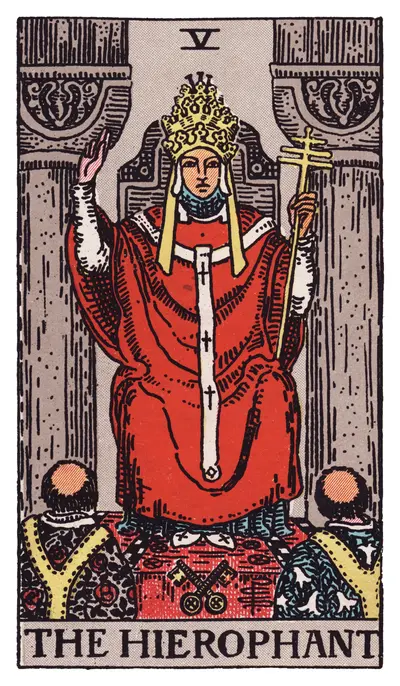
A figure in triple crown and triple-barred cross sits between two grey pillars, one hand raised in blessing, with two tonsured figures kneeling before him and two crossed keys at his feet. The Hierophant is tradition — the transmission of something through an institution rather than person to person. What makes the card specific is the pair of kneeling figures. This is the only Major in which teaching is visibly happening, and the structure of it is the subject: the knowledge here comes with a lineage, a procedure and somebody authorised to pass it on. When it arrives, the matter involves an established way of doing things. The Taurus correspondence is what stops the card being merely institutional: fixed earth is endurance, and the reason a tradition is worth consulting is that it has already survived a long time, which is a real argument and not a sentimental one. He is numbered five, which in this deck is consistently the number of friction: every Five in the Minor Arcana is a card of conflict, loss or exclusion. That the institutional card carries it is the sequence being pointed rather than neutral, and it is worth holding against the picture’s calm.
Reversed meaning
Reversed, the relationship to the institution breaks. The commonest reading is orthodoxy rejected — somebody doing it their own way, which the card treats as a genuine option rather than a rebellion to be corrected. A second is the institution failing its own standard, where the form has been kept and the substance has gone; the tradition is old about this and does not spare the figure. A third concerns conformity that has stopped being chosen, which is the quietest of the three and often the most accurate. Where a querent is chafing the first applies; where they are comfortable and stuck, the third. The fourth reading is the gentlest and often the most accurate: somebody who has simply outgrown a body of practice that served them, with no betrayal on either side. It is the most common way people leave a tradition and the version the dramatic readings never cover.
What Taurus contributes
Taurus is fixed earth, the most durable combination in the scheme, and it is the argument the card makes for itself. An institution is worth consulting not because it is right but because it has already survived a long time — it has met the failure modes a new approach has not reached yet — and fixed earth is the attribution for exactly that kind of endurance. The fit also accounts for the card’s weight and its slowness. Nothing in this picture moves: two figures kneel, a hand is raised, keys lie on the floor. Taurus is ruled by Venus, which is the detail that keeps the card from being merely bureaucratic — the roses and lilies on the kneeling robes are the same pair growing at the Magician’s feet, so what is being transmitted here is substance rather than procedure. The form is fixed earth; the content is not.
What is on the card
The crown has three tiers and the cross three bars, the papal forms, and the doubling is deliberate — authority here is layered rather than single. Two crossed keys lie at his feet, the sign of an office that opens and closes rather than of the man occupying it. The two kneeling figures wear robes patterned with roses and lilies, the same pair the Magician has growing at his feet, so what is being transmitted is the same material. The pillars are grey and plain, deliberately less striking than the black-and-white pair the High Priestess sits between. His hand is raised in a blessing with two fingers up and two folded. His pillars are grey and deliberately plainer than the black-and-white pair the High Priestess sits between — two cards about thresholds, one dramatic and one institutional, and the difference in the columns is the whole comment.
In a love reading
Commitment inside a recognised form — marriage, a public declaration, meeting the family, the parts of a relationship that involve other people acknowledging it. It is favourable on questions about whether something will be formalised and genuinely silent about whether the formalising will suit the two people involved. On questions about shared values it is among the more useful cards in the deck, since that is what the card is actually about. Where a querent is weighing convention against what they want, this card names the weight of convention rather than taking a side. On questions involving families and their expectations it is frequently the most literal card in the deck, and the useful reading is not whether to comply but what the expectation is actually made of.
In a career reading
Institutions, qualifications, established procedure, mentorship with a structure behind it. It is among the strongest cards for questions about training, accreditation or working inside a large organisation, and among the weaker ones for questions about striking out. On questions about whether to follow the standard approach it is a yes with a reason attached: the standard approach is standard because it has already survived the failure modes a new one has not met yet. On questions about a mentor it indicates somebody teaching from a lineage rather than from personal flair. It is also the card for the unglamorous part of expertise — the accreditation, the syllabus, the thing that has to be done in the prescribed order before anyone will take the work seriously — and querents who resent that stage usually meet this card while in it.
How this one is usually misread
The habitual error is reading the card as religion, which is one instance of what it describes rather than its subject. Any transmitted body of practice fits — a trade, a profession, a family’s way of doing things, an apprenticeship. Delivered as church the card misses most of the questions it is drawn for. The second misreading is treating it as a criticism of conformity. **Nothing in the picture is being coerced**: two people are kneeling voluntarily to be taught, and the keys at his feet belong to the office rather than to him. A reading that hears oppression has supplied it.
How it behaves beside other cards
With the Lovers the pair is the deck’s clearest fork between the sanctioned choice and the chosen one. Beside the Emperor the structure becomes institutional rather than personal. With the Fool tradition meets somebody carrying nothing and owing nobody. Next to the Eight of Pentacles the apprenticeship has a master and a syllabus. Its most revealing neighbour is the Hermit, where the same search is being conducted alone, and the spread is usually about which the querent actually needs. Beside the Two of Cups the institution meets a private agreement between two people, and the reading is usually about whether the two need to be reconciled. With the Tower the structure that was being transmitted fails. Next to the Seven of Pentacles the tradition is the reason somebody is willing to wait as long as the work needs. Beside the Three of Pentacles the tradition is being applied to an actual commission, and the pairing is the deck’s picture of a trade working as intended.
Why this card has a planet or sign attached
The twenty-two Major Arcana carry the seven classical planets, the twelve signs and three of the four elements between them — one each, with nothing left over. The Hierophant takes Taurus. The allocation is the Golden Dawn’s and it is structural rather than poetic: it is what lets a card be looked up from a chart instead of chosen from a shuffle.
Correspondences follow the Golden Dawn attributions set out in Book T. Degrees are computed from each card’s position in the decan sequence rather than transcribed, so they cannot drift from the spread tool on the rest of this site.
Cards next to this one
See this card come up in your own chart
The spread on our tarot astrology page reads your chart positions as cards — no shuffle, the same answer every time. The daily card does the same for the Moon’s decan right now.