Major Arcana · 3
The Empress
Upright meaning
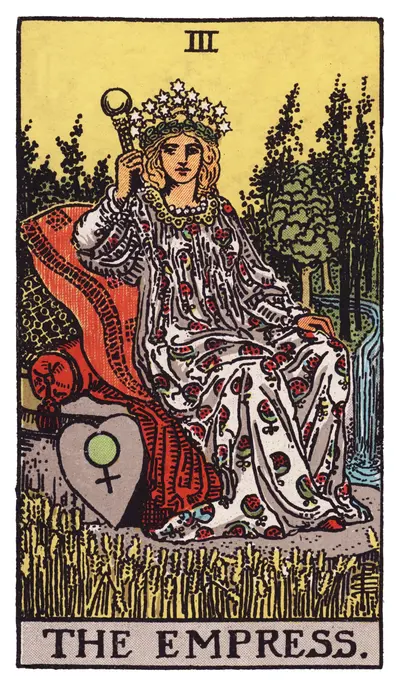
A woman reclines on cushions in a field of ripe wheat, a stream falling through the wood behind her, a crown of twelve stars on her head and a shield bearing the symbol of Venus at her side. Her robe is patterned with pomegranates. The Empress is generation — things growing, being made, being nourished into existence. What separates her from the Queen of Pentacles, who occupies similar territory, is that the Queen tends and the Empress produces: this card is upstream of care. When it arrives, something is being created or is ready to be, and the creating is not effortful in the way the working cards of the deck depict effort. She is reclining. The Venus correspondence covers more than romance — this is the planet of attraction, value and fertility in the broad sense, and the wheat in the foreground is ripe rather than sown, so the card sits at the productive end of a process rather than the beginning. She is numbered three, directly after the High Priestess, and the pomegranates carry across from that card’s veil to this card’s robe. Two is what is concealed; three is what comes out of it. The Majors rarely argue in sequence and here they plainly do.
Reversed meaning
Reversed, the generative function stalls or turns on itself. The commonest reading is creative block — the field not producing, which on a practical question usually means something a querent is trying to force that will not be forced. A second concerns dependence, where nourishment has become the whole relationship and both sides are worse for it; this is the reading the tradition attaches to a smothering version of the figure. A third is neglect, the reverse of the second: something that needed tending and did not get it. Where the spread concerns work the first applies; where it concerns family, the second and third are the ones worth weighing. The fourth reading is the one querents recognise fastest and ask about least: abundance that exists and cannot be enjoyed, where the field has produced and the figure in the card has stopped being able to rest in it. Surrounding cards in the suit of swords usually confirm it.
What Venus contributes
Venus is attraction, value and fertility in the broad sense, and the Empress is the only card in the Majors that states its own attribution inside the picture — the glyph is on the shield beside her. That is worth noticing as a fact about the deck rather than about the card: Smith put the correspondence in the frame here and in the Emperor’s rams’ heads, and nowhere else in the twenty-two. The fit is in the wheat. Venus governs what is *produced*, and the field in the foreground is ripe rather than sown, so the card sits at the yielding end of a process — which is also why this figure is reclining while every other productive card in the deck depicts effort. The attribution is broader than romance, and reading it narrowly is what shrinks this card to motherhood. A business, a body of work and a garden are all Venusian in the sense the scheme means.
What is on the card
The crown carries twelve stars, one per sign, so the whole zodiac sits on her head. The shield beside her bears the Venus glyph, the only card in the Majors that states its correspondence inside the picture. Wheat grows ripe in the foreground and a stream runs out of a cypress wood behind her — water arriving from somewhere unseen, which is how the field is being fed. Her seat is cushions rather than a throne, and she is the only Major who is genuinely reclining. The pomegranates on her robe connect her to the High Priestess, whose veil carries the same fruit, and the two cards sit next to each other in the sequence.
In a love reading
Warmth, abundance, and frequently a relationship in a genuinely fertile phase. It is among the most straightforwardly favourable cards on a relationship question. It also carries the deck’s oldest association with pregnancy, and the honest handling of that is to name the association and refuse the prediction — the card describes generative conditions, and reading it as an announcement is exactly the invented precision this cluster declines everywhere. On questions about whether somebody is nurturing, it is a clear yes; on questions about whether that is what the querent wants, it says nothing. Where a relationship has become entirely practical, this card is usually indicating what has gone missing rather than what is wrong — the difference between a partnership that works and one that produces anything is exactly the distance between the Queen of Pentacles and this figure.
In a career reading
Creative work, growth, and anything where the output is something new rather than something maintained. It is among the strongest cards for questions about whether a project will produce, and less useful for questions about structure or administration — nothing in this card is being organised. On questions about a collaboration it is favourable. Its practical contribution is the ripe wheat: whatever is being asked about is further along than the querent thinks, and the useful question is usually about harvesting rather than planting. On questions about whether to expand, the ripe field is the answer the card gives: expansion is what happens to something already yielding, and this card says it is.
How this one is usually misread
The habitual error is reading her as motherhood and stopping there, which narrows a card about generation into one demographic fact. The twelve stars and the ripe field are about production in any register — a business, a body of work, a garden — and a querent with no interest in children meets this card as often as anyone. The second misreading is treating the reclining as idleness. **The field in this card has already produced**, which is precisely why she is lying down, and a reading that hears laziness has mistaken the end of a process for the absence of one.
How it behaves beside other cards
With the Emperor the pair is structure and generation, and the reading usually turns on which the situation is short of. Beside the Queen of Pentacles the making and the tending appear together. With the Three of Pentacles the creative work acquires collaborators and a commission. Next to the Ten of Pentacles what was produced has become something inherited. Its most difficult neighbour is the Five of Pentacles, where abundance and exclusion sit side by side and the spread is usually about who is outside. Beside the Ace of Pentacles something material is being offered into conditions already fertile. With the Seven of Pentacles the growing is happening on its own schedule and the querent is waiting on it. Next to the Eight of Cups somebody is walking away from abundance, which the card has no vocabulary for and which is exactly why the pairing is worth noticing. Beside the Devil abundance and appetite sit adjacent, and the spread is usually about which one the querent is calling the other. With the Empress the question is almost never whether something can grow, and almost always whether the querent is willing to wait for the season it grows in.
Why this card has a planet or sign attached
The twenty-two Major Arcana carry the seven classical planets, the twelve signs and three of the four elements between them — one each, with nothing left over. The Empress takes Venus. The allocation is the Golden Dawn’s and it is structural rather than poetic: it is what lets a card be looked up from a chart instead of chosen from a shuffle.
Correspondences follow the Golden Dawn attributions set out in Book T. Degrees are computed from each card’s position in the decan sequence rather than transcribed, so they cannot drift from the spread tool on the rest of this site.
Cards next to this one
See this card come up in your own chart
The spread on our tarot astrology page reads your chart positions as cards — no shuffle, the same answer every time. The daily card does the same for the Moon’s decan right now.