Major Arcana · 4
The Emperor
Upright meaning
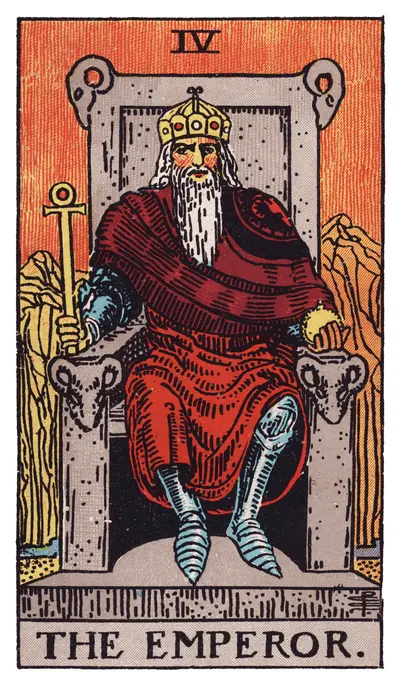
A bearded figure sits squarely on a stone throne carved with four rams’ heads, holding an ankh-headed sceptre and an orb, in full armour under a red robe, against barren mountains with a thin river at their foot. The Emperor is structure — authority that has been established and now holds a thing in place. What makes him specific is the stone. Every other seated figure in the Majors sits on something soft or ornamented; this throne is a block, and the landscape behind it is rock with almost nothing growing. The card is not hostile, but it is not fertile either: structure is what makes production possible and is not itself productive. When he arrives, the matter involves rules, boundaries, or somebody with the standing to set them. The Aries correspondence is the part most readers skip and the part that explains him: this is a cardinal-fire figure, so the order in this card was **imposed** at some point rather than inherited. He is numbered four, and four is the number of the square, the table, the foundation — the first genuinely static number in the sequence after three has produced something. The Empress precedes him, which means the deck puts generation before structure rather than the other way round.
Reversed meaning
Reversed, the structure fails or oppresses. The commonest reading is rigidity — rules that outlived their purpose and are being enforced anyway, which is the standing failure of anything built out of stone. A second is the opposite and easy to miss: authority absent where it is needed, a situation nobody is holding, which reads as chaos rather than tyranny and is just as much this card inverted. A third concerns domination, the version the tradition warns about most and the one where the Aries half stops being structure and becomes force. Where the spread involves family or institutions the first and third apply; where it involves a drifting situation, the second. A fourth version is worth naming because it is common in family spreads: authority that was legitimate once and has not been renegotiated since the people under it grew up. Nothing in it is malicious, which is what makes it hard to raise.
What Aries contributes
Aries is cardinal fire, and that is the half of this card almost every reading skips. A stone throne, bare mountains and a frontal seated figure read as fixed earth — the structure has always been there, somebody inherited it — and the attribution says otherwise. Cardinal signs *initiate*. Fire *asserts*. So the order in this card was imposed at some point by somebody, and the armour showing beneath the robe is the picture agreeing: this authority was fought for and has not been put away. The four rams’ heads carved into the throne are the sign named in the furniture, the same device the Empress uses with her shield. It also explains the barren landscape without needing to read it as failure. Fire does not grow things; it clears and it holds. Production is the Empress’s office, and the two cards sit adjacent in the sequence for exactly that reason.
What is on the card
Four rams’ heads are carved into the throne, and the ram is Aries — the card states its correspondence in the furniture, the way the Empress states hers on her shield. He holds an ankh, the Egyptian sign of life, and an orb, the sign of dominion, one in each hand. Armour shows beneath the robe, so this authority was once fought for and has not been put away. The mountains behind are bare rock. A narrow river runs along their base, the only living thing in the frame, and it is small and at the edge. He is seated absolutely square to the viewer, the most frontal figure in the Majors. The river at the foot of the mountains is the only living thing in the frame and it is small and pushed to the edge, which is the picture being honest about the cost of the arrangement rather than denying there is one.
In a love reading
Stability, commitment, and frequently a relationship in which one person provides the structure. It is favourable on questions about security and quiet on questions about warmth — there is not much in this card that is soft. On questions about whether somebody is serious it is among the clearest affirmatives in the deck, and it says the seriousness will express itself as arrangements rather than as declarations. Where a querent feels controlled rather than supported, this card upright is usually still describing support, and the reversed reading is where that tips. Where the question is about somebody who arranges rather than expresses, this card usually indicates that the arranging *is* the expression, which is worth saying plainly to a querent who has been reading it as absence.
In a career reading
Management, institutions, regulation, and anything where the job is to hold a structure. It is among the strongest cards for questions about whether something is properly organised and among the weakest for questions about innovation, since the whole content of the card is that a thing has been settled. On questions about a superior it indicates somebody demanding, consistent and not much interested in exceptions. On questions about whether to formalise an arrangement — a contract, a title, a boundary — it is a plain yes. Where a querent is the one being asked to impose order on something unstructured, the Aries half of the attribution is the practical advice the card contains: nobody inherits this position, and waiting to be handed it is the commonest way of not taking it.
How this one is usually misread
The frequent error is reading him as a father, which is a common gloss and much narrower than the card. Structure has many faces: a contract, a deadline, a law, a boundary a querent sets for themselves. Delivered as a person the card loses most of its range. The second misreading is treating the barren landscape as a judgement. **Structure is not supposed to produce anything** — that is the Empress’s office, and the two sit adjacent in the sequence for exactly that reason. Reading the bare rock as failure asks this card to do a job the deck has already assigned elsewhere.
How it behaves beside other cards
With the Empress the pair is the deck’s cleanest complement and the reading usually names which half is missing. Beside the Tower the structure is about to fail, which is the most alarming pairing either card has. With the Fool authority meets somebody with no position at all. Next to the Hierophant the personal order becomes an institutional one. Its most testing neighbour is the Eight of Cups, where somebody is leaving something properly built, which the card has no vocabulary for. Beside the Seven of Wands the structure is being defended against something. With the Three of Swords authority and grief appear together, and the spread is usually about a decision somebody made correctly and at a cost. Next to the Page of Cups the order meets somebody entirely unguarded, which the Emperor has no method for. Beside the Ten of Pentacles the structure has lasted long enough to become an inheritance, which is the most favourable outcome this card has.
Why this card has a planet or sign attached
The twenty-two Major Arcana carry the seven classical planets, the twelve signs and three of the four elements between them — one each, with nothing left over. The Emperor takes Aries. The allocation is the Golden Dawn’s and it is structural rather than poetic: it is what lets a card be looked up from a chart instead of chosen from a shuffle.
Correspondences follow the Golden Dawn attributions set out in Book T. Degrees are computed from each card’s position in the decan sequence rather than transcribed, so they cannot drift from the spread tool on the rest of this site.
Cards next to this one
See this card come up in your own chart
The spread on our tarot astrology page reads your chart positions as cards — no shuffle, the same answer every time. The daily card does the same for the Moon’s decan right now.