Major Arcana · 8
Strength
Upright meaning
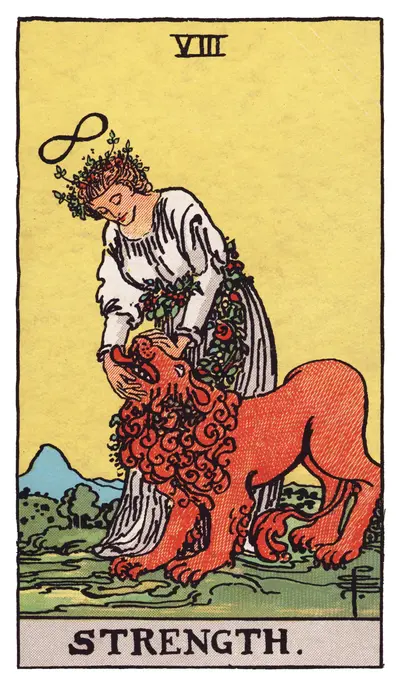
A woman in white, a chain of flowers at her waist and a lemniscate over her head, closes the jaws of a lion with her bare hands. The lion is not resisting. Strength is power applied without force — the capacity to hold something dangerous steady by being steady, which the picture states by making the gesture look gentle. What makes the card specific is the lion’s posture. It is not cowed, not snarling, and not being subdued; its head is being held and its tail is down, and it is leaning into her. When it arrives, the matter involves something powerful that needs handling rather than defeating. The card is the deck’s clearest argument that the two are different, and the argument is structural: the lion is still a lion at the end of it, which is what separates this from every card about overcoming. It is numbered eight in the Golden Dawn arrangement this site uses, where Justice takes eleven — the two were swapped from the older order so that the signs would run in zodiacal sequence. That is worth knowing because a deck following the earlier numbering puts Justice here and Strength at eleven, and neither is a mistake.
Reversed meaning
Reversed, the handling fails. The commonest reading is self-doubt — the capacity present and not believed in, which is this card’s specific and very common failure. A second is force substituted for patience, where somebody has started trying to subdue what they were managing, and the surrounding cards usually show the cost. A third concerns the lion rather than the woman: something genuinely out of hand, appetite or anger that has stopped being held. A fourth is worth naming because querents rarely volunteer it — patience extended past the point where it is a virtue, which looks like strength from outside and is endurance of something that should have ended.
What Leo contributes
Leo is fixed fire, and the lion in the picture is the sign drawn literally, which happens in only a handful of the Majors. But the attribution is not about the animal; it is about the fixity. Fixed signs sustain rather than start or change, and the whole content of this card is that the hold is being maintained — not a single act of subduing but a continuous one, which is why the woman looks unhurried. Fire is also what she is holding: appetite, temper, the part of a person that wants things and does not negotiate. The scheme puts the lion and the handler in the same sign deliberately. This is not a card about defeating something foreign; it is about a person and their own fixed fire, which is the reading that makes the flower chain at her waist make sense as the leash it plainly is.
What is on the card
The lemniscate floats above her head, and the Magician is the only other Major carrying it — the deck’s pair about applying power, one through skill and one through patience. Her belt and garland are chains of flowers, and one loops down to the lion: a leash made of something that would break if pulled. Her dress is white and her hands are bare. The lion’s tail hangs down and its eyes are half closed. A single mountain rises behind. Nothing in the frame is armoured, which on a card called Strength is the picture making its whole argument in one absence. The flowers are the detail worth returning to. A chain of blossoms is used as a leash on an animal that could break it without noticing, so the restraint in this card works only because both parties are accepting it — which is precisely what "handling" means and what "subduing" does not.
In a love reading
Patience, tolerance, and the capacity to stay steady with somebody who is not. It is favourable and it describes work rather than ease. On questions about a difficult person it is among the most useful cards in the deck, because it says the difficulty is handleable and does not say it will go away — the lion remains a lion. On questions about whether to keep being patient, the fourth reversed reading is the honest counterweight: this card cannot tell the difference between patience that is working and patience that has become endurance, and the surrounding cards usually can.
In a career reading
Handling a difficult situation or person, sustained effort, and any role where the job is to keep something from escalating. It is among the stronger cards for questions about whether the querent is equal to something and among the weaker ones for questions about speed, since nothing in this card is fast. On questions about conflict it argues consistently for the approach that leaves the other party intact. On questions about stamina it is a plain yes. On questions about a difficult colleague it is among the most practically useful cards in the deck, because it says the situation is workable while declining to promise the person will change. The lion is still a lion at the end of the card, and a strategy built on the opposite assumption is the one that fails.
How this one is usually misread
The frequent error is reading it as overcoming, which reverses the card. Nothing is being defeated: a dangerous animal is being held, calmly, by somebody who will have to keep holding it. Delivered as triumph the card loses the continuous present tense that is its whole subject. The second misreading is treating gentleness as weakness in the reading, which the picture pre-empts. **She is closing the jaws of a lion with her bare hands.** The absence of armour is not vulnerability; it is the claim that armour is unnecessary, and it is the most confident statement any figure in the Majors makes. A third error is to read the lion as another person. It is the commonest way this card gets applied and it is usually backwards: the scheme puts the handler and the lion in the same sign, which makes the animal the querent’s own fixed fire rather than somebody else’s. Delivered as a difficult colleague the card becomes advice about managing them; delivered correctly it is about what the querent does with their own temper while managing them, which is the part they can actually act on.
How it behaves beside other cards
With the Magician the two lemniscate cards appear together, and the spread is usually about whether the situation needs skill or patience. Beside the Chariot two kinds of control sit side by side — one by will, one by steadiness — and the contrast is often the reading itself. With the Seven of Wands the holding turns into a defence. Next to the Devil the chain at her waist and the chains on that card invite the comparison Smith clearly intended: one is a leash that would break and the others are loose enough to lift off. Beside the Nine of Swords the patience is being applied to a night rather than to a situation. With the Six of Wands the steady handling is recognised publicly, which this card almost never is.
Why this card has a planet or sign attached
The twenty-two Major Arcana carry the seven classical planets, the twelve signs and three of the four elements between them — one each, with nothing left over. Strength takes Leo. The allocation is the Golden Dawn’s and it is structural rather than poetic: it is what lets a card be looked up from a chart instead of chosen from a shuffle.
Correspondences follow the Golden Dawn attributions set out in Book T. Degrees are computed from each card’s position in the decan sequence rather than transcribed, so they cannot drift from the spread tool on the rest of this site.
Cards next to this one
See this card come up in your own chart
The spread on our tarot astrology page reads your chart positions as cards — no shuffle, the same answer every time. The daily card does the same for the Moon’s decan right now.