Major Arcana · 12
The Hanged Man
Upright meaning
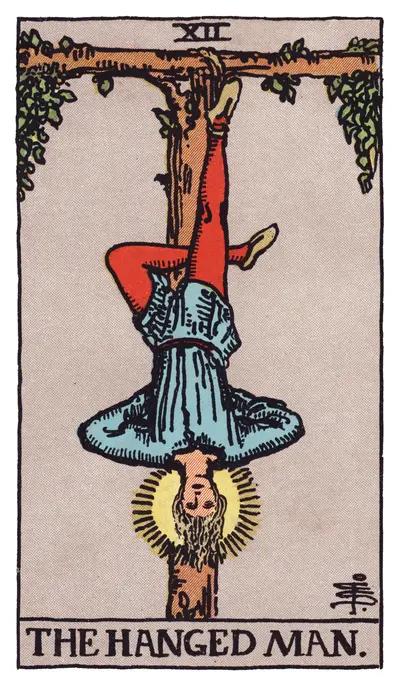
A man hangs upside down from a T-shaped wooden frame, suspended by one ankle, the other leg crossed behind at the knee. His hands are behind his back and a halo of light surrounds his head. His face is calm. The Hanged Man is suspension — a pause that is neither chosen nor resisted, in which the only thing available is a change of view. What makes the card specific is the expression. Nothing in this picture is distressed, which on a card depicting a man hung upside down from a tree is the whole argument: the position is uncomfortable and it is not an emergency. When it arrives, the situation is on hold and the hold is doing something. It is numbered twelve, the last card before Death, and the sequence is being deliberate — the deck puts the long pause immediately before the ending, not after it.
Reversed meaning
Reversed, the suspension stops working. The commonest reading is a pause that has become mere delay — time passing with no shift in view, which is the difference between waiting and being stuck and is precisely what the upright card claims to be on the right side of. A second is resistance: somebody fighting a hold they cannot end, spending on struggle what the card asks them to spend on looking. A third concerns martyrdom, and the tradition is specific about it — sacrifice performed for an audience rather than for a reason. A fourth, quieter: the pause ending, which reversed can indicate simply because the figure comes the right way up.
What Water contributes
Water is one of only three elements to reach the Majors, and the Hanged Man takes it — the element that has no shape of its own and takes the shape of whatever holds it. That is the attribution doing exact work. A card about a person who has stopped acting and is being held in position by something else needs the passive element, and water is the only candidate: fire would make the suspension a struggle, air would make it a thought, earth would make it a burden. It also accounts for the reflection reading that has attached to this card so durably. Water is the surface that shows things the other way up, which is literally what the figure is seeing, and the halo around his head is the picture agreeing that the inverted view is the one worth having.
What is on the card
The frame is a living tree, not a gallows — leaves are visible on both uprights and the crosspiece — so what holds him is growing. He hangs by one ankle and the free leg crosses behind the other at the knee, making a figure four, which is the same shape the Emperor’s number and throne make and the one the tradition reads as the completed square. His hands are behind his back and his arms make a triangle with his head. The halo is plain light with no rays. His shoe stays on. Nothing in the frame is straining and there is no rope tension drawn anywhere. The figure-four made by the crossed leg is worth holding against the Emperor, whose number it is and whose throne is built on the same square. One card sits squarely in the shape and the other hangs from it, which is as close as the Majors come to making a joke.
In a love reading
A relationship on hold, a decision deferred, or a period in which nothing is being resolved and something is being understood. It is among the least dramatic cards to draw on a relationship question and among the more accurate about long stretches of real relationships. On questions about whether to wait it is a qualified yes: the card distinguishes waiting that changes the view from waiting that only passes time, and the surrounding cards usually say which this is. Where a querent has been sacrificing something for somebody, the martyrdom reading is worth holding — the honest question is whether anybody asked. On questions about whether somebody has gone quiet for a reason, this card distinguishes between silence that is doing something and silence that is only elapsed time — and it usually indicates the first, which is more reassuring than most querents expect and less actionable than they want.
In a career reading
A project stalled, a decision pending with somebody else, a role in which the querent has no move available. It reads badly as advice to act and well as advice to use the pause. On questions about whether to force something it is one of the deck’s clearer refusals, and the reasoning is in the picture rather than in the mood: there is no rope tension, nothing to push against, and the figure is not held by anything he could argue with. On questions about a change of approach it is favourable, since a change of view is the one thing this position makes available. It is also the card for the specific frustration of a decision sitting with somebody else: a promotion pending, an application submitted, a contract with the other side’s lawyers. Nothing in the picture is within reach of the figure, and telling a querent that plainly is more use than manufacturing a next step.
How this one is usually misread
The persistent error is reading the card as punishment. The frame is a living tree with leaves on it, his shoe is still on, and his face is calm — a picture of an execution would look nothing like this, and Smith knew exactly what one looked like. Delivered as suffering the card becomes something to escape rather than something to use. The second misreading is treating the pause as passive in the sense of wasted. **The halo is the picture’s own verdict on the position**, and it is the only Major outside the Sun and the Star in which light is drawn around a figure’s head. A third, subtler: reading it as a sacrifice the querent has chosen. Nothing in the image indicates choice — he is suspended, not kneeling — and asking a querent what they gave up frequently produces the discovery that they gave up nothing and are simply waiting.
How it behaves beside other cards
With Death the pause resolves into an actual ending, which is the sequence’s own reading of the pair. Beside the Four of Swords the suspension becomes a rest, which is a considerably kinder version of the same stillness. With the Eight of Cups somebody is leaving rather than waiting, and the spread is usually about which the situation permits. Next to the Two of Swords the hold turns out to be a decision nobody is making. Its most testing neighbour is the Knight of Swords, where a card with no available move sits beside the fastest figure in the deck. Beside the Seven of Pentacles both cards are asking for the same thing from different directions, and the pairing is usually the reading: one is waiting on work already done and the other on a situation nobody controls.
Why this card has a planet or sign attached
The twenty-two Major Arcana carry the seven classical planets, the twelve signs and three of the four elements between them — one each, with nothing left over. The Hanged Man takes Water. The allocation is the Golden Dawn’s and it is structural rather than poetic: it is what lets a card be looked up from a chart instead of chosen from a shuffle.
Correspondences follow the Golden Dawn attributions set out in Book T. Degrees are computed from each card’s position in the decan sequence rather than transcribed, so they cannot drift from the spread tool on the rest of this site.
Cards next to this one
See this card come up in your own chart
The spread on our tarot astrology page reads your chart positions as cards — no shuffle, the same answer every time. The daily card does the same for the Moon’s decan right now.