Major Arcana · 13
Death
Upright meaning
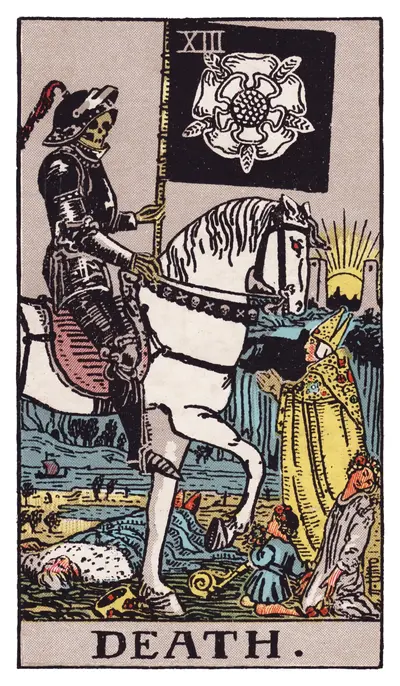
A skeleton in black armour rides a white horse across a field, carrying a black banner with a white rose. A king lies dead beneath the hooves; a bishop, a woman and a child face the rider, each differently. Two towers stand on the horizon with the sun rising between them. Death is an ending that is not negotiable — a thing genuinely finishing, after which the situation is different. What makes the card specific is the group at the front. Four people meet the same rider and none of them reacts alike: the king is already down, the bishop stands and faces it, the woman turns away, the child kneels and offers a flower. The card’s subject is as much how an ending is met as the ending itself. It is numbered thirteen and it sits directly after the long pause of the Hanged Man, which is the deck saying that what follows a suspension is not a resumption.
Reversed meaning
Reversed, the ending is obstructed. The commonest reading is resistance — something over and not being allowed to be over, which is more painful than the upright card and considerably more common. A second is the ending stalled: a transition begun and not completed, which leaves a querent in the worst part of it indefinitely. A third concerns fear rather than fact, where the reversal describes dread of a change that has not happened and may not. A fourth is worth offering: an ending that has already happened quietly, which the querent has not yet registered, and which the reversal sometimes indicates simply by putting the rider behind them.
What Scorpio contributes
Scorpio is fixed water, and the attribution is the reason this card is not about disaster. Scorpio’s subject is transformation through what cannot be undone — the sign of things that go all the way rather than partway — and fixity means the change holds. That is an ending with a floor under it rather than a catastrophe. The water half is why the card reads as inevitable rather than violent: water does not force, it arrives and does not go back. It also explains the sunrise between the two towers, which every retelling of this card as doom has to ignore. Scorpio is the sign traditionally associated with what comes after, and the picture puts an ending in the foreground and a dawn on the horizon in the same frame, deliberately, with the rider moving toward it.
What is on the card
The banner carries a white rose with five petals — the same flower the Fool holds, the deck’s suit-free emblem — on black, so the card’s one bright device is the sign of purity rather than of threat. The horse is white and walking, not galloping. The crown has fallen from the king’s head and lies on the ground beside him. A river runs behind with a boat on it. Two towers stand on the far shore with the sun rising between them, an image Smith repeats almost exactly on the Moon, where the same towers flank a different light. The rider’s armour is black and his visor is open. The two towers with the sun between them are drawn again on the Moon, almost identically, with a different light between them — the same gateway under a rising sun here and under a reflected one there. Smith reuses very little across the Majors, and both instances are at the far edge of the frame rather than at its centre.
In a love reading
The end of something, or a relationship changing so substantially that what preceded it is over. It is among the harder cards to draw on a relationship question and it is not a verdict of separation: a relationship that ends one phase and begins another is exactly this card, and so is one that ends. On questions about whether something can be recovered it is honest and unwelcome — the rider does not turn round. Where a querent is holding on, the reversed reading is usually the more accurate description of what they are actually doing, and naming it does more than softening the upright. On questions about whether a relationship that has changed beyond recognition is still the same relationship, this card answers in the only way it can: the thing that was is over, and what stands in its place has to be assessed on its own terms rather than as a continuation.
In a career reading
A role ending, a project closing, an industry changing under somebody. It is among the clearest cards for questions about whether something is finished and among the least useful for questions about how to save it. On questions about whether to let something go it is a plain yes. Its practical contribution is the four figures: the useful question in a work spread is rarely whether the ending will happen and almost always which of the four postures the querent is adopting, since that is the only part still open. Where a querent is asking whether to announce an ending or let it happen, the four figures are the practical content of the card — the ending is not in question and the posture is, and the one who is already down is the one who was not facing it.
How this one is usually misread
The habitual error needs no introduction: the card is read as a prediction of literal death, and it is not one. Nothing in the tradition supports it, the picture has a sunrise in it, and the twentieth-century association owes more to film than to tarot. **A reading that produces a death from this card has invented it**, which is the same class of error as inventing a placement — and considerably more damaging, because the querent will remember it. The second misreading is the overcorrection, now just as common: "Death simply means change." That flattens the card into every other transition in the deck. This is a *fixed* sign, and the ending here does not reverse; the Wheel is change, the Tower is disruption, and Death is the one that does not come back. The third is to treat it as arriving from outside. The rider is met by four people and only one of them is already down — the card gives the querent a posture to choose, and most readings hand them none.
How it behaves beside other cards
With the Hanged Man the pause has ended and the sequence is being read in order. Beside the Ace of any suit the ending and the beginning arrive together, which is the pairing that makes the card easiest to deliver honestly. With the Four of Cups somebody has not noticed what has finished. Next to the Ten of Pentacles an inheritance is changing hands. Its most difficult neighbour is the Two of Cups, where an ending sits beside a union and the spread is usually about which of the two the querent is being asked to accept. Beside the Star the sequence skips forward to the repair, which is the kindest pairing this card has and worth naming when it appears.
Why this card has a planet or sign attached
The twenty-two Major Arcana carry the seven classical planets, the twelve signs and three of the four elements between them — one each, with nothing left over. Death takes Scorpio. The allocation is the Golden Dawn’s and it is structural rather than poetic: it is what lets a card be looked up from a chart instead of chosen from a shuffle.
Correspondences follow the Golden Dawn attributions set out in Book T. Degrees are computed from each card’s position in the decan sequence rather than transcribed, so they cannot drift from the spread tool on the rest of this site.
Cards next to this one
See this card come up in your own chart
The spread on our tarot astrology page reads your chart positions as cards — no shuffle, the same answer every time. The daily card does the same for the Moon’s decan right now.