Major Arcana · 15
The Devil
Upright meaning
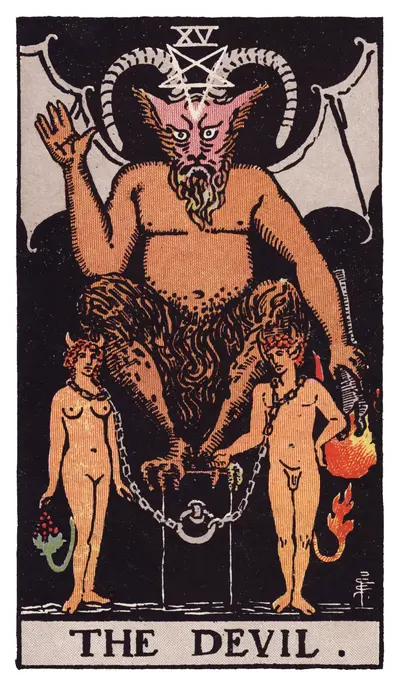
A horned figure with bat wings crouches on a half-cube, one hand raised, an inverted torch in the other. A naked man and woman stand chained to the block, horned and tailed. The chains around their necks are loose. The Devil is bondage that is being participated in — appetite, compulsion, an arrangement that costs more than it gives and is not being left. What makes the card specific and saves it from being a morality lecture is the chains. They are wide enough to lift off, and Smith drew them that way deliberately, which converts the card from a statement about being trapped into a question about why somebody is not leaving. It is numbered fifteen and the two figures are the Lovers redrawn — same posture, horns added — so the deck is explicitly showing what the same pair look like once a choice has stopped being one.
Reversed meaning
Reversed, the hold changes. The commonest reading is release — chains coming off, an arrangement being ended, which is genuinely favourable and is the most frequent meaning. A second is the opposite: the hold tightening or being recognised for the first time, which can read as worse than the upright card because awareness arrives before the exit does. A third concerns detachment that has not been acted on, where the querent has seen the arrangement clearly and is still in it. A fourth: something being called a compulsion that is simply a preference, which is worth raising because the surrounding cards usually show whether there is any cost at all. A fifth reading worth having ready: the arrangement ending because the other party ended it, which looks like release and is not chosen, and which surrounding cards in swords usually confirm.
What Capricorn contributes
Capricorn is cardinal earth, and it is the attribution readers query most — the sign of ambition, structure and the long climb handed to the deck’s card of bondage. The fit is the half-cube. Capricorn builds, and what this figure is perched on is a block: material, solid, real, and only half there. That is the card’s actual subject, which is not evil but the material world taken as the whole of it. The goat in the picture is Capricorn drawn literally. Cardinal earth also explains why the chains are loose: this is an arrangement somebody *initiated* and maintains, not one that happened to them, and a fixed attribution would have made it a condition instead of a choice. The sign’s ruler is Saturn, which is why the card feels heavy rather than frantic.
What is on the card
The chains around the two figures’ necks are visibly wider than their heads. Both have grown small horns and tails, the tails tipped with fire and grapes — the man’s flame, the woman’s fruit, which is Smith distinguishing two appetites rather than one. The torch is held downward and burns. An inverted pentagram sits between the horns. The figure’s raised hand shows an open palm with a sign on it, a parody of the Hierophant’s blessing. The half-cube is black. There is no landscape at all: the frame behind is entirely dark, the only Major drawn against nothing. The raised hand is a parody of the Hierophant’s blessing — same gesture, open palm, a sign written on it — and the two cards are numbered five and fifteen. One transmits something from a lineage and the other transmits nothing at all, which is the comparison the repeated gesture exists to invite.
In a love reading
Attraction that is not good for somebody, a relationship built on need rather than choice, or a dynamic both parties are maintaining. It is among the harder cards on a relationship question and it is not a verdict of doom. The card describes an arrangement with a cost, and the loose chains say the cost is being accepted rather than imposed. On questions about whether to leave it is unusually direct. It also covers ordinary desire without pathology attached, and the fourth reversed reading is worth keeping in mind: not every strong appetite is a chain, and the picture is specific about which ones are. Where a querent asks whether what they feel is love or need, this card does not answer and does something better: it puts the cost on the table. The useful question the picture supplies is what the arrangement is providing and what it is charging, which is answerable where the first question is not.
In a career reading
Work that is well paid and hollow, a role somebody cannot afford to leave, an industry whose terms the querent has stopped questioning. It is among the more precise cards for questions about golden handcuffs, and the half-cube is why: the problem in this card is not the material but the material treated as everything. On questions about whether the querent is stuck it usually indicates that they are choosing, which is unwelcome and more useful than confirmation. On questions about a contract or an obligation it is a caution about terms. On questions about whether an obligation is real, the loose chains are the practical test: a querent who lists the consequences of leaving and finds all of them survivable has just described this card upright, and a querent who finds one that is not has described something else entirely.
How this one is usually misread
The habitual error is theological. There is no devil in the Golden Dawn attribution — there is Capricorn, cardinal earth, the sign of building — and reading the card as evil imports a cosmology the deck does not use. Delivered that way it frightens without informing. The second misreading is helplessness. **The chains are wider than the heads they are around**, which is the single most important detail in the picture and the one every fatalistic reading has to ignore. A third: assuming the card is about addiction specifically. It is about any arrangement maintained against the querent’s own interest, and a job, a habit of thought, and a friendship all qualify — narrowing it to one category loses most of the questions it is drawn for.
How it behaves beside other cards
With the Lovers the pair is the deck quoting itself, and the spread is nearly always about what the earlier choice turned into. Beside Temperance excess sits next to proportion, and the two are numbered adjacent. With the Tower the arrangement is about to end involuntarily, which is the most common way this card resolves. Next to the Star the release has already happened and what follows is repair. Its most uncomfortable neighbour is the Ten of Pentacles, where the arrangement is a whole family’s and nobody is leaving. Beside the Eight of Cups somebody is walking away from exactly this, which is the pairing that answers the question the loose chains raise. With the Four of Pentacles the holding on is material rather than compulsive, and the difference is worth drawing.
Why this card has a planet or sign attached
The twenty-two Major Arcana carry the seven classical planets, the twelve signs and three of the four elements between them — one each, with nothing left over. The Devil takes Capricorn. The allocation is the Golden Dawn’s and it is structural rather than poetic: it is what lets a card be looked up from a chart instead of chosen from a shuffle.
Correspondences follow the Golden Dawn attributions set out in Book T. Degrees are computed from each card’s position in the decan sequence rather than transcribed, so they cannot drift from the spread tool on the rest of this site.
Cards next to this one
See this card come up in your own chart
The spread on our tarot astrology page reads your chart positions as cards — no shuffle, the same answer every time. The daily card does the same for the Moon’s decan right now.