Major Arcana · 14
Temperance
Upright meaning
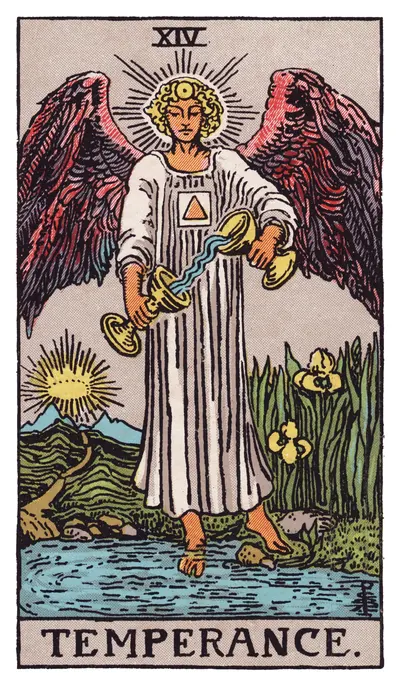
A winged figure stands with one foot on land and one in a pool, pouring liquid between two cups held at an angle no liquid should cross. A path leads back to mountains and a crown of light. An iris grows at the water’s edge. Temperance is combination — two things being brought into a working proportion, which takes time and attention and produces something neither had alone. What makes the card specific is the impossible pour. The cups are held so that the stream runs sideways and upward, and it is not an error: the picture is stating that what is happening here does not occur by itself. It is numbered fourteen and follows Death directly, which is the sequence saying that what comes after an ending is not a new thing but a mixing of what is left.
Reversed meaning
Reversed, the proportion fails. The commonest reading is imbalance — too much of one element, which on a practical question is usually a querent giving everything to one part of their life. A second is impatience: the mixing abandoned before it worked, which is the specific failure of anything that requires time rather than effort. A third concerns excess in the older sense the card’s name carries, where moderation has stopped being practised and the surrounding cards show the cost. A fourth is worth naming: over-moderation, a life balanced so carefully that nothing in it is ever at full strength. A fifth possibility, and the one querents recognise least readily: the mixing being done by one party on behalf of two, where the proportion holds only because somebody is quietly adjusting it and has not mentioned that they are.
What Sagittarius contributes
Sagittarius is mutable fire, and the attribution explains the one thing about this card the picture leaves unaccounted for, which is the path. A card about careful blending could have been drawn entirely at the water’s edge; instead there is a road leading back into mountains with a light above them, and Sagittarius is the sign of the journey toward something distant. Mutability is why the proportion can be adjusted at all — fixed signs hold, cardinal signs start, and only mutable ones modify in flight. The fire half is the part readers skip: this is not a passive card. Something is being actively brought together against its own tendency, which is why the stream runs uphill, and a water or earth attribution would have made the mixing settle rather than work.
What is on the card
One foot is on land and one submerged, the figure standing in both elements rather than between them. The stream between the cups runs at an angle no liquid takes, the deck’s one openly impossible physical event. A square with a triangle inside it is on the breast, and the sun-disc on the forehead marks the figure as an angel rather than a person. The path behind runs to two mountains with a crown of light between them, the same arrangement as the towers on Death and the Moon. Irises grow at the pool’s edge — the flower named for the rainbow, the traditional sign of things joined. The square with a triangle inside it on the breast is the alchemical figure for the work itself, and it is the only card in the Majors carrying a laboratory sign rather than a religious or astrological one. What this figure is doing is a procedure.
In a love reading
Compromise, patience, and the working-out of two people’s differences into something that functions. It is among the most favourable cards for questions about whether a difficult combination can work, and it says the working will be ongoing rather than settled. On questions about reconciliation it is one of the better cards in the deck. Where a querent wants to know whether they are giving too much, the reversed reading of imbalance is the one to weigh, and the honest version of the upright card is that proportion has to be maintained rather than arrived at. On questions about whether two people are too different, this card is among the deck’s more encouraging answers and it does not promise ease: the stream in the picture runs uphill because somebody is holding the cups at exactly the right angle, and lowering them by a degree ends it.
In a career reading
Collaboration, mediation, the integration of two approaches, or work that requires steady adjustment rather than a single decision. It is among the stronger cards for questions about whether two parties can be brought together and among the weaker ones for questions about speed. On questions about a difficult negotiation it is favourable and specific: the card’s method is proportion rather than victory. Its practical contribution is the path in the background, which says this combining has a destination and is not an end in itself. It is the card for the part of a project where two teams, two systems or two standards have to be made to work together, which is unglamorous and is where most of the actual difficulty in large work lives. On questions about whether to appoint a mediator it is a plain yes. Where a querent is the one doing the adjusting for everybody else, the fifth reversed reading is the one to raise: proportion maintained silently by one person is not a balance, it is a subsidy, and it fails the moment they stop.
How this one is usually misread
The frequent error is reading Temperance as mildness, which the name encourages and the picture contradicts. An angel is making liquid run uphill; nothing about that is moderate in the sense of tepid. Delivered as "take it easy" the card loses its subject. The second misreading is treating balance as a fifty-fifty split. **A proportion is not a halving** — the whole skill in this card is deciding how much of each, which is why the figure is watching the stream rather than simply holding the cups. A third: reading it as a state rather than an activity. Both feet are placed, the pour is in progress, and nothing here has been achieved and set down, which is why the card describes a practice and not a result.
How it behaves beside other cards
With Death the sequence reads in order and the mixing is of what an ending left. Beside the Two of Cups the proportion is between two people specifically. With the Devil the same card is its own opposite — excess against measure, and Smith numbered them adjacent. Next to the Seven of Pentacles both cards are asking for the same patience from different directions. Its most useful partner is the Three of Pentacles, where the combining is of skills rather than of temperaments and the result is something built. Beside the Ace of Cups something genuinely new arrives into a mixture that is already working. With the Five of Cups the proportion is being attempted while somebody is still looking at what spilled, which is the most common reason the pour in this card stops.
Why this card has a planet or sign attached
The twenty-two Major Arcana carry the seven classical planets, the twelve signs and three of the four elements between them — one each, with nothing left over. Temperance takes Sagittarius. The allocation is the Golden Dawn’s and it is structural rather than poetic: it is what lets a card be looked up from a chart instead of chosen from a shuffle.
Correspondences follow the Golden Dawn attributions set out in Book T. Degrees are computed from each card’s position in the decan sequence rather than transcribed, so they cannot drift from the spread tool on the rest of this site.
Cards next to this one
See this card come up in your own chart
The spread on our tarot astrology page reads your chart positions as cards — no shuffle, the same answer every time. The daily card does the same for the Moon’s decan right now.