Major Arcana · 16
The Tower
Upright meaning
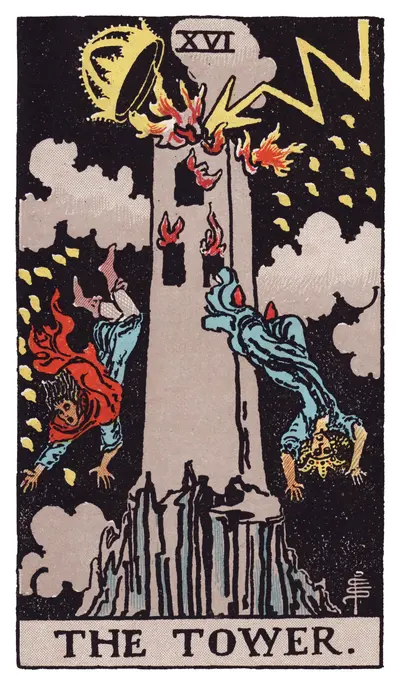
Lightning strikes the crown from the top of a tall tower. Flames come from three windows and two figures fall headfirst, one crowned. Twenty-two flames of light fall on either side against a black sky. The Tower is sudden collapse — a structure failing all at once, from outside, without negotiation. What makes the card specific is the crown. The lightning takes it off the top before anything else, which means what is being struck is not the building but the claim the building was making. When it arrives, something is ending abruptly and the ending is not the querent’s to manage. It is numbered sixteen and follows the Devil directly, which is the sequence at its most pointed: what the loose chains would not end, this card ends instead, and considerably less comfortably.
Reversed meaning
Reversed, the collapse changes character. The commonest reading is a disaster averted or reduced — the lightning that did not strike, which is genuine relief and frequently a delay rather than an escape. A second is collapse resisted, somebody holding up a structure that has already failed, which extends the worst part. A third is the internal version: the upheaval happening inside a querent rather than in their circumstances, which nobody around them can see. A fourth, worth offering because it is common: the collapse already over, with the querent still braced for it. A fifth version is the one that reads worst in practice: a collapse that keeps not quite happening, where the structure is visibly unsound and nothing forces the issue, and the querent is braced indefinitely.
What Mars contributes
Mars is the planet of force, and it is the only Major attribution that is straightforwardly what the picture shows. Mars does not negotiate, does not arrive gradually and does not consult — it is the classical malefic of sudden violence, and a bolt of lightning taking the top off a building is as literal as the scheme gets. But the useful half is what Mars is *for*. In the classical arrangement Mars is what clears, and the tradition has always paired it with the surgeon as well as the soldier: force applied to something that will not yield to anything else. That is why the card is not simply catastrophe. The tower in the picture was built on a rock with no foundation drawn and a crown balanced on top, and Mars is the attribution for what happens to a structure like that rather than the reason it was unsound.
What is on the card
The crown leaves the tower before the figures do, lifted clear by the strike. Twenty-two flames fall on either side — ten on one, twelve on the other, the numbers of the Sephiroth and the signs — so the fire in this card is also light and is falling in an ordered count rather than at random. The tower stands on a bare rock with no visible foundation. Three windows are lit and the structure is otherwise windowless. The sky is entirely black, the only Major with no light in its background at all, which makes the lightning the single source in the frame. The count of the falling flames is deliberate and asymmetric — ten on one side and twelve on the other, the Sephiroth and the signs — so the fire is drawn as an ordered descent rather than as debris. On the deck’s most chaotic image, the one element that could have been scattered is counted.
In a love reading
A sudden break, a revelation that changes what a relationship was, or an upheaval neither party chose. It is among the hardest cards to draw on a relationship question and it is not always an ending — a structure failing can be a set of assumptions rather than the relationship itself. On questions about whether something is about to change it is unambiguous. Where a querent has suspected something and is about to find out, this card is frequently the finding out, and the honest delivery names the suddenness without predicting the content. On questions about a revelation, this card indicates the arrival rather than the content, and the discipline worth keeping is to say so: predicting what the lightning will show is exactly the invented precision this cluster refuses, and the querent almost always has a candidate of their own already.
In a career reading
Redundancy, a company failing, a project collapsing, a public reversal. It is among the clearest cards for questions about whether something is stable, and the answer is no. On questions about what to do it is genuinely limited: nothing in the picture is being managed by anybody. Its practical contribution is the crown. What fails in this card is the claim rather than the person, and a querent who has identified with a position rather than held one is the one for whom this card is worst — which is a thing worth naming before it lands rather than after. Where a querent is asking whether to jump before being pushed, the card is genuinely limited — nothing in the picture is being timed by anybody — but the crown leaving first is a real piece of advice: what is about to fail is the position, so a plan that does not depend on holding it is the one worth having ready.
How this one is usually misread
The persistent error is reading the card as total ruin. It is the deck’s most feared image and the fear outruns the content: a structure falls, two people survive the fall in every reading that does not invent otherwise, and the twenty-two flames are drawn as light rather than debris. Delivered as catastrophe it terrifies without informing. The second misreading is the modern overcorrection, "the Tower is a blessing in disguise," which is worse in a different direction. **It is not a disguise and it is not pleasant**, and a reading that hurries to the silver lining has skipped the part the querent came to have named. A third: treating it as deserved. Nothing in the picture is about fault — Mars is force, not judgement, and the card that weighs a matter is Justice, five cards earlier.
How it behaves beside other cards
With the Devil the sequence reads in order and the arrangement ends the hard way. Beside the Star the collapse is followed by the deck’s clearest picture of repair, and the two adjacent numbers are the most merciful pairing the Tower has. With the Emperor a structure that looked permanent is the thing failing. Next to the Four of Wands a celebration is interrupted. Its most sobering neighbour is the Ten of Pentacles, where what falls is something that took generations to build. Beside the Three of Swords the collapse and the grief arrive in the same spread and the order between them is usually the question. With the Fool somebody is starting again from nothing, which is what the falling figures land in.
Why this card has a planet or sign attached
The twenty-two Major Arcana carry the seven classical planets, the twelve signs and three of the four elements between them — one each, with nothing left over. The Tower takes Mars. The allocation is the Golden Dawn’s and it is structural rather than poetic: it is what lets a card be looked up from a chart instead of chosen from a shuffle.
Correspondences follow the Golden Dawn attributions set out in Book T. Degrees are computed from each card’s position in the decan sequence rather than transcribed, so they cannot drift from the spread tool on the rest of this site.
Cards next to this one
See this card come up in your own chart
The spread on our tarot astrology page reads your chart positions as cards — no shuffle, the same answer every time. The daily card does the same for the Moon’s decan right now.