Minor Arcana · Wands · fire
Nine of Wands
Dates are for 2026 and shift by up to a day between years, because the tropical year is not a whole number of days.
The Book T title
Great Strength, and the title is at odds with the picture in a way that is the whole point. The figure in the image is bandaged and tired; Book T calls the card Great Strength anyway. What it is naming is not capability but reserve — what is left after the capability has been spent. Placed in the second decan of Sagittarius, it sits in the middle of the sign of endurance and distance, which is where a long journey stops being an adventure.
Upright meaning
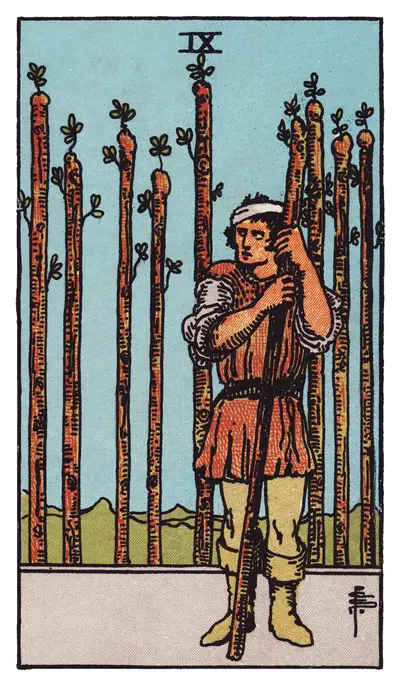
The Nine of Wands is the card of still standing. A man with a bandaged head leans on one stave while eight others stand behind him like a fence, and everything in the image says the same thing: this has been going on for a while and he has not gone down. It is one of the most specific cards in the deck and one of the most recognisable to anyone in the state it describes. What it captures precisely is the mixture of resilience and wariness that comes from having been knocked about — the figure is not looking at the viewer but past them, watching for the next thing. That vigilance is the card’s genuine warning, because it outlasts the threat. People in this position keep defending after the attacks stop, and the card is honest that the guardedness has itself become part of the tiredness. Nine is the last number before completion, which is why the Nine of Wands so often arrives just before the thing being endured ends, and why its advice, insofar as it gives any, is that there is less left than it feels like.
Reversed meaning
Reversed, the commonest reading is the reserve running out — the point at which continuing stops being possible rather than merely hard. It is one of the reversals worth taking seriously rather than softening. A second and more useful reading in practice is the guard coming down: the defence ending because it is no longer needed, which the surrounding cards usually distinguish clearly from collapse. A third concerns paranoia rather than fatigue, where the wariness has outlived every threat and is now generating the isolation it was protecting against — a reading the upright imagery already gestures at, since the eight staves behind him are as much a wall as a shelter.
What Moon in Sagittarius contributes
The Moon in Sagittarius is the odd pairing that gives this card its particular texture. The Moon supplies feeling, memory and reaction; Sagittarius supplies distance and the long haul. Together they produce something very specific: endurance that is emotionally aware of itself. This is not stoicism. The figure knows exactly how tired he is, remembers every previous round, and is standing anyway — and the memory is doing as much work as the standing. That is why the card reads as wariness rather than mere fatigue, and why its subject is so often something that has happened repeatedly rather than something that is merely difficult.
What is on the card
The bandage is the first thing anyone sees and the eight staves behind him are the second, and the relationship between them is the card: he has been hit, and he has assembled what hit him into a defence. He holds a ninth across his body rather than upright. His expression is the most legible in the suit — braced, sceptical, entirely awake. The ground is bare and the hills behind are low and dun-coloured, giving nothing away about where the threat is. Nothing in the frame is moving, which after the Eight of Wands is a deliberate and jarring stop.
In a love reading
A relationship that has survived something and is being guarded. It frequently describes wariness earned honestly — the querent protecting themselves on the basis of experience rather than fear, which the card treats as reasonable. On questions about trusting again it is neither yes nor no; it says the guard is up and that it went up for a reason. It reads poorly on questions about ease and well on questions about whether something can last.
In a career reading
A long stretch of pressure endured, and the card is common in questions about burnout, though it describes the stage before that rather than that. It reads well on questions about whether to keep going — its answer leans yes, with the caveat that less remains than it feels like — and badly on questions about new ventures, since nobody in this card has spare capacity. On questions about workplace conflict it describes someone who has been fighting the same battle repeatedly.
How this one is usually misread
The standard misreading is pessimism — seeing the bandage and reading the card as defeat or as a warning to give up. Book T calls it Great Strength precisely because the figure is still upright, and the card’s position in the sequence matters: nine is the last number before completion, so this arrives near the end of what is being endured rather than in the middle of it. A reading that advises surrender is usually wrong about how much is left. The second error is the opposite and more damaging: treating the wariness as wisdom. The guardedness in this card is earned and it also outlasts the threat, which is the quiet problem in the image — the eight staves behind him are as much a wall as a shelter, and people in this position keep defending long after the attacks stop.
How it behaves beside other cards
After the Seven of Wands it compounds into a defence with visible cost, and the two together are among the clearest fatigue readings the deck offers. Before the Ten it becomes a warning: the load is about to get heavier, not lighter. With the Star or the Four of Swords it reads as relief genuinely arriving, which is one of the more welcome pairings in the deck. Beside the Nine of Swords the fatigue turns inward and the threat becomes harder to locate. Two neighbours are worth watching for. With the Sun the wariness becomes visibly unnecessary, which is a specific and welcome reading — the threat has gone and the guard has not noticed. And beside the Eight of Cups the card turns from endurance into a question about whether the thing being defended is still worth the defence, which the Nine on its own will never ask. With the Ten of Cups it becomes clear what the defence has been for, which is the kindest reading the card allows.
Why this card has a zodiac sign attached
The thirty-six numbered cards from Two to Ten are mapped one-to-one onto the thirty-six decans — the ten-degree slices the zodiac divides into. Nine of Wands holds 250° to 260° of Sagittarius, ruled by Moon in the Chaldean order. That is a lookup from a position on the ecliptic, not an association someone chose, which is why this page can print a degree range and a date range next to it.
Correspondences follow the Golden Dawn attributions set out in Book T. Degrees are computed from each card’s position in the decan sequence rather than transcribed, so they cannot drift from the spread tool on the rest of this site.
Cards next to this one
The rest of Sagittarius
See this card come up in your own chart
The spread on our tarot astrology page reads your chart positions as cards — no shuffle, the same answer every time. The daily card does the same for the Moon’s decan right now.