Minor Arcana · Swords · air
Nine of Swords
Dates are for 2026 and shift by up to a day between years, because the tropical year is not a whole number of days.
The Book T title
Despair and Cruelty is the bluntest title in Book T and the only one naming two things at once. Placed in the second decan of Gemini, the sign of the mind, it describes what the mind does to itself in the small hours — the cruelty in the title is not administered by anybody. It is worth stating plainly that this describes a night rather than a person, and the tradition has always read it that way.
Upright meaning
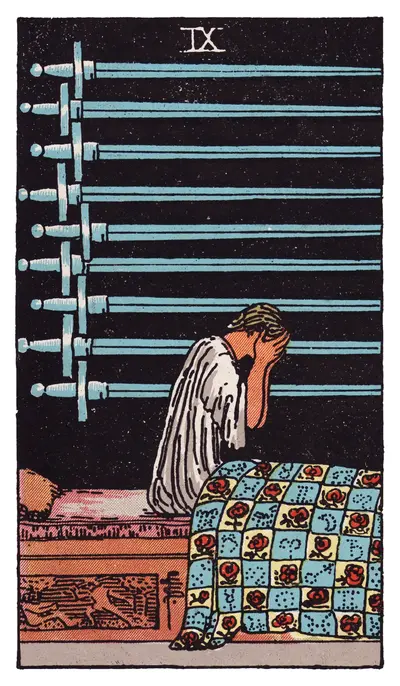
A figure sits up in bed with their face in their hands, nine swords ranged on the wall behind them, a carved panel on the bed showing one figure defeating another. It is the deck’s image of waking in the night with everything at its worst, and it is drawn with unusual restraint — the swords are on the wall, not in anybody. That is the card’s central observation: the thing being suffered is not happening. It is being rehearsed. When the Nine of Swords arrives, the situation being asked about is generating far more distress in anticipation than in fact, which is both a real description and a limited one, because knowing it changes very little at three in the morning. Nine in the pips is nearly-completion, so this arrives near the end of something rather than at its start. The card carries no verdict on the person and no claim about what will happen. It describes a state, and the state is temporary in the specific sense that nights end.
Reversed meaning
Reversed, the night ends. The commonest reading is exactly that — the worst of it passing, morning arriving, proportion returning — and it is favourable and reliable. A second reading concerns the distress being spoken about rather than held, which is frequently the mechanism by which the first happens. A third is less comfortable: the state continuing and becoming ordinary, which the surrounding cards will usually make clear. Readers should offer the first reading first; the upright card is already heavy enough without a reversal being made heavier.
What Mars in Gemini contributes
Mars in Gemini is force in the sign of the mind, and it is the most precise decan-to-image match in the suit. Mars is relentless and Gemini is verbal, so what this pairing produces is thought that attacks — not brooding, which is slow, but something sharp and repetitive that will not stop. That is the cruelty in the title, and its location is unambiguous: Mars here is not directed at anyone else. It also explains the card’s timing. Mars in a mutable air sign does not sustain indefinitely; it exhausts itself, which is why the state this card describes is characteristically nocturnal rather than permanent.
What is on the card
The nine swords hang horizontally on the wall behind the bed, overlapping, and not one of them touches the figure — the most important fact in the image. The bed is solid, with a carved panel on its side showing one figure standing over another, which is the only violence actually depicted. The quilt is worked with roses and zodiac symbols, ordinary comfort rendered in detail. The background is entirely black. The figure’s hands cover their face, so no expression is visible and nothing is being looked at.
In a love reading
Worry about a relationship that is running well ahead of anything that has happened. It frequently describes the night after an unanswered message rather than the aftermath of an event. On questions about whether something has gone wrong, its answer is characteristically that less has happened than is being felt — which is worth offering gently, since the feeling is not reduced by being disproportionate.
In a career reading
Anticipatory worry about work: the review not yet held, the mistake not yet noticed, the decision not yet made. It is one of the most common cards in questions asked at night. Its practical contribution is that the swords are on the wall — the difficulty being rehearsed has not occurred, and often will not in the form being imagined. It also describes the specific pattern of a problem that is entirely manageable during working hours and unmanageable at four in the morning, which is a difference in the hour rather than in the problem. On questions about whether to act now, the card is a reasonable argument for waiting until the light is different before deciding anything.
How this one is usually misread
The frequent error is reading this as a prediction of disaster. Nothing in the image has happened: the swords are on the wall and the room is intact. Delivered as a warning, the card manufactures the exact thing it depicts. The second and more serious misreading is treating it as a statement about the querent rather than about a night — this is the card most likely to be handed to someone as a description of who they are, and neither the tradition nor the image supports that. Book T names a state, the Golden Dawn attributed it to Mars in Gemini rather than to a person, and a reading that turns it into a verdict has gone well beyond what a deck of cards can say.
How it behaves beside other cards
With the Four of Swords the rest that would end it is available and not being taken. Beside the Ten of Cups the gap between a life that looks right and one that feels right becomes the reading. With the Sun the night is genuinely over. Next to the Eight of Swords the reasoning and the distress reinforce each other. Its most useful neighbour is the Ace of Cups or the Star, either of which changes the card from a state into a stage. Beside the Hermit the night is spent alone by choice rather than by circumstance, which changes its character entirely. With the Six of Swords the morning arrives and the crossing begins, and the pair is one of the kinder sequences in this suit. Next to the Temperance card the proportion returns, which is the thing the card most lacks. With the Empress the comfort is physical rather than argued, and it works better than reasoning does. With the Page of Cups somebody offers something kind and it is not registered, which is the specific blindness this state produces. Beside the Four of Cups the offer has been on the table for some time. Beside the Star the night has an end and the card acquires the one thing it otherwise lacks, which is a horizon.
Why this card has a zodiac sign attached
The thirty-six numbered cards from Two to Ten are mapped one-to-one onto the thirty-six decans — the ten-degree slices the zodiac divides into. Nine of Swords holds 70° to 80° of Gemini, ruled by Mars in the Chaldean order. That is a lookup from a position on the ecliptic, not an association someone chose, which is why this page can print a degree range and a date range next to it.
Correspondences follow the Golden Dawn attributions set out in Book T. Degrees are computed from each card’s position in the decan sequence rather than transcribed, so they cannot drift from the spread tool on the rest of this site.
Cards next to this one
The rest of Gemini
See this card come up in your own chart
The spread on our tarot astrology page reads your chart positions as cards — no shuffle, the same answer every time. The daily card does the same for the Moon’s decan right now.