Minor Arcana · Cups · water
Ten of Cups
Dates are for 2026 and shift by up to a day between years, because the tropical year is not a whole number of days.
The Book T title
Perfected Success, and it closes the suit as the Ten of Wands closes fire — but where Wands ends in Oppression, water ends in completion without cost. Book T places it in the final decan of Pisces, the last decan of the zodiac, so this is the terminal card of the entire wheel. The title is doing something unusual: it names a success that is finished rather than growing, which in the Golden Dawn scheme is both the best available state and, by definition, the end of a process.
Upright meaning
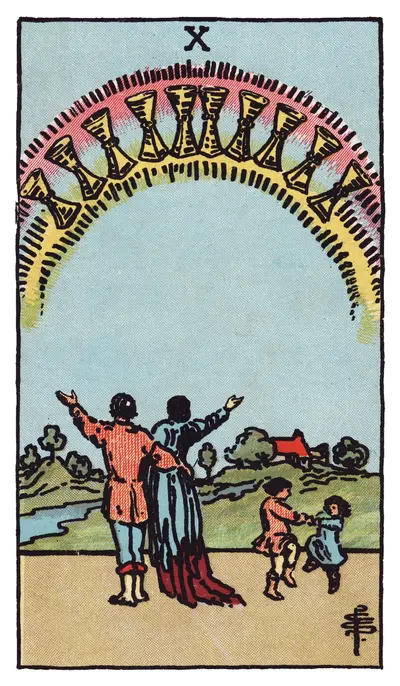
A couple stand with arms raised, two children dancing beside them, beneath an arch of ten cups in a rainbow. A river runs past a house on a low hill. It is the most unambiguously happy card in the deck and one of the very few with nothing withheld anywhere in the frame. What it describes is emotional completion shared with others — not achievement, which belongs to Pentacles, and not satisfaction, which is the Nine. The distinction from the Nine is the whole point and worth stating plainly: the Nine has nine cups on a counter behind one man, and the Ten has ten cups overhead above a family, none of them held by anybody. When it arrives, the thing being asked about is in a good state and the good is not private. The card’s only genuine complication is the one built into the number: ten completes a suit, and what completes has finished. The rainbow is the card telling you this is a moment after something rather than a condition that persists unchanged.
Reversed meaning
Reversed, the picture stays and the participation changes. The commonest reading is the appearance of harmony without the substance — the family in the frame and the feeling absent, which is a specific and quietly common situation. A second is misalignment: the querent wanting a different life from the one in the picture, which the card makes difficult to say out loud precisely because the picture is so obviously good. A third concerns disruption from outside rather than inside. Reversed, this card is rarely catastrophic and is very often about a gap between how something looks and how it is experienced.
What Mars in Pisces contributes
Mars in Pisces is the last decan of the zodiac and an odd pairing to close the suit on: the planet of force in the sign with nothing to push against. What it produces is not conflict but expenditure — Mars spending itself completely, which is what "perfected" means here. The energy has been used rather than stored. That is why the figures in the card have their arms up and nothing in their hands: there is no effort left in the image. Pisces dissolves the boundaries Mars would normally defend, which is also why this is a card about a group rather than a person.
What is on the card
The ten cups are in the rainbow and nobody is holding any of them, which is the single most important detail and the clearest contrast with the Nine. The two adults stand with arms around each other and free arms raised; the two children dance separately, not looking at the rainbow at all. The house sits on a rise above a river, modest and solid. There is no gold, no display and no audience anywhere in the frame. The light is even, and the only elevated element is the one nobody can reach.
In a love reading
The best card in the deck for a relationship question and one of the few that speaks to family rather than to a couple. It describes emotional security shared with others, which is a different and larger claim than mutual attraction. On questions about long-term prospects it is the strongest affirmative available. Its one caution is structural: ten completes, so the card describes a state arrived at, and it says nothing about what maintains it.
In a career reading
Less directly applicable than in other suits, and most useful on questions about whether a working life is compatible with the rest of one — which is a real question and badly served by the rest of the deck. Where it appears in a straightforward career question it usually indicates that the answer involves people rather than position, and that the querent already knows which. On questions about a team or a long partnership it is strongly favourable, and on questions about individual advancement it is close to silent, since nobody in the image is holding anything of their own.
How this one is usually misread
The usual error is reading this as permanence. Ten is completion, and what completes is finished — the rainbow in the image is explicitly a moment rather than a fixture, which is why it is a rainbow and not a roof. Delivered as "this will always be so", the card makes a promise the number contradicts. The second misreading is treating it as interchangeable with the Nine. They describe different things: the Nine is one person satisfied with cups he has accumulated and can see; the Ten is a group under cups nobody owns. Reading the Ten as simply more of the Nine loses the distinction between having got what you wanted and having something that is not about you.
How it behaves beside other cards
With the Four of Wands it becomes domestic and frequently literal — a home, a marriage, a household established. Beside the Eight of Cups it is the most painful pairing in the suit, because the thing being walked away from is this. With the Three of Cups the circle widens from family to community. Its most sobering neighbour is the Ten of Swords, which is the same completeness in the opposite register and usually means one area of life is finished in each sense. Next to the Ace of Cups the completion turns out to be a beginning, which is the deck’s way of saying the wheel does not stop here. With the Empress the domestic reading becomes literal and often concerns children. Beside the Nine of Swords the gap between the picture and the experience opens wide, and the pair is one of the clearest statements the deck makes about a life that looks right from outside. With the Six of Cups the family in the picture is partly remembered, and the card acquires a tense it does not otherwise have. Beside the Sun the whole picture becomes unqualified, which is as good as two cards together get.
Why this card has a zodiac sign attached
The thirty-six numbered cards from Two to Ten are mapped one-to-one onto the thirty-six decans — the ten-degree slices the zodiac divides into. Ten of Cups holds 350° to 360° of Pisces, ruled by Mars in the Chaldean order. That is a lookup from a position on the ecliptic, not an association someone chose, which is why this page can print a degree range and a date range next to it.
Correspondences follow the Golden Dawn attributions set out in Book T. Degrees are computed from each card’s position in the decan sequence rather than transcribed, so they cannot drift from the spread tool on the rest of this site.
Cards next to this one
The rest of Pisces
See this card come up in your own chart
The spread on our tarot astrology page reads your chart positions as cards — no shuffle, the same answer every time. The daily card does the same for the Moon’s decan right now.