Minor Arcana · Cups · water
Nine of Cups
Dates are for 2026 and shift by up to a day between years, because the tropical year is not a whole number of days.
The Book T title
Material Happiness, and both words are load-bearing. Book T is naming contentment that has an object — satisfaction in things that can be counted, rather than the diffuse well-being the popular "wish card" reading suggests. Placed in the second decan of Pisces, in the sign least concerned with the material, the title reads almost as a correction: this is what Pisces produces when it does get what it wants, and what it wants turns out to be tangible.
Upright meaning
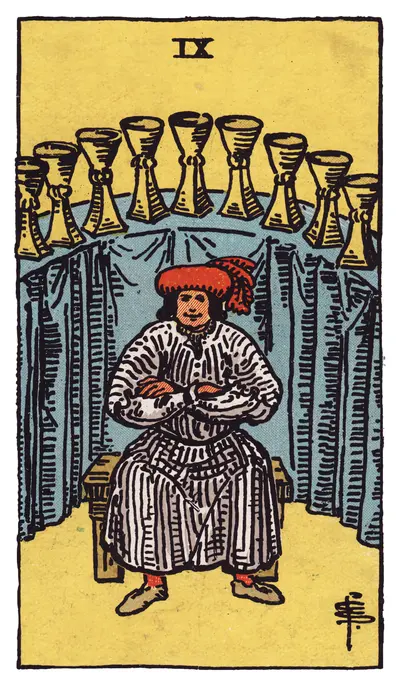
A man sits with folded arms before nine cups arranged on a curved counter behind him, draped in blue cloth. He is well fed, well dressed and pleased. The Nine of Cups is the deck’s satisfaction card and it is more specific than its reputation: the cups are behind him, on display, and he is facing the viewer. This is contentment that includes being seen to be content. That is not a criticism — the card is genuinely favourable and one of the better ones to draw on almost any question — but it is the detail that distinguishes it from the Ten, where the cups are overhead and shared. Nine in the pips is nearly-completion, so what the card describes is a sufficiency arrived at rather than a conclusion. Its popular name, the wish card, comes from precisely this: it is the state of having got what you asked for, which is a narrower thing than having everything you need.
Reversed meaning
Reversed, the satisfaction becomes questionable rather than absent. The commonest reading is getting what was wanted and finding it insufficient, which is the specific disappointment this card is uniquely positioned to describe. A second reading concerns display: contentment performed rather than felt, which the upright arrangement of cups on a counter always risks. A third and gentler one is simply indulgence — the same pleasures taken past the point where they give anything back. The card is rarely severe reversed, and the most common honest reading is that something was achieved and has not delivered what was expected of it.
What Jupiter in Pisces contributes
Jupiter in Pisces is a planet in the sign it traditionally rules, the third such placement among the pips, and it is the most generous combination available in the deck. Jupiter expands and Pisces has no edges, so nothing constrains the increase. That is why the card is favourable almost without qualification. It also accounts for the card’s one weakness: Jupiter in Pisces does not know when to stop, which is what makes the reversed reading of excess so natural and why the upright card sits so close to indulgence without quite arriving there.
What is on the card
The nine cups stand in a single row on a curved counter, raised above and behind the seated figure, which puts them on display rather than in use — none is in his hand. The blue cloth beneath them conceals whatever the counter is, so the foundation of all this is deliberately not shown. He wears a red cap and white tunic, arms folded in satisfaction rather than defence, and sits on a low wooden bench that is noticeably plainer than the display behind him. The background is blank. Nothing else exists in the frame.
In a love reading
Contentment, and frequently a relationship that is simply going well — which is rarer as a reading than it sounds, since most cards drawn on love questions describe movement rather than state. On wish questions it is the most affirmative card in the deck. Its limitation is the folded arms: the figure is not reaching toward anyone, so on questions about connection rather than satisfaction it is less useful than its warmth suggests.
In a career reading
Achievement enjoyed, a goal reached, a comfortable position. It is one of the more favourable cards on questions about whether something will come off. On questions about what to do next it is unhelpful by design, since the figure has stopped, and on questions about ambition it sometimes indicates a target that has been reached and not replaced. On money questions specifically it is one of the clearest favourable cards available, since Material Happiness is the title and the counter behind him is full.
How this one is usually misread
The persistent error is the wish card reading taken as a promise. It is a real part of the tradition and it is narrower than it gets delivered: the card describes having got what was asked for, which is not the same as the wish being the right one. Handed to a querent as "you will get what you want", it makes a prediction the card does not make and skips the more useful question of whether the thing wanted will do what is expected of it. The second misreading is confusing this with the Ten of Cups. The Nine is one person, satisfied, with the cups behind him; the Ten is a family under an arch of them. Satisfaction and shared happiness are different conditions, and a reading that treats them as degrees of the same thing loses the distinction the two cards exist to make.
How it behaves beside other cards
With the Ten of Cups it escalates from personal satisfaction to shared, and the pair is about as favourable as two cards get. Beside the Four of Cups it becomes the same contentment gone flat, which is a sequence worth watching for over successive readings. With the Devil the indulgence hardens into something being used rather than enjoyed. Its most instructive neighbour is the Five of Pentacles, which is its exact inverse and turns the display into something precarious. Next to the Seven of Cups the wish is identified as one of the seven, which is the most practical thing that pairing can do. With the Page of Wands the satisfaction turns out to be a staging post rather than a destination. Beside the Hermit it becomes contentment that has quietly become solitude, which is the least comfortable thing this card can be made to say and occasionally the true one. With the Ten of Pentacles the satisfaction turns out to rest on something built by other people over a long time. Beside the Four of Wands the satisfaction becomes shared and acquires an occasion. With the Two of Cups it stops being a private state and turns into something one other person is also enjoying, which is the difference between contentment and company. Beside the Ace of Pentacles the satisfaction acquires a source, which this card otherwise never shows.
Why this card has a zodiac sign attached
The thirty-six numbered cards from Two to Ten are mapped one-to-one onto the thirty-six decans — the ten-degree slices the zodiac divides into. Nine of Cups holds 340° to 350° of Pisces, ruled by Jupiter in the Chaldean order. That is a lookup from a position on the ecliptic, not an association someone chose, which is why this page can print a degree range and a date range next to it.
Correspondences follow the Golden Dawn attributions set out in Book T. Degrees are computed from each card’s position in the decan sequence rather than transcribed, so they cannot drift from the spread tool on the rest of this site.
Cards next to this one
The rest of Pisces
See this card come up in your own chart
The spread on our tarot astrology page reads your chart positions as cards — no shuffle, the same answer every time. The daily card does the same for the Moon’s decan right now.