Minor Arcana · Wands · fire
King of Wands
The Book T title
Book T calls this figure the Lord of the Flame and the Lightning, King of the Spirits of Fire, and the RWS rank matches the Golden Dawn’s Knight rather than its Prince — the mounted lord, the oldest and most authoritative of the four. The ranks in Book T are themselves elemental, which is the most explanatory fact the tradition supplies about the courts and is rarely printed: the King is fire, the Queen water, the Knight air, the Page earth, each modifying its suit. This card is therefore fire of fire, one of only four doubled courts and the most concentrated expression of its element in the deck. Nothing tempers it. The lightning in the title is the giveaway — not a steady flame but the kind that arrives all at once and settles nothing about what happens next.
Upright meaning
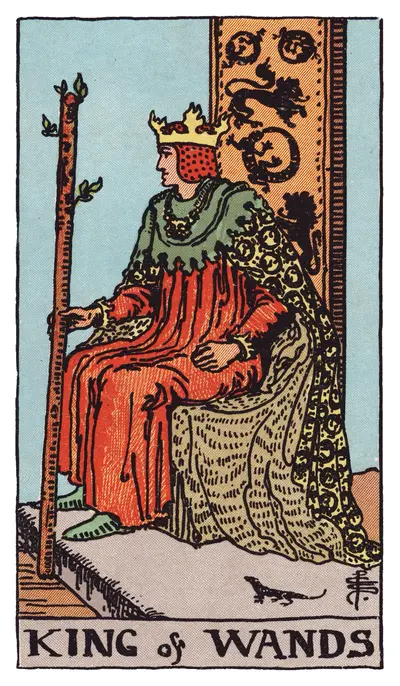
A man sits in profile on a throne carved with lions and salamanders, holding a budding staff, with a live salamander at his feet. He is turned slightly away, mid-motion, as though about to stand. The King of Wands is vision with the authority to act on it — somebody who sees where a thing should go and has the standing to take it there. What separates him from the Knight of the same suit is not calm but scale: the Knight pursues something and the King commissions it. When he arrives, the matter being asked about involves leadership of the entrepreneurial rather than administrative kind, and the distinction is worth preserving in a reading. This is not a figure who manages. He decides a direction and expects other people to supply the detail, which is why he is the most effective court card to have on your side and the hardest to work for.
Reversed meaning
Reversed, the authority becomes its own subject. The commonest reading is arrogance — vision that has stopped being checked against anything, which is the specific failure of a doubled fire card. A second is impatience with other people, where the direction is sound and the figure has no tolerance for anybody who needs it explained. A third is more sympathetic and frequently accurate: a leader with nothing left to lead, authority intact and no direction in it. Where the surrounding cards involve subordinates the second applies; where they involve the querent alone, the third.
Why this card spans two signs
This King holds the last twenty degrees of Scorpio running into the first ten of Sagittarius, which is a darker span than the fire suit suggests and explains a great deal. The closing decans of Scorpio are about power and what it costs; the opening of Sagittarius is conviction and expansion. A figure straddling that seam has come through something and turned it into direction, which is why the King of Wands has weight the Knight does not. The twelve spanned courts each cover thirty degrees this way, with the seams deliberately falling inside signs rather than between them.
Read as a person
Read as a person, the King of Wands is somebody who starts things and gets other people to build them. They are persuasive, impatient and usually right about direction and wrong about timescale. Their characteristic strength is that they can make a room believe in something. Their characteristic cost is that the detail is somebody else’s problem and always has been. Deciding whether a court card means another person, the querent, or the situation is the one difficulty these sixteen share, and the tradition supplies no rule. The tell here is position: where somebody in the reading has the authority to decide, that person is this card. Where the querent is being asked to lead rather than to deliver, it is the querent. As a situation it describes circumstances where a direction has been set and the details have not.
What is on the card
The throne carries lions and salamanders, and the salamanders here are complete circles with their tails in their mouths — the same emblem the Page and Knight wear unfinished. A live salamander sits at his feet, the only one outside the furniture. His staff is budding, as every Wands staff in the deck is. His crown is flame-shaped. He is seated in profile, turned away, one foot forward: alone among the four Kings he does not look settled in the chair, and the image is quite deliberate about it. Worth noticing too is what is not in the frame. Behind him there is nothing — a flat ochre ground with no horizon, no building, no landscape of any kind. The two Wands courts with thrones share that emptiness and no other court card does: the King of Swords has trees and sky, the King of Cups a sea and a ship, the King of Pentacles a castle and his own vineyard. A suit whose whole subject is what has not happened yet is drawn against a background containing no evidence of anything having happened, and for a figure whose authority rests on vision rather than on holdings, that is a more accurate setting than an estate would be.
In a love reading
Somebody whose conviction is the attraction, or a relationship in which one person is setting the direction. It is favourable on questions about whether somebody is serious — this figure does not hedge — and less useful on questions about whether they will be present for the ordinary parts. On questions about commitment it is a strong affirmative of the decisive kind: the decision will be made quickly and then treated as settled, which suits some querents and not others.
In a career reading
Founders, directors, anybody whose job is to say where a thing goes. It is among the strongest cards for questions about starting a business or taking a leadership role, and among the weaker ones for questions about working within a structure somebody else runs. On questions about a manager it indicates someone inspiring and demanding in roughly equal measure. On questions about whether an ambitious plan has backing, it is a clear yes.
How this one is usually misread
The frequent error is reading the Kings as simply the most powerful version of their suit, which flattens four distinct offices into a ranking. A King is the fire of his element — its initiating, directing aspect — and the Queen is its water, which is a difference in kind and not in seniority. The second misreading is treating this figure as steady because he is a King. He is the only one of the four not sitting still, his salamanders are the finished emblem of a suit that never finishes anything, and doubled fire is the least temperate compound in the deck. He is authoritative. He is not calm.
How it behaves beside other cards
With the Knight of Wands the direction meets the pursuit and the pair often describes a leader and the person carrying it out. Beside the Emperor two kinds of authority sit together and the reading usually turns on which is legitimate. With the Three of Pentacles the vision finally meets people who can build it. Next to the Eight of Wands everything he set in motion arrives at once. Its most testing neighbour is the Seven of Pentacles, where a figure constitutionally unable to wait is in a situation that only rewards waiting.
Why this card spans two signs
The twelve court cards above Page each cover the last twenty degrees of one sign and the first ten of the next, so the twelve of them tile the circle once with the seams falling inside signs rather than between them. King of Wands runs from Scorpio into Sagittarius. Pages take a whole seasonal quadrant instead and have no degree span.
Correspondences follow the Golden Dawn attributions set out in Book T. Degrees are computed from each card’s position in the decan sequence rather than transcribed, so they cannot drift from the spread tool on the rest of this site.
Cards next to this one
See this card come up in your own chart
The spread on our tarot astrology page reads your chart positions as cards — no shuffle, the same answer every time. The daily card does the same for the Moon’s decan right now.