Minor Arcana · Wands · fire
Queen of Wands
The Book T title
The Queen of the Thrones of Flame, and Book T’s Queens are the receptive, sustaining aspect of their element rather than its active expression. That distinction does real work here: the Knight of Wands has fire’s momentum and the Queen has its warmth, which is the quality that lasts. A throne is a fixed position, and a queen of flame is somebody who holds fire in place rather than carrying it somewhere. Book T gives each rank an element of its own, and the resulting compound is the most explanatory fact the tradition supplies about the courts. King is fire, Queen water, Knight air, Page earth. This card is therefore water of fire, which sounds like a contradiction and is in fact the description of warmth rather than flame. Water is what makes fire sustainable in this scheme — it gives it a vessel and a depth — and that is precisely what separates this figure from the Knight of the same suit. His fire is fast and hers has somewhere to sit.
Upright meaning
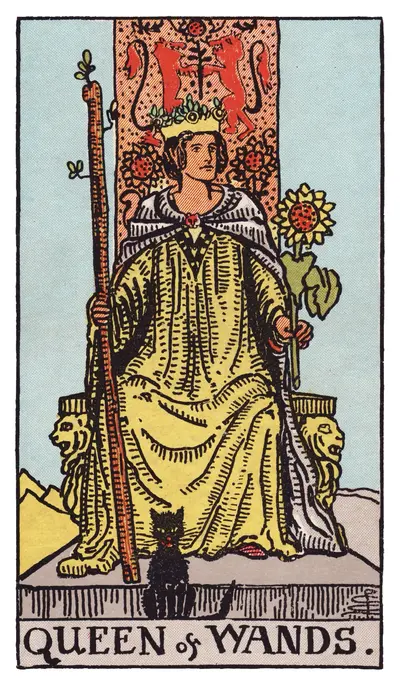
A woman sits facing forward on a throne carved with lions, holding a sunflower in one hand and a budding staff in the other, with a black cat at her feet. Of the four Queens she is the only one looking directly out of the card. The Queen of Wands is warmth with authority behind it — magnetism, confidence, the kind of presence that organises a room without raising its voice. What separates her from the Knight is durability: the fire here has been burning for a long time and shows no sign of consuming its own fuel. When she arrives, the thing being asked about involves somebody whose personal authority is the operative factor. The black cat at her feet is the card’s unresolved element and the tradition has never agreed about it, which is itself informative — there is something in this figure that is not entirely accounted for by the warmth.
Reversed meaning
Reversed, the warmth becomes demanding. The commonest reading is confidence tipping into domination — presence that has stopped leaving room for anybody else, which is the specific failure of this figure. A second concerns jealousy, and the tradition is old on this point: the reversed Queen of Wands is the deck’s most consistent indicator of possessiveness. A third is more sympathetic and frequently accurate: warmth that has been spent, somebody who has been the room’s energy for too long and has none left. Where the reading involves others the first two apply; where it involves the querent, the third.
Why this card spans two signs
This Queen holds the last twenty degrees of Pisces running into the first ten of Aries, which is the seam where the zodiac ends and begins — the only court card spanning the year’s hinge. That accounts for something the image alone does not explain: her warmth has depth under it. The closing decans of Pisces are boundaryless and receptive, and the opening of Aries is pure initiation, so this figure feels everything and then acts anyway. The twelve spanned courts each cover thirty degrees with the seams inside signs; this one is the only seam that is also the start of the wheel.
Read as a person
Read as a person, the Queen of Wands is someone whose presence is the point. They are warm, direct, and considerably more perceptive than their sociability suggests — the Pisces end of the span is doing quiet work. Their characteristic strength is that other people become more themselves around them. Their characteristic difficulty is that this is not switchable, so they are as visible on a bad day as a good one. In readings about other people this figure is usually somebody the querent is drawn to. As the querent it indicates operating from personal authority rather than from position. A court card can be another person, the querent, or the situation, and the deck offers no rule for telling them apart — the standing problem with these sixteen. The tell here is attention. Where the question concerned somebody the querent is drawn to, the card is almost certainly them; this figure is not a background presence in anybody’s life. Where the question was about the querent’s own standing, it is the querent, and it is one of the more encouraging things to be told. As a situation it describes circumstances where personal presence, rather than merit or position, is deciding the outcome.
What is on the card
She is the only Queen facing directly forward, meeting the viewer’s eye. The sunflower she holds appears again on the throne’s back and is the card’s emblem of warmth returned. Lions are carved into the throne, doubled, facing outward. The black cat sits at her feet looking out, the only animal in the four Queens and the element the tradition has never settled. Her staff is budding. Behind her the background is a plain desert ochre with no landscape at all.
In a love reading
Somebody whose warmth is the attraction, or a relationship in which one person is unmistakably the sun it orbits. It is favourable and it is not symmetrical, which is worth naming: nothing in this card is an exchange. On questions about whether somebody is interested it is a clear affirmative, since this figure does not conceal. On questions about a rival it is the card most likely to be indicating one, and the tradition’s association with jealousy sits reversed rather than upright.
In a career reading
Leadership by presence rather than by title, and one of the best cards for questions about whether the querent can carry a room. It appears in questions about client work, teaching, performance and anything where personal energy is the deliverable. On questions about management it is favourable and slightly warning: this figure leads by being followed, which does not survive being resented. On questions about whether to take a visible role, it is a plain yes.
How this one is usually misread
The frequent error is reading the Queens as women, which halves the deck for no reason the tradition supports. A Queen is the sustaining aspect of an element, and anybody operating in that mode fits. The second misreading is treating this figure as merely charming. The span reaches back into the last degrees of Pisces, the black cat is watching something, and the tradition has consistently attached both perceptiveness and jealousy to her — a reading that stops at warmth has taken the easiest third of the card and left the part that makes her interesting.
How it behaves beside other cards
With the Knight of Wands the fire appears in its impatient form and the pair often describes two people who recognise each other. Beside the Queen of Pentacles two entirely different modes of care sit together. With the Seven of Wands the warmth is being defended. Next to the Moon the black cat acquires significance and the card’s unaccounted element becomes the reading. Its most revealing neighbour is the Nine of Pentacles, where a comparable self-possession exists with nobody else in the room. Beside the Sun the warmth is uncomplicated and the black cat stops mattering. With the Five of Pentacles somebody outside the door would be let in immediately if they knocked, which this card makes likelier than most.
Why this card spans two signs
The twelve court cards above Page each cover the last twenty degrees of one sign and the first ten of the next, so the twelve of them tile the circle once with the seams falling inside signs rather than between them. Queen of Wands runs from Pisces into Aries. Pages take a whole seasonal quadrant instead and have no degree span.
Correspondences follow the Golden Dawn attributions set out in Book T. Degrees are computed from each card’s position in the decan sequence rather than transcribed, so they cannot drift from the spread tool on the rest of this site.
Cards next to this one
See this card come up in your own chart
The spread on our tarot astrology page reads your chart positions as cards — no shuffle, the same answer every time. The daily card does the same for the Moon’s decan right now.