Minor Arcana · Wands · fire
Knight of Wands
The Book T title
The Golden Dawn calls this figure the Prince of the Chariot of Fire, and the title is worth having because the English rank obscures it. Our Knight is their Prince — the chariot-borne son rather than the mounted lord — and the whole character of the rank follows from that. A Prince is in motion on somebody else’s authority, which is a different position from a King and a more precarious one. The Knights are the deck’s cards of active pursuit, and this one pursues hardest. The ranks in Book T are themselves elemental, which is the fact that explains the court cards better than anything else in the tradition and is rarely printed. Each rank carries an element that modifies the suit: the King is fire, the Queen water, the Knight air, the Page earth. That makes this card air of fire — wind on a flame, which is the most accurate two-word description of the Knight of Wands available. Air does not create fire and it does not sustain it; it accelerates it, carries it sideways, and can put it out. Every reading of this figure as thrilling and unreliable is a restatement of that compound.
Upright meaning
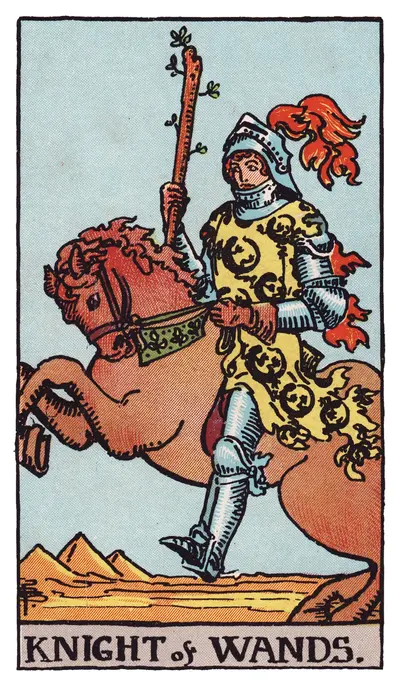
An armoured rider on a rearing horse, salamanders on his tunic, plume streaming, three pyramids in the distance. The horse has left the ground. Of the sixteen court cards this is the one with the most momentum in it and the least control, and the two facts are the same fact. The Knight of Wands is pursuit — a person or a situation moving fast toward something wanted, with the energy entirely real and the follow-through unproven. What separates it from the Page of Wands is that the Page has appetite and this figure has already set off. When it arrives, something is in motion and the motion is characteristic rather than accidental: this is how the person or the situation operates. The card carries no warning and no endorsement. It simply notes that the pace is high and that nothing in the image indicates where the rider is going, since the pyramids behind him are the same ones the Page was standing among and he is riding away from them.
Reversed meaning
Reversed, the momentum turns destructive or evaporates. The commonest reading is recklessness — speed without judgement, the horse bolting rather than being ridden, which is the rank’s natural failure. A second is the opposite: the pursuit stalling, energy that was going somewhere and stopped, which is more common than the imagery suggests. A third concerns the person rather than the pace, where reversed the card describes someone whose enthusiasm is unreliable in a way that has begun to cost other people. Where the reading involves a project the first applies; where it involves a person, the third.
Why this card spans two signs
This Knight holds the last twenty degrees of Cancer running into the first ten of Leo, which is a combination that explains more of the card than the fire suit does on its own. The final decan of Cancer is watery and defensive; the opening of Leo is undiluted self-assertion. A figure straddling that seam begins in something protective and ends in something demonstrative, which is why the Knight of Wands is more sensitive than he looks and reacts to slights faster than to opportunities. The twelve spanned courts each cover thirty degrees this way, and the seams deliberately fall inside signs rather than between them.
Read as a person
Read as a person, the Knight of Wands is someone who commits fast and completely, usually to the thing in front of them. They are genuinely energising to be around and genuinely difficult to plan with. Their characteristic failure is not laziness but succession — the next thing arrives and is pursued with the same conviction as the last. In readings about other people this figure is frequently the one who has just proposed something dramatic. As the querent it describes being mid-pursuit, which is a good state to be in and a poor one from which to assess anything. Deciding whether a court card is somebody else, the querent, or the situation is the one problem these sixteen cards have and the tradition supplies no rule for it. The tell here is the question that was asked. If it concerned a person, this figure is almost always them, because the Knight of Wands is conspicuous and querents do not usually fail to notice being pursued. If it concerned a decision, the card is far likelier to be the querent’s own state — wanting something at a speed that has not been examined. As a situation rather than a person it describes circumstances that are accelerating without anybody having chosen it.
What is on the card
The horse is rearing with both forelegs off the ground, the only mount in the deck not in contact with the earth — every other Knight’s horse is walking, galloping or standing. Salamanders cover the tunic, several with their tails not quite in their mouths, the same incomplete circles the Page of Wands wears. The staff is budding and held upright rather than levelled. Three pyramids stand in the background, the same landscape as the Page. His visor is up, so the face is visible: he is not expecting resistance.
In a love reading
Passion arriving at speed, and one of the clearest cards in the deck for an intense beginning. It reads well on questions about whether there is heat and badly on questions about whether it will last, which is the rank’s consistent limitation rather than a judgement about anyone. It also describes a relationship in a phase of high momentum where neither party is doing much thinking, which is a real and enjoyable stage the deck rarely gets accused of being sentimental about. Where the question is about someone’s intentions, the card is honest: the intentions are sincere and were formed quickly.
In a career reading
A project moving fast, a role that demands drive, or a colleague who operates at a pace others cannot match. It is favourable on questions about launching something and unhelpful on questions about maintaining it. On questions about travel or relocation for work it is frequently literal. Its practical contribution is the rearing horse: the energy is real and is currently not touching the ground, so on questions about whether a plan is grounded the answer is that it has not been tested against anything yet.
How this one is usually misread
The frequent error is reading this as a young man, which narrows a card about a mode of operating into a demographic. Court cards describe how somebody is behaving, and a cautious person in a phase of pursuit is the Knight of Wands regardless of age or sex. The second misreading is treating the speed as a warning. Nothing in the image is going wrong — the rider is in control, his visor is up, the horse is rearing rather than bolting — and delivering the card as recklessness imports the reversed meaning into the upright position. The pace is the card’s subject, not its problem.
How it behaves beside other cards
With the Page of Wands the same energy appears in its earlier form and the pair often describes one person at two stages. Beside the Eight of Wands everything accelerates at once. With the Four of Swords the pursuit is exactly what should be paused. Next to the Queen of Wands the momentum meets somebody who has sustained it for decades. Its most sobering neighbour is the Seven of Pentacles, where speed meets a situation that can only be waited out. Beside the Ace of Wands the pursuit has a genuine opportunity behind it rather than a mood, which is the difference between this card being exciting and being useful. With the Tower the speed meets something that was going to collapse anyway.
Why this card spans two signs
The twelve court cards above Page each cover the last twenty degrees of one sign and the first ten of the next, so the twelve of them tile the circle once with the seams falling inside signs rather than between them. Knight of Wands runs from Cancer into Leo. Pages take a whole seasonal quadrant instead and have no degree span.
Correspondences follow the Golden Dawn attributions set out in Book T. Degrees are computed from each card’s position in the decan sequence rather than transcribed, so they cannot drift from the spread tool on the rest of this site.
Cards next to this one
See this card come up in your own chart
The spread on our tarot astrology page reads your chart positions as cards — no shuffle, the same answer every time. The daily card does the same for the Moon’s decan right now.