Minor Arcana · Swords · air
Queen of Swords
The Book T title
The Queen of the Thrones of Air, and of the four Queens she is the one whose throne is most visibly earned. Book T’s Queens sustain their element, and sustained air is clear thought maintained over time — not a flash of insight but a settled accuracy about how things are. The title is worth having because the popular reading of this card as severity misses that a throne is a position of responsibility rather than of judgement. Book T makes each rank elemental in itself, and the compound is the most useful single fact about any court card. King is fire, Queen water, Knight air, Page earth. This card is water of air — feeling underneath thought, which is not what her reputation suggests and is what the image shows. The raised open hand, the tilt of the sword, the fact that she is the only Queen drawn in strict profile: all three read differently once the compound is known. Her clarity has water in it. That is why the tradition attaches grief to this figure and not merely judgement.
Upright meaning
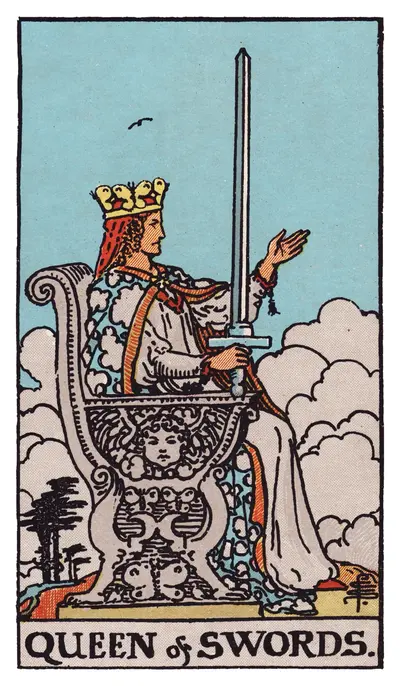
A woman sits in profile on a throne carved with butterflies and a sylph, one hand raised and open, a sword held upright in the other. Clouds sit below the throne and a single bird flies overhead. The Queen of Swords is clear sight without illusion — somebody who understands the situation accurately, including the unflattering parts, and has stopped expecting it to be otherwise. Her reputation is coldness and the reputation is unfair: the open hand is the detail that undoes it. She is not warding anybody off; she is receiving. When she arrives, the thing being asked about involves somebody who sees it plainly, and the card’s contribution is usually that the honest account is available if the querent wants it. What makes her formidable is not severity but the absence of any interest in comfortable versions.
Reversed meaning
Reversed, the clarity turns. The commonest reading is bitterness — accuracy that has curdled into something that enjoys being right, which is the specific failure of this figure. A second is the opposite: judgement clouded, usually by an attachment the querent would rather not examine. A third concerns coldness as protection rather than temperament, where the reversal describes somebody who has been hurt into this position rather than arriving at it. The third is offered too rarely and is frequently the most accurate.
Why this card spans two signs
This Queen holds the last twenty degrees of Virgo running into the first ten of Libra, and the combination explains her better than the suit does. The closing decans of Virgo are exacting and unsentimental about detail; the opening of Libra is concerned with fairness and with what is owed. A figure spanning that seam is precise and just, which is a very different thing from being harsh — her accuracy has a principle behind it. The twelve spanned courts each cover thirty degrees, with the joins falling inside signs rather than between them.
Read as a person
Read as a person, the Queen of Swords is someone who will tell you the truth and will not enjoy doing it. They are typically somebody who has been through something and has declined to become sentimental about it. Their characteristic strength is that their assessment can be relied on. Their characteristic cost is that people bring them problems and not warmth. In readings about other people this figure is often the one whose opinion the querent is avoiding asking for. As the querent it describes seeing a situation without the comfortable interpretation, which is uncomfortable and usually correct. A court card may be another person, the querent, or the situation, and the tradition supplies no way of choosing — the difficulty these sixteen share. The tell here is avoidance. Where there is somebody whose opinion the querent has not asked for, that person is usually this card. Where the querent has already worked out the unflattering answer and is looking for a second view, the card is them. As a situation it describes circumstances that can be seen plainly and have not yet been described plainly by anybody, which is a gap a reading can close in one sentence.
What is on the card
Her raised hand is open and extended toward the viewer, not defensive — the single most misread element in the card. The sword is upright and tilted slightly, not vertical, which reads as ready rather than ceremonial. Butterflies are carved into the throne and one is worked into her crown; a sylph, the air elemental, appears on the throne’s side. Clouds bank beneath the throne so that she is seated above them. A tassel hangs from her wrist. She is in strict profile, the only Queen who does not face the viewer at all.
In a love reading
Somebody who sees the relationship clearly, which can be the most loving thing in a reading or the least comfortable. It appears frequently in questions after a separation, where it describes the stage at which the situation is understood rather than mourned. On questions about whether to be honest it is a plain yes. It also indicates a partner or friend whose directness is a form of care, and the open hand is worth pointing at: this figure is not withholding.
In a career reading
Professional judgement, difficult feedback, somebody whose assessment settles a matter. It is among the strongest cards for questions about whether the querent is seeing a work situation accurately. On questions about a manager or a colleague it indicates someone fair and unsentimental. On questions about negotiation it is favourable and warns that this figure has already worked out what the other side wants.
How this one is usually misread
The frequent error is reading her as bitter, which is the reversed meaning and has attached itself to the upright card through sheer repetition. Look at the hand: it is open and extended. A figure warding people off would not be drawn that way, and the tradition of the widow or the cold woman is an interpretive layer rather than something in the picture. The second misreading is treating clarity as unkindness. The Libra half of her span is about fairness, and an accurate account delivered without flattery is a service — the deck has other cards for cruelty, and none of them look like this.
How it behaves beside other cards
With the Page of Swords the same faculty appears young and untempered. Beside the Three of Swords she is the person who will say what happened. With the King of Swords two kinds of authority sit together and the reading usually concerns which is being deferred to. Next to the Eight of Swords she can see the whole arrangement and has not been asked. Its most humane neighbour is the Queen of Cups, where the same accuracy exists with a different temperature. Beside the Justice card the fairness becomes structural rather than personal. With the Ten of Cups the accuracy is being applied to something the querent would rather not examine closely, which is this pairing’s characteristic discomfort.
Why this card spans two signs
The twelve court cards above Page each cover the last twenty degrees of one sign and the first ten of the next, so the twelve of them tile the circle once with the seams falling inside signs rather than between them. Queen of Swords runs from Virgo into Libra. Pages take a whole seasonal quadrant instead and have no degree span.
Correspondences follow the Golden Dawn attributions set out in Book T. Degrees are computed from each card’s position in the decan sequence rather than transcribed, so they cannot drift from the spread tool on the rest of this site.
Cards next to this one
See this card come up in your own chart
The spread on our tarot astrology page reads your chart positions as cards — no shuffle, the same answer every time. The daily card does the same for the Moon’s decan right now.