Minor Arcana · Swords · air
Knight of Swords
The Book T title
The Prince of the Chariot of the Winds, and of the four Princes this is the one whose chariot is most obviously running away with him. The rank denotes borrowed authority acting at speed, and in air that produces someone whose conviction outruns their mandate. Book T places the Princes as the active, mobile expression of their element, and the wind is the element that moves fastest and stops least. The ranks in Book T carry elements of their own, which accounts for the court cards more economically than any amount of character description. King is fire, Queen water, Knight air, Page earth. This card is therefore air of air, one of only four doubled courts in the deck and the most extreme of them — nothing dilutes it and nothing weighs it down. That is why the Knight of Swords is the fastest card in the seventy-eight and the one with the least ballast: the suit and the rank are the same element, pulling in the same direction, with no second nature anywhere in the compound.
Upright meaning
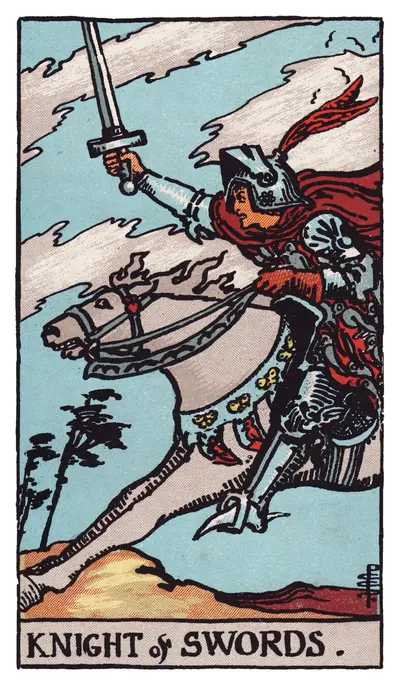
A rider charges at full gallop with sword raised, cloak and horse’s mane streaming, trees bent double and birds scattered across a torn sky. Everything in the frame is being blown sideways. The Knight of Swords is the deck’s fastest card and its least reflective — a person or a situation moving at maximum speed toward something they are certain about. The certainty is the point rather than the speed: this figure is not merely hurrying, he has decided, and the decision is not currently open to revision. When it arrives, something is happening quickly and somebody involved is entirely convinced. The card is genuinely double-edged. Decisiveness at this pitch cuts through situations that would otherwise take months, and it arrives at conclusions before all the information does, and both of those are the same trait seen from different sides.
Reversed meaning
Reversed, the charge fails. The commonest reading is haste producing a mistake — the conclusion reached before the facts, which is the rank’s characteristic failure in this suit. A second is aggression rather than speed: the sword used on people rather than on problems. A third is favourable and under-offered: the charge halted in time, or somebody choosing not to make a fight of something. Where the surrounding cards involve other people the second is worth weighing carefully, since this is the court card most capable of doing damage.
Why this card spans two signs
This Knight holds the last twenty degrees of Capricorn running into the first ten of Aquarius, which is a colder combination than the image suggests. The closing decans of Capricorn are disciplined and unsentimental; the opening of Aquarius is principled and detached. A figure spanning that seam is not charging on impulse — he is executing a decision already made on grounds he considers sufficient, which is considerably more alarming than mere recklessness. The twelve spanned courts each cover thirty degrees, with the seams falling inside signs rather than between them.
Read as a person
Read as a person, the Knight of Swords is someone who decides quickly, argues well and does not revisit. They are effective in a crisis and exhausting in a negotiation. Their characteristic blindness is not stupidity but velocity: they are frequently right and they arrive at right before anybody has finished speaking. In readings about other people this figure is usually the one driving a situation forward. As the querent it describes being certain, which is worth noticing precisely because certainty does not feel like a state one is in. Court cards can mean another person, the querent, or the situation itself, and nothing in the image tells you which — the standing problem with these sixteen. The tell here is uncomfortable: certainty does not feel like a position one is occupying, so a querent who is sure they are not this card is the likeliest candidate for being it. Where a reading is about conflict, the card usually indicates whoever is moving fastest, which is a question the querent can answer honestly. As a situation it describes events that have acquired momentum and will not now be slowed by discussion.
What is on the card
The horse is at full gallop with all four legs off the ground, the most extreme motion in the deck. The rider’s sword is raised above his head rather than levelled, so he is not aiming at anything in particular. Butterflies decorate the horse’s bridle and the rider’s tunic — the suit’s emblem of thought — and birds fly scattered across the sky. Trees in the background are bent almost horizontal. His visor is down, which no other Knight’s is: the face is hidden and the eyes cannot be checked.
In a love reading
Intensity arriving fast and frequently ending as fast, or a confrontation somebody has decided to have. It is one of the less comfortable court cards on a relationship question and not necessarily a bad one: it describes directness, which is scarce. On questions about whether something will be said, it is a clear yes and says nothing about how it will land. Where a relationship is being conducted at high speed by one party, this card usually identifies which.
In a career reading
A decision executed at speed, an aggressive strategy, or a colleague who is already three steps into a plan nobody agreed to. It is favourable on questions about cutting through obstruction and a genuine caution on questions requiring consensus. On questions about whether something will move, it is the strongest yes in the court cards. Its practical contribution is the raised sword: force is being applied and no specific target is visible in the frame.
How this one is usually misread
The frequent error is reading this as pure recklessness, which the Capricorn half of the span argues against. This figure is not impulsive; he is executing a conclusion he has already reached, which is a different and more formidable thing. Delivering it as thoughtlessness underestimates the situation. The second misreading is treating the speed as inherently negative. Some situations are only resolved by somebody who will not wait, and the deck has no other card for that — the Knight of Swords is the one that arrives, and readings that only warn about him have discarded half of what he is for.
How it behaves beside other cards
With the Page of Swords the noticing has become acting. Beside the Two of Swords the deadlock is broken by force rather than resolved. With the Four of Swords the charge is interrupting a rest that was needed. Next to the Eight of Wands everything in the reading is moving at once. Its most revealing neighbour is the Queen of Swords, where the same clarity appears without the velocity and the contrast is the whole reading. Beside the Chariot the drive has a direction and a driver rather than a raised sword. With the Three of Cups the charge arrives somewhere that was not expecting a fight, which is the pairing most likely to be describing a real social mistake.
Why this card spans two signs
The twelve court cards above Page each cover the last twenty degrees of one sign and the first ten of the next, so the twelve of them tile the circle once with the seams falling inside signs rather than between them. Knight of Swords runs from Capricorn into Aquarius. Pages take a whole seasonal quadrant instead and have no degree span.
Correspondences follow the Golden Dawn attributions set out in Book T. Degrees are computed from each card’s position in the decan sequence rather than transcribed, so they cannot drift from the spread tool on the rest of this site.
Cards next to this one
See this card come up in your own chart
The spread on our tarot astrology page reads your chart positions as cards — no shuffle, the same answer every time. The daily card does the same for the Moon’s decan right now.