Minor Arcana · Swords · air
King of Swords
The Book T title
The Lord of the Winds and the Breezes, King of the Spirit of Air — the Golden Dawn’s Knight of Swords, our King in RWS ranks. Book T assigns each rank an element of its own, which explains the court cards more economically than any description of character: King is fire, Queen water, Knight air, Page earth. This card is fire of air, and the compound is unusually apt because fire in air is the only pairing in the scheme where one element straightforwardly feeds the other. Air makes fire burn hotter and faster. Applied to thought, that produces judgement with force behind it — not merely an accurate view but one that will be acted on, which is precisely what separates this figure from the Queen of the same suit.
Upright meaning
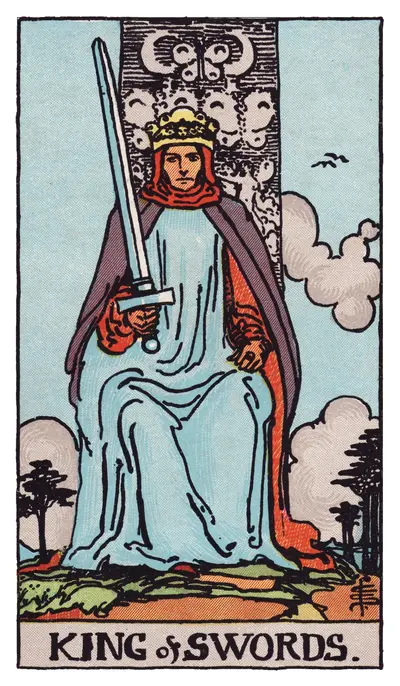
A man sits facing almost forward on a throne carved with butterflies and a crescent moon, holding a sword upright and tilted slightly to his right. Two birds fly in a pale sky and the trees behind him are barely moving. The King of Swords is authority exercised through judgement — somebody whose decision settles a matter because it has been properly reasoned and because they have the standing to make it. What separates him from every other court card is that he is the only figure in the deck whose office is to decide between other people. When he arrives, the matter involves a ruling of some kind: a professional judgement, a legal one, an assessment that ends a dispute. The card is impartial rather than cold, and the distinction matters — impartiality is what makes a judgement worth having, and it is also what makes it feel unkind to whoever loses.
Reversed meaning
Reversed, the judgement is compromised. The commonest reading is authority used badly — reasoning deployed to justify a conclusion arrived at some other way, which is the specific corruption available to this figure. A second is rigidity: a ruling that was right and has outlived the circumstances it was made in. A third concerns the misuse of intelligence against people rather than problems, and the tradition has always attached that to the reversed card rather than the upright. Where the reading involves an institution the first two apply; where it involves one person, the third.
Why this card spans two signs
This King holds the last twenty degrees of Taurus running into the first ten of Gemini, which is a slower span than the suit implies and is what gives his judgement weight. The closing decans of Taurus are deliberate and immovable; the opening of Gemini is quick and verbal. A figure spanning that seam thinks fast and does not change his mind afterwards, which is the combination that makes a ruling stick. The twelve spanned court cards each cover thirty degrees, with the seams falling inside signs rather than between them.
Read as a person
Read as a person, the King of Swords is somebody whose opinion carries. They are precise, unsentimental and fair, and they will give the same answer whoever is asking. Their characteristic strength is that a decision from them is final in a useful way. Their characteristic blind spot is that a correct answer delivered without regard for its effect is still a correct answer to them. Deciding whether a court card is another person, the querent, or the situation is the standing difficulty with these sixteen. The tell here is authority: where somebody’s judgement will settle the matter, that person is this card. Where the querent is the one being asked to rule on something, it is the querent. As a situation it describes circumstances that will be resolved by a decision rather than by time.
What is on the card
He faces almost forward but not quite, the only King drawn at that angle, so he is neither confronting the viewer nor turned away. The sword is upright and tilted to his right — the direction of mercy in the Kabbalistic scheme the Golden Dawn used, which is a detail the card is rarely given credit for. Butterflies and a crescent moon are carved into the throne, the suit’s emblem and the faculty that tempers it. Two birds fly overhead where the Knight of the same suit has ten scattering. The trees are still. Nothing in the frame is in motion. The four Kings repay direct comparison, since Smith drew them as variations on one chair and the postures diverge sharply. The King of Wands is turned away and half-risen, the King of Cups floats on rough water, the King of Pentacles sits planted among his own vines — and this one faces almost squarely out, the only King who meets the viewer at all. That is an office, not a personality: a judge sits facing the room because the ruling has to be given to somebody. The near-frontal angle is also why the card reads as confrontational to people who have not noticed which way his sword is leaning.
In a love reading
Somebody honest, or a relationship in which reason is doing more work than feeling. It appears frequently in questions involving separation, legal matters or difficult conversations that have to be had properly. On questions about whether a partner is straightforward it is a clear yes. On questions about warmth it is honest about its limits: this card describes a person who will be fair to you, which is not the same promise as being kind to you and is sometimes worth more.
In a career reading
Law, medicine, senior management, anything where the job is to decide. It is among the strongest cards for questions about a professional judgement going the querent’s way, provided the querent’s case is sound — this figure is not persuadable by anything except the merits. On questions about a superior it indicates somebody demanding and consistent. On questions about negotiation it is favourable: a counterpart who argues in good faith is a better outcome than most querents expect.
How this one is usually misread
The frequent error is reading him as harsh, which the tilt of the sword argues against — it leans toward mercy, and the Golden Dawn scheme Waite and Smith were working inside makes that placement deliberate rather than accidental. The second misreading is treating the Kings as the strongest version of their suit. Each of the four ranks is a different elemental office, so the King is the fire of his element and the Queen is its water; they are not a hierarchy. Reading this figure as a better Queen of Swords discards the one thing that distinguishes him, which is that his judgement is going to be enacted.
How it behaves beside other cards
With the Queen of Swords two kinds of clarity appear and the reading usually concerns which is being deferred to. Beside the Justice card the ruling becomes institutional rather than personal. With the Page of Swords somebody young has asked a question that will be answered precisely and not gently. Next to the Two of Swords the deadlock ends because somebody with standing decides it. Its most difficult neighbour is the Three of Cups, where a correct judgement arrives somewhere it will cost more than it settles.
Why this card spans two signs
The twelve court cards above Page each cover the last twenty degrees of one sign and the first ten of the next, so the twelve of them tile the circle once with the seams falling inside signs rather than between them. King of Swords runs from Taurus into Gemini. Pages take a whole seasonal quadrant instead and have no degree span.
Correspondences follow the Golden Dawn attributions set out in Book T. Degrees are computed from each card’s position in the decan sequence rather than transcribed, so they cannot drift from the spread tool on the rest of this site.
Cards next to this one
See this card come up in your own chart
The spread on our tarot astrology page reads your chart positions as cards — no shuffle, the same answer every time. The daily card does the same for the Moon’s decan right now.