Minor Arcana · Cups · water
Queen of Cups
The Book T title
The Queen of the Thrones of the Waters, and the throne in the title is the key to the card. Book T’s Queens hold their element in place, and water held in place is the hardest of the four to imagine — which is precisely what the image solves by seating her at the boundary between shore and sea. Everything about this figure is about containing something that does not naturally hold a shape. The Book T ranks carry elements in their own right, and the compound explains a court card faster than any description of temperament. King is fire, Queen water, Knight air, Page earth. This card is water of water, one of the four doubled courts and the deepest point in the deck: nothing in the compound lightens it or moves it along. That accounts for both her competence and her risk. Undiluted water is the most perceptive thing the scheme can produce and the least able to hold a boundary, which is exactly the pair of facts every reading of this figure ends up circling.
Upright meaning
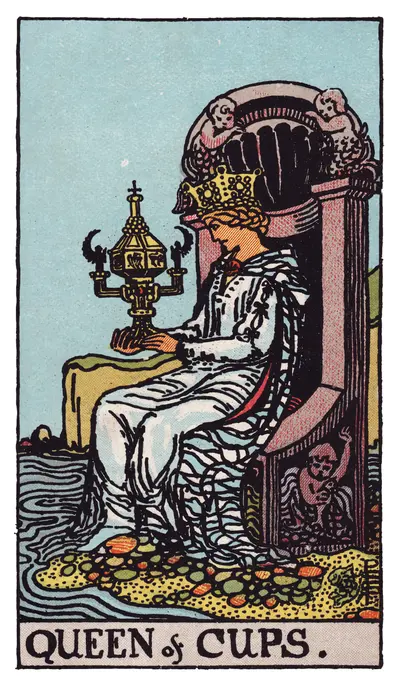
A woman sits on an ornate throne at the water’s edge, holding an elaborate lidded cup and looking at it rather than at the viewer. Her feet are on the shore and the water begins immediately in front of her. The Queen of Cups is emotional depth under control — feeling that is fully present and fully contained, which is a rarer thing than either feeling or control alone. What separates her from the other Cups courts is the lid: hers is the only closed cup in the deck, and she is studying it. When she arrives, the thing being asked about involves somebody whose understanding of the emotional situation exceeds what they are saying about it. The card is frequently read as intuition, and the reading is fair provided intuition is understood as attention rather than magic. She is looking very carefully at something nobody else in the deck bothers to open.
Reversed meaning
Reversed, the containment fails in one direction or the other. The commonest reading is emotional overwhelm — the water coming over the shore, which is the natural failure of a figure whose whole competence is holding a boundary. A second is the opposite: containment become suppression, the lid kept on past the point of usefulness. A third concerns other people, where the reversed Queen of Cups describes someone absorbing more than is theirs to carry, which is this figure’s specific occupational hazard. Where the surrounding cards are turbulent the first applies; where they are static, the second.
Why this card spans two signs
This Queen holds the last twenty degrees of Gemini running into the first ten of Cancer, which is a more intellectual span than the card’s reputation suggests. The closing decans of Gemini are analytical and verbal; the opening of Cancer is protective and instinctive. A figure straddling that seam understands what she is feeling, which is the exact distinction between this Queen and a merely sensitive person. The twelve spanned courts each cover thirty degrees in this way, with the seams deliberately falling inside signs rather than between them.
Read as a person
Read as a person, the Queen of Cups is someone who reads a room accurately and says a fraction of what they have noticed. They are the person others tell things to, and the cost of that is rarely visible. Their characteristic strength is that their perception is not performed. Their characteristic difficulty is boundary: they absorb what is around them and the absorbing is automatic. In readings about other people this figure often indicates somebody who has understood the situation better than the querent has. As the querent it describes knowing more than can currently be said. Each of the sixteen court cards can mean another person, the querent or the situation, and nothing in the picture distinguishes them. The tell in this one is who is doing the noticing. If the reading concerns somebody who has understood more than they have said, that is this figure, whether or not the querent has realised it. Where the querent is the one holding an unspoken accurate read, the card is them, and it is frequently the most useful thing a reading can name. As a situation it describes circumstances in which the emotional facts are known and unstated by everybody involved.
What is on the card
The cup is the only closed vessel in the deck — lidded, handled with angel figures, and elaborate beyond any other cup — and she is looking directly into it as though its contents were not obvious. Her throne is carved with shells and a pair of merchildren. Coloured stones line the shore at her feet, and the water begins exactly where the throne ends. Her robe flows into the water so that the boundary between fabric and sea is not drawable. The sky is pale and still.
In a love reading
Emotional understanding, and frequently somebody who has grasped the situation without discussing it. It is one of the most favourable court cards on a relationship question and one of the quietest. On questions about whether someone cares it is a clear affirmative and says that the caring may not be legible from outside. On questions about communication it is a caution: this figure feels accurately and expresses selectively, and a relationship conducted entirely in that register accumulates unspoken material.
In a career reading
Work involving people — care, counselling, management of difficult teams, anything where reading the situation is the skill. It is among the better cards for questions about whether the querent can handle a sensitive matter. On ordinary advancement questions it is quiet, since nothing in this figure pushes. On questions about a colleague it frequently indicates someone whose contribution is invisible in the way that emotional labour is invisible, which is a real workplace fact and rarely named.
How this one is usually misread
The persistent error is reading this figure as passive, which the Gemini half of her span contradicts — she is analysing, not drifting, and the closed cup is being examined rather than guarded. Delivered as gentleness the card loses its intelligence. The second misreading is the psychic one. Intuition is a reasonable word for what this card describes as long as it means noticing very carefully; delivered as a claim about foreknowledge it turns a card about attention into one about powers, which is the wrong side of the line this site draws everywhere else.
How it behaves beside other cards
With the Page of Cups the openness appears in its earliest form and the pair describes a difference of depth. Beside the King of Cups the containment is shared and the two figures make the deck’s most composed pairing. With the Three of Swords she is the person the querent will tell. Next to the Moon the accuracy becomes uncertain and the water is harder to see into. Its most demanding neighbour is the Ten of Wands, where somebody is carrying a great deal and she has noticed. Beside the High Priestess two kinds of knowing sit together and the reading usually turns on which is being asked for. With the Knight of Wands the depth meets a pace that will not wait for it.
Why this card spans two signs
The twelve court cards above Page each cover the last twenty degrees of one sign and the first ten of the next, so the twelve of them tile the circle once with the seams falling inside signs rather than between them. Queen of Cups runs from Gemini into Cancer. Pages take a whole seasonal quadrant instead and have no degree span.
Correspondences follow the Golden Dawn attributions set out in Book T. Degrees are computed from each card’s position in the decan sequence rather than transcribed, so they cannot drift from the spread tool on the rest of this site.
Cards next to this one
See this card come up in your own chart
The spread on our tarot astrology page reads your chart positions as cards — no shuffle, the same answer every time. The daily card does the same for the Moon’s decan right now.